

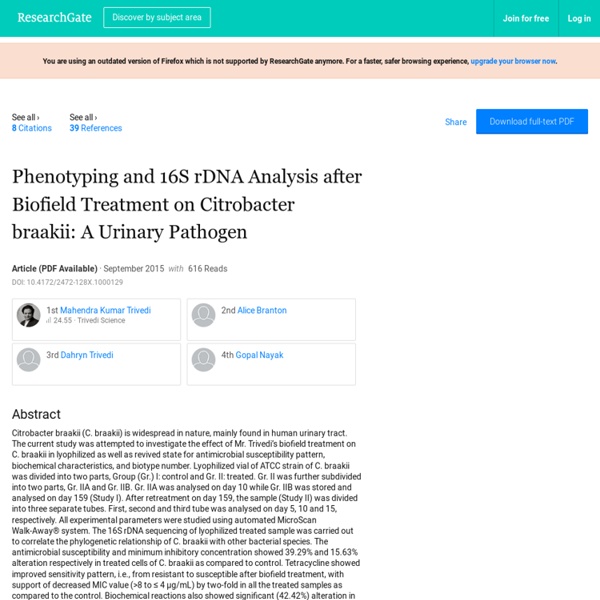
Phenotyping Analysis of Citrobacter Braakii after Biofield Treatment Description Citrobacter braakii (C. braakii) is widespread in nature, mainly found in human urinary tract. The current study was attempted to investigate the effect of Mr. Trivedi’s biofield treatment on C. braakii in lyophilized as well as revived state for antimicrobial susceptibility pattern, biochemical characteristics, and biotype number. Lyophilized vial of ATCC strain of C. braakii was divided into two parts, Group (Gr.) I: control and Gr. Citation Information Trivedi MK, Branton A, Trivedi D, Nayak G, Charan S, et al. (2015) Phenotyping and 16S rDNA Analysis after Biofield Treatment on Citrobacter braakii: A Urinary Pathogen.
Study of Biochemical Characteristics of Citrobacter Braakii Research Article Open Access Trivedi et al., J Clin Med Genom 2015, 3:1 Volume 3 • Issue 1 • 1000129 J Clin Med Genom ISSN: IJGM, an open access journal Journal of Clinical & Medical Genomics Keywords: Citrobacter braakii; Antimicrobial susceptibility; Bioeld treatment; Biochemical reaction; Biotype; 16S rDNA analysis; Gram- negative bacteria; Enterobacteriaceae Abbreviations: MDR: Multi-Drug Resistant; ATCC: American Type Culture Collection; NBPC 30: Negative Breakpoint Combo 30; MIC: Minimum Inhibitory Concentration; OTUs: Operational Taxonomic Units; NCBI: National Center for Biotechnology Information; MEGA: Molecular Evolutionary Genetics Analysis; PCR: Polymerase Chain Reaction; RDP: Ribosomal Database Project; HBMEC: Human Brain Microvascular Endothelial Cells Introduction Citrobacter braakii (C. braakii) is a genus of Gram-negative, straight, facultative anaerobic and motile bacilli bacterium widely distributed in water, soil, and food in the environment.
16s rDNA Sequencing of Human Energy Treated C. Braakii Title: Phenotyping and 16S rDNA Analysis after Biofield Treatment on Citrobacter braakii: A Urinary Pathogen Publication: Journal of Clinical & Medical Genomics Select license: Creative Commons Attributions-NonCommercial-ShareAlike Updated: November 21st, 2016 Abstract: Citrobacter braakii (C. braakii) is widespread in nature, mainly found in human urinary tract. Citrobacter Braakii – Study of Biochemical Characteristics Abstract Citrobacter braakii (C. braakii) is widespread in nature, mainly found in human urinary tract. The current study was attempted to investigate the effect of Mr. Trivedi’s biofield treatment on C. braakii in lyophilized as well as revived state for antimicrobial susceptibility pattern, biochemical characteristics, and biotype number. Keywords: Citrobacter braakii; Antimicrobial susceptibility; Biofield treatment; Biochemical reaction; Biotype; 16S rDNA analysis; Gramnegative bacteria; Enterobacteriaceae Abbreviations: MDR: Multi-Drug Resistant;ATCC: American Type Culture Collection; NBPC 30: Negative Breakpoint Combo 30; MIC: Minimum Inhibitory Concentration; OTUs: Operational Taxonomic Units; NCBI: National Center for Biotechnology Information; MEGA: Molecular Evolutionary Genetics Analysis; PCR: Polymerase Chain Reaction; RDP: Ribosomal Database Project; HBMEC: Human Brain Microvascular Endothelial Cells . Introduction Materials and Methods Experimental design Group IIB – Study I 1.
Antimicrobial Susceptibility Testing of Burkholderia Cepacia Abstract Burkholderia cepacia (B. cepacia) is an opportunistic, Gram negative pathogen which causes infection mainly in immunocompromised population and associated with high rate of morbidity and mortality in cystic fibrosis patients. Aim of the present study was to analyze the impact of biofield treatment on multidrug resistant B. cepacia. Clinical sample of B. cepacia was divided into two groups i.e. control and biofield treated. Citation Information Mahendra Kumar Trivedi. Biofield Impact on Biotype Number of R. Ornithinolytica Description Raoultella ornithinolytica is belongs to the family of Enterobacteriaceae, a Gram-negative encapsulated aerobic bacillus associated with bacteremia and urinary tract infections. As biofield therapy is increasingly popular in biomedical heath care, so present study aimed to evaluate the impact of Mr. Citation Information Mahendra Kumar Trivedi.
Burkholderia Cepacia Antimicrobial Susceptibility Testing An Effect of Biofield Treatment on Multidrug-resistant Burkholderia cepacia: A Multihost Pathogen Mahendra Kumar Trivedi , Shrikant Patil , Harish Shettigar , Mayank Gangwar , Snehasis Jana Trivedi Global Inc., 10624 S Eastern Avenue Suite A-969, Henderson, NV 89052, USA Trivedi Science Research Laboratory Pvt. Corresponding author: Snehasis Jana, Trivedi Science Research Laboratory Pvt. 462026, Madhya Pradesh, India, Tel: +91-755-6660006; E-mail: publication@trivedisrl.com Rec date: Jun 29, 2015, Acc date: Jul 10, 2015, Pub date: Jul 17, 2015 Copyright: © 2015 Jana S et al. distribution, and reproduction in any medium, provided the original author and source are credited. Abstract Burkholderia cepacia (B. cepacia) is an opportunistic, Gram negative pathogen which causes infection mainly in immunocompromised population and associated with high rate of morbidity and mortality in cystic fibrosis patients. sample of B. cepacia was divided into two groups i.e. control and biofield treated. tazobactam.
Characterization of Physical and Structural Properties of Brass Powder Title: Characterization of Physical and Structural Properties of Brass Powder After Biofield Treatment Publication: Powder Metallurgy & Mining Select license: Creative Commons Attributions-NonCommercial-ShareAlike Updated: November 19th, 2016 Abstract: Brass, a copper-zinc (Cu-Zn) alloy has gained extensive attention in industries due to its high corrosion resistance, machinability and strength to weight ratio. Mahendra Trivedi on iScience About Mahendra Trivedi earned his 5-year Bachelor’s degree in Mechanical Engineering in 1985 and worked as an Engineer for 10 years. In 1995, Mr. Trivedi discovered that he had the unique ability to harness the energy from the universe and transmit it to anywhere on the globe, infusing it into living organisms and nonliving materials, thus optimizing their potential. Research Although Mr. He amassed a collection of over 4,000 scientific studies in many life sciences and material sciences, including: agriculture, livestock, biotechnology, microbiology, materials science, genetics, cancer and human health and has several dozens of publications in leading international peer-reviewed scientific journals, all in support to the dramatic results reported through human testimonials, thus excluding the possibility of the placebo effect. Mr. Mr. You can read more about Mr. 1). 2). 3). 4). 5). 6). 7). 8). 9).
Human Energy Treatment of Brass Powder & X-Ray Diffraction Analysis 0WordPress0CiteULike0 New Brass, a copper-zinc (Cu-Zn) alloy has gained extensive attention in industries due to its high corrosion resistance, machinability and strength to weight ratio. The aim of present study was to evaluate the effect of biofield treatment on structural and physical properties of brass powder. The brass powder sample was divided into two parts: control and treated. The treated part was subjected to Mr.Trivedi’s biofield treatment. Your session has expired but don’t worry, your message has been saved.Please log in and we’ll bring you back to this page. Your evaluation is of great value to our authors and readers. Review When you're done, click "publish" Only blue fields are mandatory. Your mailing list is currently empty.It will build up as you send messagesand links to your peers. No one besides you has access to this list. Enter the e-mail addresses of your recipients in the box below. Your message has been sent. Description Leave a comment Your comment
Brass Powder Energy Healing Therapy & X-Ray Diffraction Analysis Description Brass, a copper-zinc (Cu-Zn) alloy has gained extensive attention in industries due to its high corrosion resistance, machinability and strength to weight ratio. The aim of present study was to evaluate the effect of biofield treatment on structural and physical properties of brass powder. The brass powder sample was divided into two parts: control and treated. The treated part was subjected to Mr.Trivedi’s biofield treatment. Control and treated brass powder were characterized using particle size analyser, X-ray diffraction (XRD), scanning electron microscope (SEM), and Fourier transform infrared (FT-IR) spectroscopy. Citation Information Mahendra Kumar Trivedi.