Anonymous
Anonymous (used as a mass noun) is a loosely associated international network of activist and hacktivist entities. A website nominally associated with the group describes it as "an internet gathering" with "a very loose and decentralized command structure that operates on ideas rather than directives". The group became known for a series of well-publicized publicity stunts and distributed denial-of-service (DDoS) attacks on government, religious, and corporate websites. Anonymous originated in 2003 on the imageboard 4chan, representing the concept of many online and offline community users simultaneously existing as an anarchic, digitized global brain.[3][4] Anonymous members (known as "Anons") can be distinguished in public by the wearing of stylised Guy Fawkes masks.[5] In its early form, the concept was adopted by a decentralized online community acting anonymously in a coordinated manner, usually toward a loosely self-agreed goal, and primarily focused on entertainment, or "lulz".
The Gunpowder Plot of 1605
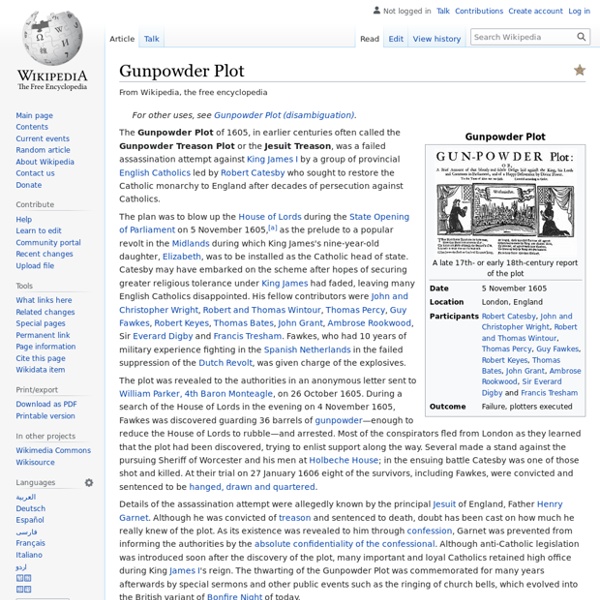
In November 1605, the infamous Gunpowder Plot took place in which some Catholics, most famously Guy Fawkes, plotted to blow up James I, the first of the Stuart kings of England. The story is remembered each November 5th when ‘Guys’ are burned in a celebration known as "Bonfire Night". The story appears to be very simple. Catholics in England had expected James to be more tolerant of them. In fact, he had proved to be the opposite and had ordered all Catholic priests to leave England. Guy Fawkes and his fellow conspirators, having rented out a house right by the Houses of Parliament, managed to get 36 barrels of gunpowder into a cellar of the House of Lords. The other conspirators were: Robert and Thomas Wintour, Thomas Percy, Christopher and John Wright, Francis Tresham, Everard Digby, Ambrose Rookwood, Thomas Bates, Robert Keyes, Hugh Owen, John Grant and the man who is said to have organised the whole plot Robert Catesby. The most famous picture of some the conspirators
Anonymous Says They'll Attack Facebook Next
AnonOps Communications
One account. All of Google. Sign in to continue to Blogger Find my account Forgot password? Sign in with a different account Create account One Google Account for everything Google
LOIC
The software has inspired the creation of an independent JavaScript version called JS LOIC, as well as LOIC-derived web version called Low Orbit Web Cannon. These enable a DoS from a web browser.[4] Use LOIC performs a denial-of-service (DoS) attack (or when used by multiple individuals, a DDoS attack) on a target site by flooding the server with TCP or UDP packets with the intention of disrupting the service of a particular host. Countermeasures LOIC attacks are easily identified in system logs, and the attack can be tracked down to the IP addresses used at the attack.[8] Notable uses Project Chanology and Operation Payback Operation Megaupload Origin of name The LOIC application is named after the Ion cannon, a fictional weapon from many sci-fi works.[14] Other implementations Another implementation of LOIC named LOIC++[15] has been made to run natively on Linux. References External links
Anonymous takes aim over Europe's SOPA | InSecurity Complex
Online activists Anonymous are targeting the European Parliament and supporters of the Anti-Counterfeiting Trade Agreement (ACTA), which critics say would curtail freedom of expression and encourage surveillance by service providers. Copyrightalliance.org was inaccessible today after Anonymous set its sights on the Web site for its pro-ACTA stance. Meanwhile, hackers were poking at the sites of the European Parliament and governments in the EU, with plans to dig up information on officials that could be released publicly, a source familiar with Anonymous' plans told CNET. Anonymous has a history of operations against what the group complains are antipiracy efforts that quash rights to freedom of expression on the Internet. The digital activists protested the Stop Online Piracy Act (SOPA), which lost steam last week after tech companies demonstrated with a one-day blackout . Critics say ACTA is even worse than SOPA in that it allows for closed door negotiations and can't be repealed.
Site-blocking law dubbed 'Ireland's Sopa' to pass without parliamentary vote
Ireland is soon to have a law similar to Sopa passed that would give music and movie companies the power to force Irish ISPs to block access to sites suspected of having copyright infringing material on them. Irish citizens won't have a chance to lobby their democratic representatives because there won't be a vote on the law -- snappily named "S.I. No. of 2011 European Communities (Copyright and Related Rights) Regulations 2011" -- in the Irish Parliament. Instead the law is being enacted by ministerial order because it is being prepared in the form of a Statutory Instrument. The law could mean that judges can order Irish ISPs -- such as Eircom and UPC -- as well as mobile networks to block access to social networking sites where an individual user has shared infringing material. An early draft of the law said that the copyright holder can apply to the high court for an injunction against the person who provides the facilities that are used by third parties to infringe their copyright.
Cloud computing, “an unrivalled opportunity” for Ireland
Concentrated and swift efforts by Ireland to invest in and promote cloud computing will improve the country’s competitiveness and return the economy to growth, according to a reports on cloud computing released by Microsoft today. The Goodbody Economic Consultants report, commissioned by Microsoft, suggests that targeted investment by the government now, while cloud computing is in its infancy, could be economically and socially beneficial to the country. Download the full report here (PDF | 1.7MB) According to Microsoft Ireland’s Managing Director Paul Rellis, “[the report] highlights the significant opportunity that Cloud Computing presents to Ireland – both in terms of helping to improve the competitiveness of organisations in the Public and Private Sectors and also in terms of supporting the country’s FDI (Foreign Direct Investment), entrepreneurial and public policy strategies and goals. The report was commissioned to coincide with Microsoft’s 25 anniversary in Ireland.