

Association for Global New Thought Council for Secular Humanism If you’ve rejected traditional religion (or were never religious to start), you may be asking, “Is that all there is?” It’s liberating to recognize that supernatural beings are human creations … that there are no such things as “spirit” or “transcendence”... that people are undesigned, unintended, and responsible for themselves. But what’s next? For many, mere atheism (the absence of belief in gods and the supernatural) or agnosticism (the view that such questions cannot be answered) aren’t enough. Atheism and agnosticism are silent on larger questions of values and meaning. For the questions that remain unanswered after we’ve cleared our minds of gods and souls and spirits, many atheists, agnostics, skeptics, and freethinkers turn to secular humanism.
Sacred Texts Sacred-texts home The New Thought movement, which originated in the late 19th and early 20th century, has at its core a belief that a higher power pervades all existence, and that individuals can create their own reality via affirmations, meditation and prayer. Early New Thought groups emerged from a Christian Science background, and many New Thought writers refer back to the Bible as their foundation text. What All the World's A-Seeking by Ralph Waldo Trine [1896]Compassion for all life and meditation as keys to mental power and success. A Common-Sense View of the Mind Cure by Laura M. The Edinburgh Lectures on Mental Science by Thomas Troward [1909] The Dore Lectures on Mental Science by Thomas Troward [1909] In Tune with the Infinite by Ralph Waldo Trine [1910] The Science of Geting Rich by Wallace Delois Wattles [1910] Unity Church books now have their own page. Science and Health with Key to the Scriptures by Mary Baker Eddy [1910]The central text of Christian Science.
New Age The New Age movement is a Western spiritual movement that developed in the second half of the 20th century. Its central precepts have been described as "drawing on both Eastern and Western spiritual and metaphysical traditions and infusing them with influences from self-help and motivational psychology, holistic health, parapsychology, consciousness research and quantum physics".[2] The term New Age refers to the coming astrological Age of Aquarius.[1] The movement aims to create "a spirituality without borders or confining dogmas" that is inclusive and pluralistic.[3] It holds to "a holistic worldview",[4] emphasising that the Mind, Body, and Spirit are interrelated[1] and that there is a form of monism and unity throughout the universe.[5] It attempts to create "a worldview that includes both science and spirituality"[6] and embraces a number of forms of mainstream science as well as other forms of science that are considered fringe. History[edit] Origins[edit] Development[edit]
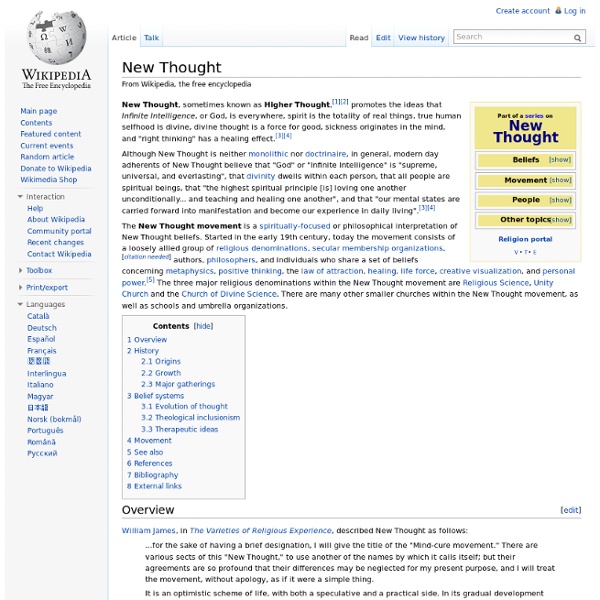
New Thought Movement 1931Google + What is New Thought? New Thought is a mind-healing movement that originated in the 19th-century United States. It has no one creed, but its fundamental teaching is that spirit is more real and more powerful than matter and that the mind has the power to heal the body. Major groups within the New Thought movement include the Unity Church, Church of Religious Science, and Divine Science. Many, but all, New Thought groups are based in Christianity. Phineas Parkhurst Quimby (1802-66), the earliest founder of New Thought. Emma Curtis Hopkins (1849–1925), one of the founders of New Thought. Myrtle Fillmore (1845-1941), co-founder with her husband of the Unity Church. Ernest Holmes (1887-1960), founder of Religious Science. History The New Thought movement has roots in American Christianity as well as the metaphysical and romantic climate of the 19th century that came as a reaction against the religious skepticism of the previous century. Phineas P. Myrtle did get better. Texts Beliefs
Understanding Affirmations | Science of Change and Affirmations Understanding Affirmations In case you do not know what affirmations are, they are tools that people who believe in the New Age, and the New Thought systems, use to address unwanted conditions in their lives? Affirmations are sometimes written down and sometimes they are statements that the individuals repeat verbally either aloud or to themselves. Affirmations are statements that are positive affirming the control the person has over their life. These statements are meant to focus on the positive outcome of the situation that the individual is concerned with. Affirmations are simply statements that are used to prove the old saying of if you can see it then you can be it. Affirmations are confidence boosters. Individuals that need to lose some weight will have a greater success if they visualize their body slimmer. More than likely when you were a child you read the tale of the little engine that wanted to climb the hill.
New Thought Library What Are Positive Affirmations - Understanding Affirmations People can often confuse matters when explaining exactly what are affirmations and how they work but there’s really no need, to get started using affirmations you really only need to understand the basics of what they do and how to apply them. So what are affirmations? Affirmations are simply short, sharp and meaningful statements that “affirm” a particular or desired outcome, so let’s break that down and really lay out a map for how one can draw up their own affirmations before discussing how this powerful technique for self improvement works. So let’s use one of mans most common desires which is to be more wealthy and successful and assume I am drafting up my own affirmations for my own personal use. Firsrlty I would need to be completely transparent as to what it is I desire, being wealthy and successful is to vague and this is where many people go wrong. So an example of a suitable affirmation for me could be..
New Thought Faiths and Practices The New Thought movement is an umbrella term for diverse beliefs that emphasize practically oriented spirituality promoting wholeness in living through constructive thinking, meditation, prayer and the realization of the presence of God. New Thought, which is more than a century old, includes Unity, Religious Science (Science of Mind), Divine Science, and other groups. Because it maintains that the mind is continually growing, New Thought is not a static system of beliefs. While it acknowledges the importance of traditional religious thought as a part of the mind’s development, it finds the permanence of dogma to be contradictory to the mind’s natural striving for advancement. This perpetual development of the mind is often called progressive or unfolding thought. New Thought practitioners believe there exists one God—an omnipresent Universal Mind or creative intelligence. There are no particular incarnations, as God is within all equally. New Thought worship is syncretic.
How To Make Affirmations Work For You « John Assaraf By John Assaraf How to Make Affirmations Work for You “We are what we repeatedly do. Excellence then, is not an act, but a habit. —Aristotle Just imagine: If you could have it all, what would do and be in your life? In order to reach an intended destination, you have to know your intended destination. Growing up, I developed the belief that I was not very good at achieving worthwhile things in life. I wrote a statement for myself that was in such stark contrast to what I had grown up believing, it still resonates with huge impact to this day: I am a brilliant and savvy businessman. Mind you, when I wrote this, I didn’t believe it. Over the years, I have added to the list and redesigned the statements I tell myself…Here are a few: I give myself permission to be powerful.I have absolute certainty in my ability to generate any amount of income I choose.Money is flowing to me from both expected and unexpected sources. Affirmations are self-fulfilling prophecies. Practice meditation daily.
How to Use Affirmations Effectively: 7 steps Edit Article Deciding on the Content of Your AffirmationsUsing Affirmations Edited by maryann laraia, Krystle C., Amanda, Ben Rubenstein and 19 others Self-affirmations are positive statements or self-scripts that can condition the subconscious mind to help you develop a more positive perception of yourself. Ad Steps Part 1 of 2: Deciding on the Content of Your Affirmations 1Think about your positive attributes. 2Think about what negative scripts you want to counteract or what positive goals you want to accomplish. Part 2 of 2: Using Affirmations 1Prioritize your list of things to work on. 5Continue using your affirmations. Tips Affirmations can be used in combination with visualizations to increase the effectiveness of both. Warnings Don't let other people be your judge.