

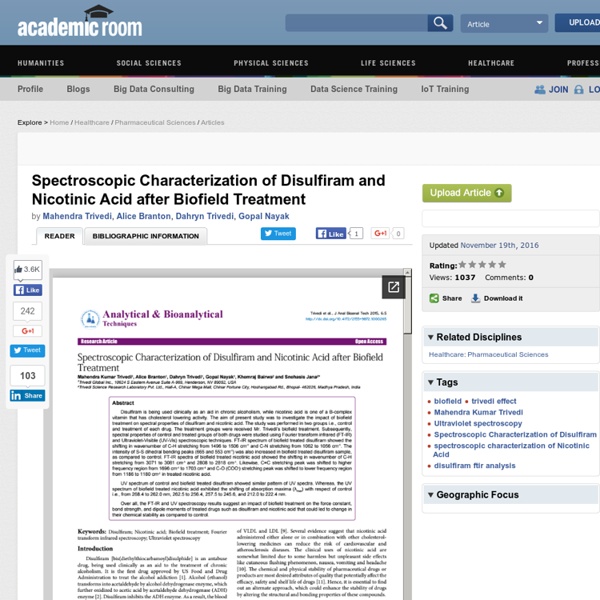
Spectroscopic Characterization of Disulfiram and Nicotinic Acid after Biofield Treatment Open Access Research Article Analytical & Bioanalytical Techniques o u r n a l f y t i c e h q s Trivedi et al., J Anal Bioanal Tech 2015, 6:5 Volume 6 • Issue 5 • 1000265 J Anal Bioanal Tech ISSN: 2155-9872 JABT, an open access journal Keywords: Disulram; Nicotinic acid; Bioeld treatment; Fourier transform infrared spectroscopy; Ultraviolet spectroscopy Introduction Disulram [bis(diethylthiocarbamoyl)disulphide] is an antabuse drug, being used clinically as an aid to the treatment of chronic alcoholism. Administration to treat the alcohol addiction [1]. transforms into acetaldehyde by alcohol dehydrogenase enzyme, which further oxidized to acetic acid by acetaldehyde dehydrogenase (ADH) enzyme [2]. concentration of acetaldehyde increases and causes an unpleasant eect, thus increase the patient's motivation to remain abstinent [3]. addition to this, disulram is reported for protozoacidal eect in vitro study [4,5]. B3) that has cholesterol lowering activity. [7]. [10].
Publication meta - Spectroscopic Characterization of Disulfiram and Nicotinic Acid after Biofield Treatment Disulfiram is being used clinically as an aid in chronic alcoholism, while nicotinic acid is one of a B-complex vitamin that has cholesterol lowering activity. The aim of present study was to investigate the impact of biofield treatment on spectral properties of disulfiram and nicotinic acid. The study was performed in two groups i.e., control and treatment of each drug. The treatment groups were received Mr. Trivedi’s biofield treatment. Subsequently, spectral properties of control and treated groups of both drugs were studied using Fourier transform infrared (FT-IR) and Ultraviolet-Visible (UV-Vis) spectroscopic techniques.
"Spectroscopic Characterization of Disulfiram and Nicotinic Acid after Description Disulfiram is being used clinically as an aid in chronic alcoholism, while nicotinic acid is one of a B-complex vitamin that has cholesterol lowering activity. The aim of present study was to investigate the impact of biofield treatment on spectral properties of disulfiram and nicotinic acid. The study was performed in two groups i.e., control and treatment of each drug. The treatment groups were received Mr. Trivedi’s biofield treatment. Citation Information Mahendra Kumar Trivedi.
Spectroscopic Characterization of Disulfiram and Nicotinic Acid after Biofield Treatment *The embed functionality can only be used for non commercial purposes. In order to maintain its sustainability, all mass use of content by commercial or not for profit companies must be done in agreement with figshare. Description Disulfiram is being used clinically as an aid in chronic alcoholism, while nicotinic acid is one of a B-complex vitamin that has cholesterol lowering activity. Published on 13 Oct 2015 - 12:07 (GMT) Filesize is 1.35 MB License (what's this?) Cite "Filename" Place your mouse over the citation text to select it Embed "Spectroscopic Characterization of Disulfiram and Nicotinic Acid after Biofield Treatment" Show filename on top Place your mouse over the embed code to select and copy it
Spectroscopic Characterization of Disulfiram and Nicotinic Acid after Biofield Treatment Trivedi, M. K. (2015), 'Spectroscopic Characterization of Disulfiram and Nicotinic Acid after Biofield Treatment'. %0 Thesis %1 mahendrakumartrivedi %A Trivedi, Mahendra Kumar %B Spectroscopic Characterization of Disulfiram and Nicotinic Acid after Biofield Treatment %D 2015 %I Mahendra Kumar Trivedi %J Analytical & Bioanalytical Techniques %K biofield mahendrakumartrivedi myown %N 5 %T Spectroscopic Characterization of Disulfiram and Nicotinic Acid after Biofield Treatment %U %V 6 %X Disulfiram is being used clinically as an aid in chronic alcoholism, while nicotinic acid is one of a B-complex vitamin that has cholesterol lowering activity. The aim of present study was to investigate the impact of biofield treatment on spectral properties of disulfiram and nicotinic acid.
Trivedi Effect on the App Store Evaluation of Phenotyping and Genotyping Characteristic of Shigella sonnei after Biofield Treatment | Open Access | OMICS International Abstract Shigella sonnei (S. sonnei) is a non-motile, rod shape, clinically significant, Gram-negative bacterium. It is commonly associated with dysentery (shigellosis). Recently, resistance to third and fourth generation cephalosporins and fluoroquinolones has been reported in S. sonnei. In the present study, we assessed the effect of biofield treatment on phenotyping and genotyping characteristic of S. sonnei (ATCC 9290). Tables at a glance Figures at a glance
Journal of Accord Integrative Medicine Journal of Accord Integrative Medicine Copyright © 2009 All rights reserved. No part of this publication may be used or reproduced, stored in a retrieval system, or transmitted in any forms or by any means, electronic, mechanical, photocopying, recording or otherwise, without written permission. 2009, Volume 5, Number 1 Impact of an external energy on Enterococcus faecalis [ATCC – 51299] in relation to antibiotic susceptibility and biochemical reactions – An experimental study 2009, Volume 5, Number 2: 119-130 1Society for Divine Life, A-14, Kanwal Apartment, Four Bungalows, Andheri (W.), Mumbai, Maharashtra – INDIA 2Advanced Society For Divine Life, Bhopal (Madhya Pradesh)-INDIA 3Divine Life Foundation, 1680, N.Delany Road, Gurnee, Illinois – 60031-1238 USA *Corresponding author - Shrikant Patil Email address - thelifeenergy@gmail.com Contact number +1 (847) 876 - 0898 Category of submission: In Vitro Study Institution in which the work was performed: Microbiology Laboratory of P.D. Background :
Publication meta - Bio-field Treatment: A Potential Strategy for Modification of Physical and Thermal Properties of Gluten Hydrolysate and Ipomoea Macroelements - Publications The objective of present study was to study the effect of biofield treatment on physical and thermal properties of gluten hydrolysate (GH) and ipomoea macroelements (IM). The study was performed in two groups (control and treated). The control group remained as untreated, and biofield treatment was given to treated group. The control and treated GH and IM were characterized by particle size analysis, surface area analysis, X-ray diffraction (XRD), Differential scanning calorimetry (DSC), and Thermogravimetric analysis (TGA).