

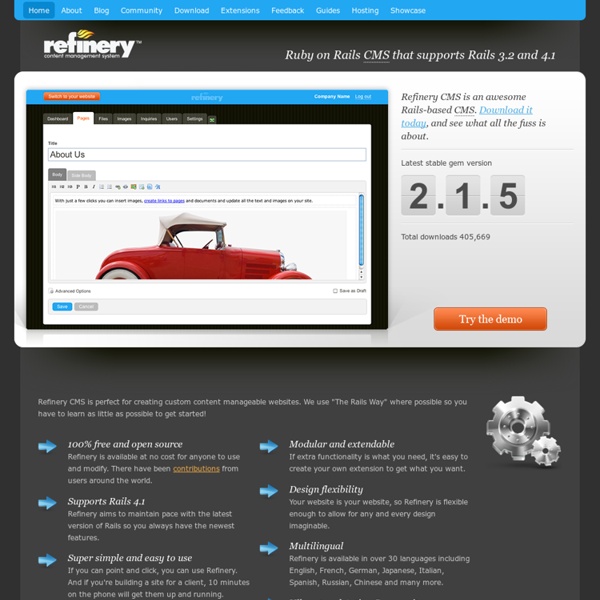
Expanse +++ dream. create. do. Refinery : le meilleur du CMS open source sur Ruby on Rails Pour une entreprise, une première approche du web est bien souvent de mettre en ligne un site internet pour mettre en valeur son savoir-faire et ses produits. La solution recommandée est alors le site web de type CMS. Simplement, le CMS (Content Management System) est un site entièrement administrable et qui rend le propriétaire du site web indépendant. De ce fait, le site CMS est aussi très bien adapté pour des publications fréquentes sous un système éditorial. Chez Synbioz, nous avons développé plusieurs sites utilisant le CMS Refinery et développé nos propres moteurs pour s’adapter aux demandes de nos clients, comme par exemple l’optimisation d’URLs pour le SEO (Search engine optimization) ou encore la gestion de newsletters. Nous devions mettre à l’honneur Refinery, voici donc pourquoi nous avons choisi ce CMS. Les différents éléments composant le CMS Refinery : Design et Ergonomie Toutes les formes de design web et d’ergonomie sont possibles, du design sobre au plus impactant.
Roadmap for Learning Rails | techiferous Accelerating Your Learning If you have no prior development experience, one of the worst things you can do when learning Rails is to just dive in. Some of the concepts build on each other, so jumping in would be like signing up for a calculus class before you’ve learned algebra. Sure, you could muddle through it, but most of your time would be spent trying to figure out why things aren’t working. Another difficulty for a beginner is figuring out what to learn. Another mistake is spending too much time mastering a concept when you only need a basic understanding. Therefore, to accelerate your learning, learn the right things in the right order at the right depth. The following roadmap will help you do exactly that. But First Some Ground Rules… It takes a significant investment of time to learn Rails. Otherwise, you will waste your time learning Rails when all you really needed was WordPress. Roadmap for Learning Rails Ruby Ruby is the most important technology to know when learning Rails. Tools
frodefi/rails-messaging sNews - Lightweight Content Management System Zena, the most powerful Ruby on Rails CMS Criando sua própria RubyGem Todo mundo já deve ter usado pelo menos uma vez na vida as famosas gems. Elas ajudam muito na hora distribuir e usar bibliotecas Ruby, sem dúvida nenhuma. Mas o que nem todo mundo sabe é que criar uma gem é muito mais fácil do que parece. Neste artigo você verá como criar e distribuir sua própria gem. Entendo a gem Uma gem nada mais é que um arquivo .tar.gz. $ tar -ztvf bundler-0.9.26.gem -rw-r--r-- 0 wheel wheel 47579 Dec 31 1969 data.tar.gz -rw-r--r-- 0 wheel wheel 993 Dec 31 1969 metadata.gz Neste arquivo, você encontra o código Ruby propriamente dito (data.tar.gz) e os metadados (metadata.gz), que é a gem specification (ou apenas gemspec) em formato YAML. Uma gem é composta por uma estrutura mais ou menos definida de arquivos e diretórios, como você pode ver abaixo. O diretório lib é de longe o mais importante. O RubyGems substitui o método Kernel#require com sua própria implementação, que faz uma busca pela gem que você precisa utilizando os diretórios adicionados ao GEM_PATH. Ótimo!
A treatise on mailboxer ruby gem | The Admin Mailboxer gem adds messaging capability to your models.By far of all messaging gems we have found this one easy to implement / add to your models with good documentation. Mailboxer Installation In you rails application add gem "mailboxer", "~> 0.9.0" to your Gemfile and run bundle install to install it. Now go to rails application directory and run to generate the necessary migrations and then migrate the changes to your database rails g mailboxer:install rake db:migrate Configuring Maiboxer In rails you can create an intializer called mailboxer.rb in folder /config/intializer and modify the default behaviour of mailboxer. Preparing the Model In your user model add acts_as_messageable and implement the method name as shown below class User < ActiveRecord::Base attr_accessible :email, :first_name, :last_name acts_as_messageable # Returns the name of the user def name return "#{first_name} #{last_name}" end end Basic Messaging To send a message to user2 from user1 To reply to the message Misc stuff
Pixie CMS - The Small, Simple, Site Maker - Home Weblog How to enable Travis CI for an extension John Muhl This information is also available on the wiki where it will receive updates as needed. Travis CI is a flexible and easy to use continuous integration server; see the Getting Started page for more details. The flexibility means that there are any number of ways to setup and test your extensions. Here is one way. First you need to add a .travis.yml file to the root of your repository. rvm: - 1.8.7 - 1.9.2 - 1.9.3 before_script: ". The rvm array shows the Ruby versions you want to test against; since Radiant 1.0 supports the three latest Ruby releases your extension should too. Next up we need to create the before_script referenced above. cd ~ git clone cd ~/radiant if [[ $RADIANT_VERSION ! Replace YOUR_REPOSITORY_NAME and YOUR_EXTENSION_NAME in the before_script with the actual name of your repo and extension; e.g. radiant-sheets-extension and sheets respectively. Radiant 1.0.0 Release Candidate 4 Jim Gay
o um único desenvolvedor Rails fez para escalar um site com 10 milhões de requisições por dia Publicado por Rafael Rosa em 11 de October de 2009 O Ravelry é uma comunidade on-line de tricô e crochê gerida pelo casal Casey e Jessica Forbes. Há algumas semanas, eles foram entrevistados por Tim Bray onde revelaram que seu site tem mais de 400.000 usuários registrados e consegue 3,6 milhões de pageviews por day - que geram 10 milhões de requisições por dia no Rails, já que recebem muitas chamadas de API, RSS e AJAX. Todd Hoff do HighScalability.com coletou todos os detalhes que conseguiu sobre o Ravelry e escreveu o artigo " Como a Ravelry Escalou para 10 Milhões de Requisições Usando Rails. " (em inglês), que é uma excelente análise sobre a estrutura do site, mas se você preferir a versão resumida, eles estão usando: Xen para virtualização HAProxy Nginx Tokyo Cabinet (para armazenamento de objetos grandes) Nagios New Relic Amazon S3 Amazon Cloudfront (for CDN) Sphinx Memcached
Customizing Mailboxer mailer views | The Admin To copy the mailboxer mailer views to your rails app run This will generate two folders, message_mailer and notification_mailer with html & text views for messages, notification and message replies respectively. Next create a modify the initializer of mailboxer to include the following config Mailboxer.setup do |config| #Enables or disables email sending for Notifications and Messages config.uses_emails = true #Configures the default `from` address for the email sent for Messages and Notifications of Mailboxer config.default_from = "admin@yoursite.com" end Add the following method to your messageable model #Returning the email address of the model if an email should be sent for this object (Message or Notification). To change the title of you mail messages open config/locales/en.yml and you will see the following line belonging to each mail you can the below line to suit to your needs
Free CMS - The Easy CMS for Web Designers Easy Setup You will be up and running in no time,with no installs and no hassles. Powerful Features Don't let the simplicity fool you. Customizable UI Go ahead, take the credit.