

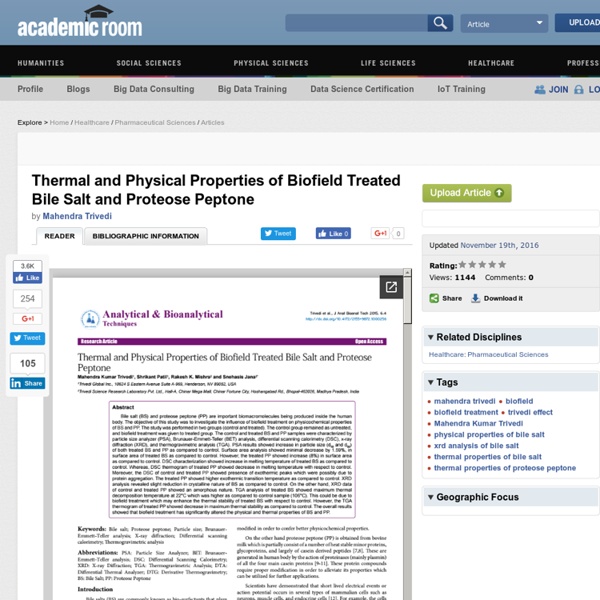
Physical & Thermal Properties of Proteose Peptone 0WordPress0CiteULike0 4 Bile salt (BS) and proteose peptone (PP) are important biomacromolecules being produced inside the human body. The objective of this study was to investigate the influence of biofield treatment on physicochemical properties of BS and PP. The study was performed in two groups (control and treated). The control group remained as untreated, and biofield treatment was given to treated group. Your session has expired but don’t worry, your message has been saved.Please log in and we’ll bring you back to this page. Your evaluation is of great value to our authors and readers. Review When you're done, click "publish" Only blue fields are mandatory. Your mailing list is currently empty.It will build up as you send messagesand links to your peers. No one besides you has access to this list. Enter the e-mail addresses of your recipients in the box below. Your message has been sent. Description Subject : Materials ScienceArea : Materials ScienceLanguage : EnglishYear : 2015
Thermal and Physical Properties of Biofield Treated Bile Salt and Proteose Peptone *The embed functionality can only be used for non commercial purposes. In order to maintain its sustainability, all mass use of content by commercial or not for profit companies must be done in agreement with figshare. Description Bile salt (BS) and proteose peptone (PP) are important biomacromolecules being produced inside the human body. Comments (0) Published on 09 Sep 2015 - 11:08 (GMT) Filesize is 1.22 MB License (what's this?) Cite "Filename" Place your mouse over the citation text to select it Embed "Thermal and Physical Properties of Biofield Treated Bile Salt and Proteose Peptone" Show filename on top Place your mouse over the embed code to select and copy it
God Help Me - Special Prayers! Oh God help me! Whenever we are in any kind of danger, we always utter theses three words as we believe that if we pray to Almighty God, he will definitely help us to sort out our problem or show the ways to rescue us from uncertain troubles and even at the time of great success and something uncertain turn out to us. We know that it’s natural to remember god whenever we feel any kind of problem or experience any trouble and also when we want a kind help from god. In this age of modern technology, we are advancing with numerous equipment and techniques, even though we entirely depended on the will of God except our hard working towards our goals and achievements. Everyone in their life, experience for one or more time a situation when we felt so disable doing something at that time we use to say please god help me. We know that due to varied reasons we remember the almighty. Whoever may be a bad one or the good one we all need the help of our god, one or the other day for our support.
Change in Physical Properties of Proteose Peptone Description Bile salt (BS) and proteose peptone (PP) are important biomacromolecules being produced inside the human body. The objective of this study was to investigate the influence of biofield treatment on physicochemical properties of BS and PP. The study was performed in two groups (control and treated). Citation Information Mahendra Kumar Trivedi. Phenotypic and Biotypic Characterization of Klebsiella oxytoca: An Impact of Biofield Treatment Citation: Trivedi MK, Patil S, Shettigar H, Bairwa K, Jana S (2015) Phenotypic and Biotypic Characterization of Klebsiella oxytoca: An Impact of Bioeld Treatment. J Microb Biochem Technol 7:4 202-205. doi:10.4172/1948-5948.1000204 Volume 7(4): 202-205 (2015) - 203 J Microb Biochem Technol ISSN: 1948-5948 JMBT, an open access journal Collection (ATCC) 43165] were procured from MicroBioLogics, Inc., USA. till the further use. reactions patterns, and biotype number were evaluated on MicroScan Walk-Away® (Dade Behring Inc., West Sacramento, CA) using Negative Breakpoint Combo 30 (NBPC30) panel [19]. biochemicals used in the study were procured from Sigma-Aldrich. Study design e lyophilized cells of K. oxytoca were divided into three groups: C (control), T1 (treatment, revived) and T2 (treatment, lyophilized). e treatment groups (T1 and T2) were in sealed pack and handed over to Mr. Trivedi provided the treatment through his energy transmission process reactions, and biotype number. Results pattern S.
"An Impact of Biofield Treatment on Spectroscopic Characterization of P" by Mahendra Kumar Trivedi Description The stability of any pharmaceutical compound is most desired quality that determines its shelf life and effectiveness. The stability can be correlated to structural and bonding properties of compound and any variation arise in these properties can be easily determined by spectroscopic analysis. The present study was aimed to evaluate the impact of biofield treatment on these properties of four pharmaceutical compounds such as urea, thiourea, sodium carbonate, and magnesium sulphate, using spectroscopic analysis. Citation Information Mahendra Kumar Trivedi.
XRD analysis of Bile Salt to Evaluate Human Energy Impact Open Access Research Article Analytical & Bioanalytical Techniques o u r n a l f y t i c e h q s Trivedi et al., J Anal Bioanal Tech 2015, 6:4 Volume 6 • Issue 4 • 1000256 J Anal Bioanal Tech ISSN: 2155-9872 JABT, an open access journal Keywords: Bile salt; Proteose peptone; Particle size; Brunauer- Emmett-Teller analysis; X-ray diraction; Dierential scanning calorimetry; ermogravimetric analysis Abbreviations: PSA: Particle Size Analyzer; BET: Brunauer- Emmett-Teller analysis; DSC: Dierential Scanning Calorimetry; XRD: X-ray Diraction; TGA: ermogravimetric Analysis; DTA: Dierential ermal Analyzer; DTG: Derivative ermogravimetry; BS: Bile Salt; PP: Proteose Peptone Introduction Bile salts (BS) are commonly known as bio-surfactants that plays crucial physiological role in human gastro intestinal tract such as fat digestion and absorption of nutrients and also serve as a mean for removal of waste products from blood [1,2]. with phospholipids. solubility [1]. Abstract
"Spectroscopic Characterization of Chloramphenicol and Tetracycline: An" by Mahendra Kumar Trivedi Description Objective: Chloramphenicol and tetracycline are broad-spectrum antibiotics and widely used against variety of microbial infections. Nowadays, several microbes have acquired resistance to chloramphenicol and tetracycline. The present study was aimed to evaluate the impact of biofield treatment for spectroscopic characterization of chloramphenicol and tetracycline using FT-IR and UV-Vis spectroscopy. Methods: The study was performed in two groups (control and treatment) of each antibiotic. Citation Information Trivedi MK, Patil S, Shettigar H, Bairwa K, Jana s, et al. (2015) Spectroscopic Characterization of Chloramphenicol and Tetracycline: an Impact of Biofield .
Publication meta - An Impact of Biofield Treatment on Spectroscopic Characterization of Pharmaceutical Compounds The stability of any pharmaceutical compound is most desired quality that determines its shelf life and effectiveness. The stability can be correlated to structural and bonding properties of compound and any variation arise in these properties can be easily determined by spectroscopic analysis. The present study was aimed to evaluate the impact of biofield treatment on these properties of four pharmaceutical compounds such as urea, thiourea, sodium carbonate, and magnesium sulphate, using spectroscopic analysis.