

Discovering Ancient Egypt Talisman and Amulets *** Talisman and Amulets - Worn by the Living and the DeadTalisman and Amulets are one of the oldest forms of magic and were worn or carried by both rich and poor ancient Egyptians. Talisman and Amulets played an important role in the design of ancient Egyptian jewelry and examples can be seen on items can be seen on rings, pendants and necklaces. But in ancient Egypt Talisman and Amulets were not just viewed as a piece of jewelry to adorn the living they were also used to adorn the dead. Talisman and AmuletsEach of the Talisman and Amulets in ancient Egypt had a specific meaning and symbolic significance. The potency of amulets and talismans was recognised in the religious ceremonies and rituals especially those relating to funerary and mortuary rites. Ancient Egyptian Magic - The Magical Powers of the Talisman and AmuletsEach talisman and amulet had a specific magical meaning and religious significance ascribed to it.
Primary History - Romans - Religion Priests in Ancient Egypt, A Feature Tour Egypt Story Priests in Ancient Egypt By Marie Parsons Priests in ancient Egypt had a role different to the role of a priest in modern society. Though the Egyptians had close associations with their gods ,they did not practice any form of organized religion, as modern times would define it. The priests did not preach, proselytize, or care for a congregation. No preaching was required because every Egyptian accepted the validity of the traditional religious theology, i.e. the world was created, ordered and governed by the gods, through the intermediary the king, the only actual priest in Egypt. Egyptian priests did have a vital role in the religious ritual of daily and festival life. Every temple in Egypt had a claim to be the site of the First Occasion, the place where the first moment of creation had occurred. Evidence for the forms of religious observance from predynastic times are sparse. One easily identifiable emblem is the horned female head known as Bat, associated with Hathor. Sources:
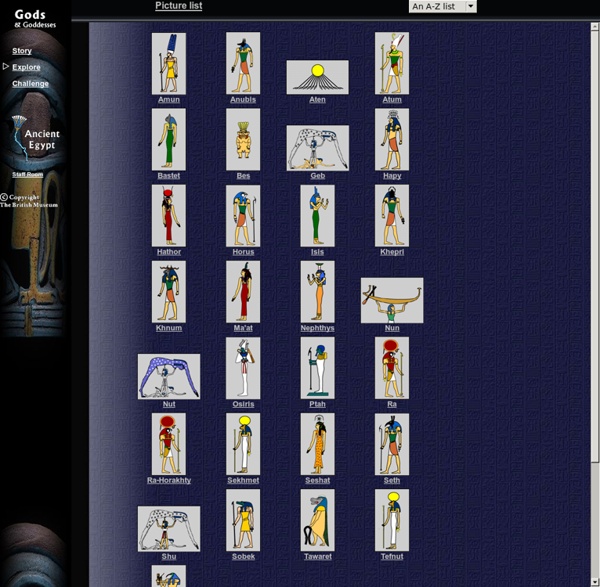
History - Ancient History in depth: Pyramid Challenge The Egyptian God Family Tree – Veritable Hokum First: I opened a store! It has a poster of this, as well as updated versions of the Norse and Greek god family trees I did a while back. More to come soon. Next, a disclaimer: this family tree isn’t, strictly speaking, historically accurate, because what we think of as The Egyptian Pantheon is really a whole bunch of similar-but-not-identical pantheons which were mostly based in individual cities – Thebes, Heliopolis, Memphis, etc. – and went through a lot of changes over their 3000+ year history. It’s as nice a chart as I could make after smooshing together a bunch of those similar-but-not-identical pantheons into one image, but it also contains at least a half-dozen gods who were in charge of their own version of this pantheon, and a bunch of others who could be related to each other in totally different ways depending on when and where you asked. And now that I’ve disclaimed historical responsibility, onto What I Know About Those Gods Up There: Nun Apep Aten Ra Atum Amun Mut Hathor Sekhmet Shu
Chinese Gods - Ancient China for Kids! People worshipped many different gods in ancient China. Some of these gods have been worshipped since the Shang Dynasty (about 2000 BC ). Other Chinese gods became popular later on. Some of these gods are representations of the weather or natural forces like the sun or the moon or the rain . For instance, the goddess Ba, the daughter of Heaven, is a personification of drought (she's what drought would look like, if drought were a person). Sometimes people made abstract ideas into gods, like Cai-shen, the god of prosperity, who you could pray to for success in business, for instance. Cheng-huang protects your city from enemies and brings rain for your crops, and help you get to Heaven after you die. Some gods are based on Taoist ideas, like the eight gods of the Ba Xian (or Pa Hsien), who represent eight ways of being human: being young, being old, being poor, being rich, being a peasant, being an aristocrat, being a boy, and being a girl. Cite this page: Carr, Karen (PhD).
Sumerian Myths Sumerian civilization originated in what is now southern Iraq, just upriver from the mouths of the Tigris and Euphrates rivers. "Civilization" in this context means a settled town or city-dwelling people who possess a stable agricultural technology (including domesticated animals) and have developed a hierarchical system of social classes (peasants, laborers, slaves, craftsmen [smiths, masons, carpenters, potters, etc.], farmers, fishermen, merchants, doctors, architects, priests and temple attendants, bureaucrats, scribes, advisers, priest-kings). Since the climate of southern Iraq is hot and dry, agriculture requires an extensive irrigation system of canals and dikes. Often, the Sumerians wrote as if their civilization (agricultural techniques, cities, classes of people) came first, and people later. Map of Mesopotamian Archeological Sites (Oriental Institute, University of Chicago) Sumerian cities were close agglomerations of one or two story mud brick dwellings. Questions:1. 2. 3.
Sairas egyptiläinen haki apua eläimiltä | Historianet.fi Jos egyptiläinen kuuli huonosti, vaivan saattoi parantaa gasellin korvalla. Ebersin papyruksen mukaan lääkärin oli leikattava gasellilta korva ja tehtävä siitä, annek-kasvista, kilpikonnankuorilastuista ja päästäisen päästä tahna. Sitä paineltiin korvaan, minkä jälkeen potilaan pään ympäri kiedottiin liina. Sitten lääkärin piti kutsua ilmanjumala Shuta, jotta tämä lähettäisi parantavia voimia maan päälle. Possun silmät: Possun silmät palauttivat näön Ebersin papyruksessa kerrotaan lyijystä,hunajasta ja siansilmistä sekoitetun tahnan parantavan sokeuden. Otetaan kaksi kuivattua siansilmää, murskataan ne ja sekoitetaan murska punaisen lyijymönjän ja hunajan kanssa, niin saadaan lääke, joka karkottaa sokeuden. Kun lääkäri oli sekoittanut tahnan, hän siveli sitä potilaan silmiin. Egyptiläiset uskoivat, että sokeus oli jumalien rangaistus ihmiselle.