StarChild: A Learning Center for Young Astronomers
The StarChild site is a service of the High Energy Astrophysics Science Archive Research Center (HEASARC), Dr. Alan Smale (Director), within the Astrophysics Science Division (ASD) at NASA/GSFC. StarChild Authors: The StarChild Team StarChild Graphics & Music: Acknowledgments StarChild Project Leader: Dr. Laura A. Whitlock Curator: Responsible NASA Official: If you have comments or questions about the StarChild site, please send them to us.
Star Walk 2 Night Sky Map: Watch Stars and Planets on the App Store
The Earth and Beyond
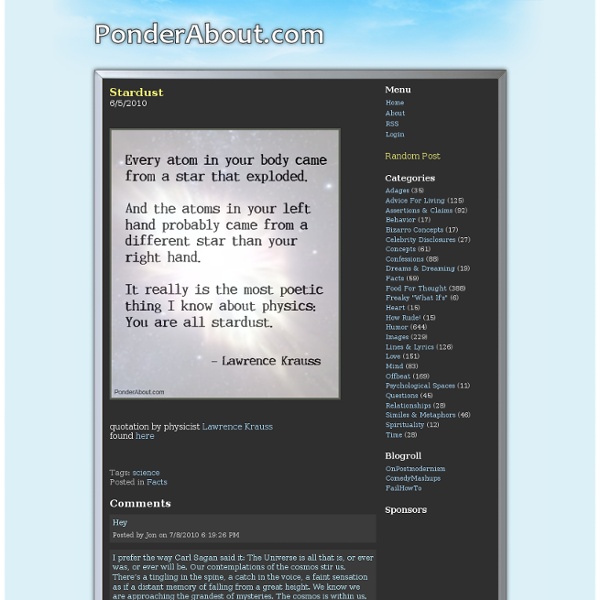
Welcome to The Earth and Beyond Hello, my name is Tim O'Brien. I'm an astronomer working at The University of Manchester's Jodrell Bank Observatory. As an astronomer my job is to try and understand how the universe works and my main interest is why some stars explode - more about this later! I also get to visit lots of schools and share amazing facts with children and teachers about the Sun, Earth and Moon, the stars and planets, and the Universe as we know it! Now, in the Children’s University, I can share the excitement with you. Exploding stars You may know the names of some patterns of stars (called constellations) such as Orion or the Great Bear. This picture shows Orion the Hunter and Taurus the Bull with the position of an exploded star known as the Crab Nebula. We're all made of stars Understanding why stars explode is very important because most of the chemical elements (carbon, oxygen, nitrogen and so on) were made inside stars and are spread out into space when they explode.
Curious Kids: Where do black holes lead to?
This is an article from Curious Kids, a series for children. The Conversation is asking kids to send in questions they’d like an expert to answer. All questions are welcome – serious, weird or wacky! You might also like the podcast Imagine This, a co-production between ABC KIDS listen and The Conversation, based on Curious Kids. Hi. Hi Merion. Black holes can form when a massive star dies. These stars are also made up of very hot gas which lets off a lot of heat. Normally the pull from gravity and the push from the heat balance each other out. Read more: Curious Kids: Does space go on forever? You will never be able to escape a black hole Because black holes are made up of a lot of mass squished into a very small area of space (in science speak we say black holes are very dense) they create a lot of gravity. Black holes were given that name because if you were to take a picture of one, you wouldn’t be able to see anything. So, where do they lead to? Hello, curious kids!
Matariki - The Māori Phases of the Moon - Museums Wellington
The Moon travels around Earth in 29.53 days – this is the period of the lunar phases, also known as the synodic month. The lunar phase or Moon phase is the shape of the directly sunlit portion of the Moon, as viewed from Earth. The synodic month is the average period of the Moon’s orbit concerning the line joining the Sun and Earth. The Moon’s appearance depends on the position of the Moon for the Sun as seen from the Earth. The lunar phases gradually change over a synodic month, as the orbital positions of the Moon around Earth, and Earth around the Sun, shift. This 4K visualization shows the Moon’s phase and libration at hourly intervals throughout 2020, as viewed from the Southern Hemisphere. The time it takes for the Moon to return to the same phase in the sky is 29.53 days. How the Māori applied Marama’s thirty nights to fit in with the proper age of the moon has not been made clear. The names omutu and mutu-whenua mean the same thing, that is, the ending of the moon’s night.
Astronomy Observing Events and Star Parties - Astronomy on Sea and Sky
February 5 - 11, 2024 Southern Cross Astronomical Society Camp Sawyer on Big Pine Key, Florida The Winter Star Party "WSP" is a serious event designed for amateur astronomers. WSP is held annually, usually during the new moon in February. The event is unique in that it occurs mid-winter during the height of the Florida Keys tourist season. The warm weather, coupled with dark skies, and possibly the steadies skies in North America attracts attendees from all over the frozen United States, Canada, and Europe giving the event an international flavor. The amateur astronomical "get-to-together"allows participants to meet and share observing ideas, astro-imaging techniques, as well as find out what's new in the hobby. WSP offers a stellar daily line-up of speakers who are experts in their particular field.
Stars Activities | Museum of the North
Explore the stars with these hands-on activities! There are billions of stars in our universe. For thousands of years, people have looked up at the night sky, marveled at what they saw, and told stories about the patterns they see. Discover more about constellations, learn how to identify stars in the sky, and make a tool to calculate the angle of stars above the horizon. Activities Note: PDFs meet accessibility standards. Alaska Flag Ornament: Explore how stars connect to history and culture by making an Alaska flag ornament. A winter night sky view at Wonder Lake, Denali National Park.Photo by Jacob Frank, National Park Service. Return to Space Science Activities homepage. This project was funded under NASA cooperative agreement NNX16AL65A and cooperative agreement number NNH15ZDA004C.