

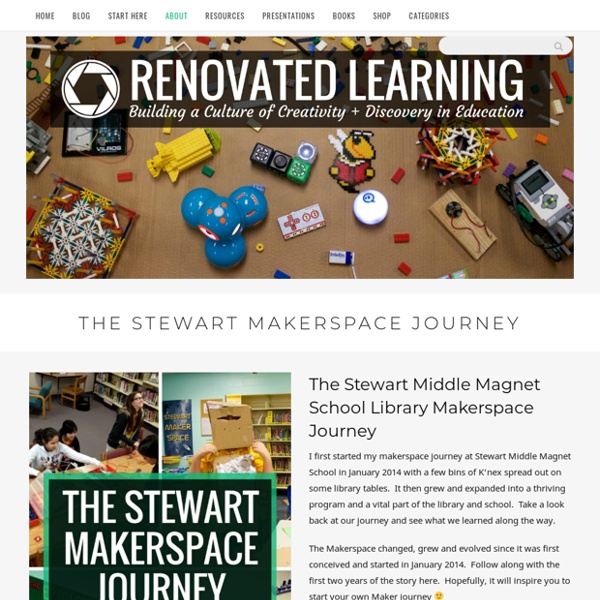
Creating School Library Makerspaces While there is no clear, single definition to the term makerspaces (Burke, 2013; Fontichiaro, as cited in Bell, 2015), there are commonalities existing in terms of features, functions, goals and activities that makerspaces provide. A makerspace is a place where people gather as communities to be innovative, create and collaborate, to share knowledge, tools and resources (Britton, 2012). Makerspaces have transpired from the maker movement which has been popularised by Make magazine and Maker Faire founder Dale Dougherty. Regardless of educational or community contexts, makerspaces are learner-centred and facilitate cooperative and participatory learning, independent nquiry and experiential hands-on exploration via iterative activities, including robotics, 3D design and printing, electronics, physical computing, textiles, craft, gaming, digital fabrication.
Starting a School Makerspace from Scratch With the National Week of Making behind us, you might be ready to start a makerspace in your school -- but not know where to start. Will purchasing a costly 3D printer and the latest robotics kit ensure learning and maker success? What are some steps to starting a successful makerspace from scratch? Step 1: Immerse Yourself in Maker Education Before you can build your own community of makers, you need to join one! Step 2: Get Others Involved Start a steering committee for your makerspace by involving interested teachers and students. If you can, reach out to the community and get parents and community members involved. Step 3: Purchasing Makerspace Resources Here are three guidelines: What purchases will give you the most bang for your buck? Step 4: Building a Community of Makers Immerse your students in maker supplies. Photo Credit: Colleen Graves Step 5: Hosting Workshops and/or Design Challenges Here are some design challenge ideas that worked for me:
The Golden Age of Education | Highly Effective Tools and Strategies Advocating for Makerspaces in Libraries Since I first started my Makerspace at Stewart Middle Magnet School in January 2014, I have received a lot of positive feedback. I’ve given talks, presented at conferences, and shared about our experiences through my blog and through social media. Some of the questions I am most frequently asked are: Why should makerspaces be in the library? Why not just convert a classroom into a STEM lab? In a similar vein, I often hear from librarians who are struggling to get their administration/teachers/community to understand the rationale for having a Makerspace in their library. Aren’t those kids just playing? How we react to these types of questions are crucial in our advocacy for our spaces. Why should makerspaces be in the library? This has a lot to do with the philosophy behind libraries. Why not just convert a classroom into a STEM lab? If you’ve got a classroom available to turn into a tricked out STEM lab, go for it. Aren’t those kids just playing? See these books for research on play:
Exploring Makerspace culture It’s twelve months since Kristen Fontichiaro presented Sharpening our toolkit: defining great work, exploring Makerspace culture and badging accomplishments at the SLAV Conference Transliteracy: whom do you ask and how can you participate? At that time Kristen spoke of the value of Makerspaces as positive learning opportunities based on her experience and research with the Michigan Makers group and the University of Michigan, USA. A number of schools have explored the idea and are implementing them in various ways. Makerspaces: creating an opportunity Regardless of the focus, Makerspaces share a common definition: A place where people can use tools and materials and can develop creative projectsCan be embedded in an existing organisation or stand alone e.g. Opportunities for innovation are emerging rapidly as schools purchase 3D printers and the notion of introducing computer coding as a primary school subject is being canvassed by education departments worldwide.
School Libraries and Makerspaces: Can They Coexist? More and more schools are coming to value maker education and exploring ways to create makerspaces in their schools. Many schools are discussing how they might utilize their library to facilitate this. As my school has increased our commitment to constructionist learning and maker education over the last few years, we have done so in close collaboration with our school library. In exploring the relationship between the school library and school makerspace, it's not difficult to see why conversations about the growth of makerspaces are often tied to the conversation about the future of libraries. Both makerspaces and libraries are constructivist learning spaces that share a number of common goals, while approaching them in different ways and through very different material resources. Similar Yet Distinct Makerspaces and libraries are sites of informal learning. Libraries and makerspaces are inherently interdisciplinary spaces. Makerspaces and libraries are more than just resource closets.
Nurturing Intrinsic Motivation and Growth Mindset in Writing It's the first writing conference, four weeks into the year, with this blond senior. He stiffly leans back from me as far as the metal desk will allow, exuding cynicism, too cool for meeting with teachers about his writing. I can see he doesn't trust me yet or know why we conference, and he's afraid. He says, "So, what is this meeting about then?" And we begin. The Power of Teacher Enthusiasm Conferencing and portfolios work for me. But I wish the research would point to these systems as consistent and universal means of student growth. Then, two years ago, I read Daniel Pink's Drive and Carol Dweck's Mindset, and I realized that a system of portfolios and conferences was not enough to change student engagement on its own. Intrinsic Motivation Pink’s Drive argues that employees -- and students -- after their basic needs are met, are motivated by autonomy, purpose, and mastery. But sometimes, I also got it right. Growth Mindset The Payoff: Engagement and Ownership
Make & Takes: Let Students Own the Learning Make & Takes Build Excitement & Engagement A few weeks ago, I was meeting with a group of girls to plan activities we want to do with our STEMgirls club that we’re starting. They had tons of great ideas and suggestions: “We want to learn how to sew and make beds for an animal shelter”“We want a workshop on how to solder and make jewelry”“We should get more arts and crafts supplies for the makerspace”“It would be cool to have a t-shirt alteration challenge.” As we discussed ideas and I offered up some of my own, I started to notice a theme. I started thinking back along the history of our makerspace and realized that many of our most popular activities have been make & takes: our Rainbow Loom band fundraiser, the Perler Bead station that we first started with Teen Tech Week, our DIY bookmark center, the arts & crafts parties that first spurred on our makerspace. Cardboard robot made during Stewart Makers Club Balancing Reusable/Non-consumable Activities with Make & Takes Related Posts:
Your Students can be “Makers”: 16 Projects Invented by Teachers (This post was edited on 6/30/2015 to add a 17th project previously omitted. Be sure to scroll down to see that project!) New York City, The Big Apple, a global hub for innovation and invention from the Otis elevator through the MakerBot 3D printer… The perfect location for teachers to flex their own innovation and invention muscles at Design, Do, Discover 2015. In June 2014, I attended the second Design Do Discover conference at Castilleja School in Palo Alto, CA. The first year was a wonderful learning experience for everyone – coaches and participants alike. The premise is simple: start with a quick tour of the facility and very brief show-and-tell of the tools (less than 30 minutes!) The final projects blew ALL of us coaches away! 1. This project was created by a team from my own school in Seattle… They were pursuing an idea of presenting the whole school with the same project prompt: solve a problem related to water. 2. 3. 4. 5. 6. 7. 8. Lego Mindstorms, Laser cutting. 9. 10. 11. 12.
A Librarian’s Guide to OER in the Maker Space Dynamic, living, breathing, current, personalized, adaptive, engaging, creative, cutting-edge, and current are just some of the words that have been used to describe the open educational resources (OER) movement. The U.S. Department of Education recently expanded its efforts to increase schools’ access to high-quality, openly licensed learning resources, giving educators more access to technology to personalize learning for their students. What are OER? OER are teaching, learning, and research resources that reside in the public domain or have been released under an intellectual property license that permits sharing, accessing, repurposing—including for commercial purposes—and collaborating with others. The benefits of using OER in the maker space The Williamsfield School District in Illinois has been leading the OER charge. Because of their capacity to stimulate creativity, OER are the perfect complement to the maker space movement. A switch-activated circuit from “High-tech Fashion.”
6 Ways to Rethink Your Library Space and Make it Amazing Over the past five years, we have redesigned our media center and transformed it into a more flexible, collaborative space. This is the story of how we got there, and how you can apply what we learned as you rethink your library space. Want to learn even more about transforming your library space? Check out my book, Reimagining Library Spaces: Transform Your Space on Any Budget The Maker Corner – 2010 vs 2015 Note: Post contains affiliate links. Rethink Your Library Space When I first arrived at Stewart in 2010, the library was in pretty dismal shape. Remove Obstacles and Clutter – Sometimes less is more Removing obstacles and clutter When I first got to Stewart in 2010, the collection hadn’t been weeded in decades. Open up your space I began massively weeding the collection, paring it down to the books that students were actually reading. Color can be an easy and effective way to brighten up your space Adding Color Movable and flexible furniture is key Movement and Flexibility Variety of seating