

Curriculum and Instruction - Student Center Activities, Grades 2-3 - Student Center Activities, Grades 2-3 Frequently Asked Questions about the K-5 Student Center Activities. Introduction During the spring 2004 Florida Reading First school site visits, staff from the Florida Center for Reading Research (FCRR) determined that teachers may benefit from classroom materials that would be immediately useful in implementing independent student center activities. In 2004-2005, a team of teachers at FCRR reviewed current research, collected ideas, and created materials for use in kindergarten and first grade classrooms. These Student Center Activities, Teacher Resource Guide, and accompanying Professional Development DVD (K-1 Project) can be accessed at In 2005-2006, a team of teachers at FCRR reviewed current research, collected ideas, and created materials for use in second and third grade classrooms. The 2-3 Student Center Activities include three books and one DVD: 1. The Teacher Resource Guide is posted below as a PDF file.
English Games for kids - Learn Sight Words While some sight words are easy to identify for young children, particularly those who are in kindergarten, there are others that must wait a couple of years. We offer online sight words games for children who are at varying levels of learning, from kindergarten through second grade. Each level of learning provides sight words games that help children gain a better grasp of the English language so they are able to read better. Encourage Learning Learning to read can sometimes be a difficult process for children, especially when they realize there are exceptions to the basic rules of the English language.
Phonics Games Phonics can help a person recognize more words, improve spelling, increase reading speed and comprehension, improve writing skills, help with pronunciation, and improve vocabulary. While a learner may still have to memorize the pronunciation and spelling of some words, he or she will be able to sound out many more on his/her own. Creating phonemic awareness should begin with the vowels: a, e, i, o, u, and sometimes y. Students should work on the short vowel sounds before moving on to the long vowel sounds. These sounds are foundational for learning how to read English words.
Phonics: In Depth The goal of phonics instruction is to help children learn and use the alphabetic principle — the alphabetic principle is the understanding that there are clear, logical and predictable relationships between written letters and spoken sounds. Knowing these relationships will help children recognize familiar words accurately and automatically, and "decode" new words. In short, knowledge of the alphabetic principle contributes greatly to children's ability to read words both in isolation and in connected text. Phonics instruction teaches children the relationships between letters and sounds. Sometimes different terms are used to describe the relationship between letters and sounds. A sound is a unit of speech called a phoneme. Critics of phonics instruction argue that English spellings are too irregular for phonics instruction to really help children learn to read words. Let's look at the definitions of "systematic" and "explicit" again Systematic and explicit phonics instruction No.
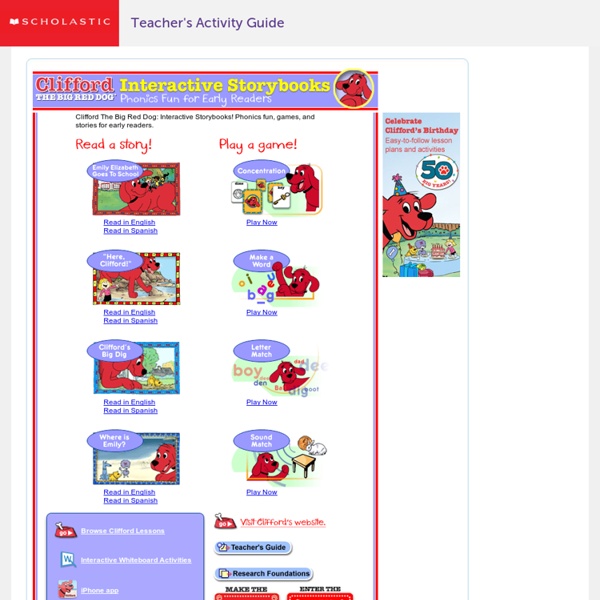
For younger readers Clifford is iconic and these activities help to enhance the understanding of reading activities to be interactive for the reader.. by shalenejaramillo Nov 5
This website has some fun phonics activities for students. There are interactive readings, word building games, and letter and sound matches. I like that the stories are read line by line and it asks for sentences to be completed as it goes along. by vr1v3ra Jul 24
Not really applicable to my students or classroom but I imagine this is the direction technology is leading us in by adamrosskuhn Mar 8