

Scientific journal For a broader class of publications, which include scientific journals, see Academic journal. The history of scientific journals dates from 1665, when the French Journal des sçavans and the English Philosophical Transactions of the Royal Society first began systematically publishing research results. Over a thousand, mostly ephemeral, were founded in the 18th century, and the number has increased rapidly after that.[1] Articles in scientific journals can be used in research and higher education. Articles tend to be highly technical, representing the latest theoretical research and experimental results in the field of science covered by the journal. Types of articles[edit] There are several types of journal articles; the exact terminology and definitions vary by field and specific journal, but often include: In addition to the above, some scientific journals such as Science will include a news section where scientific developments (often involving political issues) are described. Cost[edit]
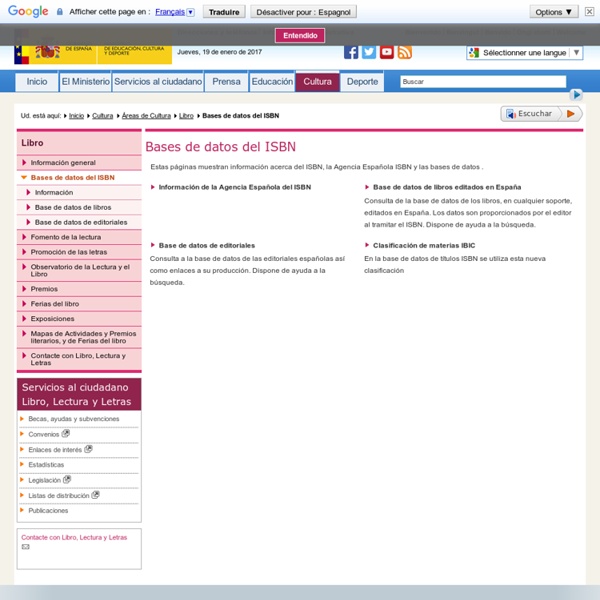
Index Translationum (para saber quién ha traducido qué) La base de datos contiene una información bibliográfica acumulativa sobre las obras traducidas y publicadas en un centenar de Estados Miembros de la UNESCO entre 1979 y 2009. Más de 1.800.000 referencias de todas las disciplinas: literatura, ciencias sociales y humanas, ciencias exactas y naturales, arte, historia, etc. Búsqueda bibliográfica en línea Las referencias anteriores a 1979, pueden ser consultadas en la versión impresa, que se encuentra en las bibliotecas depositarias y en la biblioteca de la UNESCO, París. En el año 2012, el Index Translationum ha celebrado su 80 aniversario. Descargarel cartel deeste día enPDF de alta resolución.
List of scientific journals The following is a partial list of scientific journals. There are thousands of scientific journals in publication, and many more have been published at various points in the past. The list given here is far from exhaustive, containing only some of the most influential, currently publishing journals in each field. Note: there are many science magazines that are not scientific journals, including Scientific American, New Scientist, Australasian Science and others. For periodicals in the social sciences and humanities, see List of social science journals. General and multidisciplinary science[edit] see also Category:Multidisciplinary scientific journals Basic and physical sciences[edit] Astronomy and astrophysics[edit] Chemistry[edit] Earth and atmospheric sciences[edit] Materials science[edit] Mechanics[edit] Physics[edit] Life sciences[edit] Biology in general[edit] Agriculture[edit] Bioinformatics[edit] see List of bioinformatics journals Biophysics and biochemistry[edit] Botany[edit] Ecology[edit]
Systeme Universitaire de Documentation: SUDOC Translation Studies Bibliography Translation Studies (sometimes also called: Translation and Interpreting Studies) comprises the discipline dealing with transfer and mediation, containing aspects of intra- and interlingual translation, intercultural communication, adaptation, interpreting, localization, multimedia translation, language mediation, terminology and documentation. In recent years, Translation Studies has demonstrated that it has established itself as a mature academic discipline. We welcome you to explore the broad range of publications in this field, using the innovative and advanced Translation Studies Bibliography. The database is continuously updated and now contains approx. 40,000 annotated records. The bibliography is enhanced by a thesaurus and provides CrossRef DOIs, where available, for easier interlinking. Starting from 2002, the original TSB partners were KU Leuven, the European Society for Translation Studies (EST) and John Benjamins Publishing Company. DOI:
List of academic databases and search engines From Wikipedia, the free encyclopedia This article contains a representative list of notable databases and search engines useful in an academic setting for finding and accessing articles in academic journals, institutional repositories, archives, or other collections of scientific and other articles. Databases and search engines differ substantially in terms of coverage and retrieval qualities.[1] Users need to account for qualities and limitations of databases and search engines, especially those searching systematically for records such as in systematic reviews or meta-analyses.[2] As the distinction between a database and a search engine is unclear for these complex document retrieval systems, see: the general list of search engines for all-purpose search engines that can be used for academic purposesthe article about bibliographic databases for information about databases giving bibliographic information about finding books and journal articles. Operating services[edit] [edit] [edit]
BDDOC CSIC: Sistemas de información CSIC Dialnet DICE. Difusion y Calidad Editorial de las Revistas Españolas de Humanidades y Ciencias Sociales Database checklist: Key academic research resources -- both free and restricted Journalist (iStock) Members of the media do “research” by performing all sorts of tasks — pulling financial records, tracking down contact information for sources, scraping data from government websites. But another key skill is the ability to locate and review academic studies to strengthen and deepen stories. The Journalist’s Resource studies database distills top research, but there’s a much bigger universe of research out there. One common search strategy for finding academic research is trying a series of keywords in popular search engines such as Google, Yahoo and Bing. While no particular strategy is perfect, establishing a checklist of key databases is essential. Access issue Of course, there is the problem of free versus paid access to research. News databases As part of your search strategy, you may want to also “pull the clips” on a topic, to see what the media has reported and what prior research has been cited publicly. A core checklist Below is a list of useful databases. Open databases