
The sealed bottle garden still thriving after 40 years without fresh air or water. David Latimer first planted his bottle garden in 1960 and last watered it in 1972 before tightly sealing it shut 'as an experiment'The hardy spiderworts plant inside has grown to fill the 10-gallon container by surviving entirely on recycled air, nutrients and waterGardeners' Question Time expert says it is 'a great example just how pioneering plants can be' By David Wilkes for the Daily Mail Published: 10:45 BST, 24 January 2013 | Updated: 16:33 BST, 6 March 2016 To look at this flourishing mass of plant life you’d think David Latimer was a green-fingered genius.
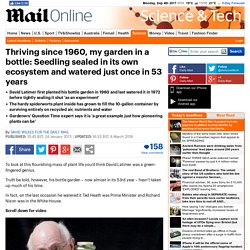
Truth be told, however, his bottle garden – now almost in its 53rd year – hasn’t taken up much of his time. In fact, on the last occasion he watered it Ted Heath was Prime Minister and Richard Nixon was in the White House. Scroll down for video For the last 40 years it has been completely sealed from the outside world. Yesterday Mr Latimer, 80, said: ‘It’s 6ft from a window so gets a bit of sunlight. First choose a glass container. Thinking Like an Ecosystem. Ecoliteracy.org Thinking Like an Ecosystem Hope is not wishful thinking.
It's not a temperament we're born with. It is a stance toward life that we can choose . . . or not. The real question for me, though, is whether my hope is effective, whether it produces results or is just where I hide to ease my own pain. What I strive for I call honest hope. The good news is that we face this historic challenge just as our understanding of life's rich complexity, and human nature itself, is expanding exponentially. So here, in this final chapter, is an invitation to explore what it means to think like an ecosystem.
So, if we want life to thrive, we keep foremost the question, What conditions enhance life? Shifting from the mechanical assumption of separateness and seeing our societies as ecosystems, we get curious about how aspects interact. The implication? It's the context, stupid! Thinking like an ecosystem means seeing everything in context, or at least giving it our best shot. You are here Tools. Traditional Knowledge Systems for Biodiversity Conservation. Introduction Traditional knowledge is vital for sustainability of natural resources including forests, water, and agroecosystems across landscape continuum spanning from households through farms, village, commons and wilderness. Here, I examine the traditional knowledge on biodiversity, particularly in the light of contemporary research on traditional and formal knowledge systems and demonstrate the value of traditional knowledge for biodiversity conservation.
I also revisit the efficacy of traditional knowledge systems for conservation. I identify recent developments in local knowledge research and interface this with the challenges that contemporary society faces in India and how local knowledge can be useful to address the biodiversity conservation. Humanity faces exceptional challenge of eroding natural resources and declining ecosystems services due to a multitude of threats created by unprecedented growth and consumerism.
Ontario Society for Ecological Restoration. Sustainability and forest transitions in the southern Yucatán: The land architecture approach - Scholars Portal Journals. Uwspace.uwaterloo.ca/bitstream/10012/7011/1/McGrath_Darby.pdf. Trends in Ecology & Evolution - What's new about old fields? Land abandonment and ecosystem assembly. To view the full text, please login as a subscribed user or purchase a subscription.

Click here to view the full text on ScienceDirect. Environmental and socio-economic changes are leading to increased levels of land abandonment worldwide. The assembly of plant communities on old fields has informed much ecological theory, which in turn has facilitated efforts at ecological restoration. The interaction of the cultivation legacy with inherent soil and vegetation characteristics will determine the dynamics of plant community assembly on old fields and indicate the level of effort required to restore historical vegetation states.
The abandonment of traditional agricultural lands in some areas will create old fields that require limited or no restoration. Register an Account If you do not have an account, create one by clicking the button below, and take full advantage of this site's features.