
What Is Unicode? In order for a computer to be able to store text and numbers that humans can understand, there needs to be a code that transforms characters into numbers.
The Unicode standard defines such a code by using character encoding. Character Encoding All character encoding does is assign a number to every character that can be used. I could if I really wanted to make a character encoding right now. For example, I could say "A" becomes the number 13, "a" = 14, "1" = 33, "#" = 123 and so on. This is where industry wide standards come in. What is Unicode? ASCII which stands for American Standard Code for Information Interchange became the first widespread encoding scheme. It became apparent that a new character encoding scheme was needed and the Unicode standard was created.
UTF-8: only uses one byte (8 bits) to encode English characters. Code Points. Code Conventions for the Java Programming Language. Java SE Downloads. The Java Community Process(SM) Program. Java SE Overview - at a Glance. What's New Java Platform, Standard Edition 8 Update 121 (Java SE 8u121) This latest release of the Java Platform includes important security fixes.
Oracle strongly recommends that all Java SE 8 users upgrade to this release. JDK for ARM releases are available on the same page as the downloads for other platforms Download Release Notes Advanced Management Console 2.5 Provides system administrators an effective control over diverse Java versions running on desktops in the enterprise enabling a more secure environment and enhanced application experience and availability. Java SE 8 is Now Available The Java Platform, Standard Edition 8 (Java SE 8) is a major feature release. Download Release Notes Security of the Java Platform A description of security information provided by role. LiveConnect changes in 7u45 Java 7 update 45 (October 2013) introduces a new warning to users of LiveConnect applications. Java API Documentation Updater Tool Archive of Technical Articles Updates Release Notes ? Java Tutorials. User Groups.
Bruce Eckel's MindView, Inc: Free Electronic Book: Thinking in Java, 3rd Edition. This page apparently has both "Thinking in Java" and "Thinking in C++" as being reader's choices for best book of 2002.
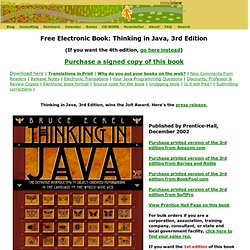
I don't know which readers, other than that they are Chinese. Subscribe to the free OOP Newsletter from Bruce Eckel Subscribing to the newsletter provides automatic notification when the book is revised and information about CD Roms and Java Seminars and workshops. As many of you have noticed, I am terribly swamped with email and am unable to answer programming questions. There are several people who have kindly offered to answer Java questions that you would normally send to me. Steps for installing source code on your machine: Go to the download site and download the file titled Thinking in Java, 3rd Edition by clicking on this link and requesting that your browser save the file. Please note that these files were tested with the most recent version of Java. Using "ant" to compile the files Note: using ant is completely optional. Ant If you like the book, please: Java Tutorials. This section contains tutorials concerning all aspects of the Java programming language ecosystem for desktop and enterprise applications development.
The Core Java Tutorials section contains tutorials regarding the core Java programming language. Here you can find tutorials about the latest core Java technologies including but not limited to JUnit, JSON, JAXB, Design Patterns, Concurrency, IO, Collections, Guava, Eclipse, Netbeans, IntelliJ IDEA etc.The Enterprise Java Tutorials section contains tutorials regarding Java extensions and libraries/frameworks for developing enterprise class applications. Here you can find tutorials about the latest enterprise Java technologies including but not limited to Spring, JSF, Hadoop, Hibernate, JPA, OSGi, Java EE6, GWT, Play! Overview (Java Platform SE 6) Naming a Package (The Java™ Tutorials > Learning the Java Language > Packages) With programmers worldwide writing classes and interfaces using the Java programming language, it is likely that many programmers will use the same name for different types.
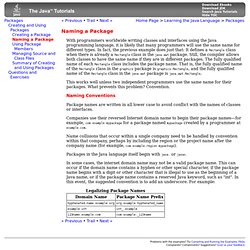
In fact, the previous example does just that: It defines a Rectangle class when there is already a Rectangle class in the java.awt package. Still, the compiler allows both classes to have the same name if they are in different packages. The fully qualified name of each Rectangle class includes the package name.