
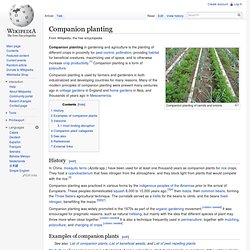
Companion planting. Companion planting of carrots and onions.
Intercropping. When crops are carefully selected, other agronomic benefits are also achieved.
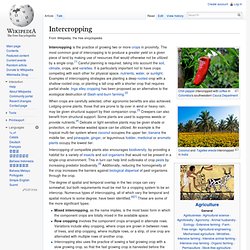
Lodging-prone plants, those that are prone to tip over in wind or heavy rain, may be given structural support by their companion crop.[3] Creepers can also benefit from structural support. Some plants are used to suppress weeds or provide nutrients.[4] Delicate or light sensitive plants may be given shade or protection, or otherwise wasted space can be utilized. An example is the tropical multi-tier system where coconut occupies the upper tier, banana the middle tier, and pineapple, ginger, or leguminous fodder, medicinal or aromatic plants occupy the lowest tier. The degree of spatial and temporal overlap in the two crops can vary somewhat, but both requirements must be met for a cropping system to be an intercrop. Sphagnum. Sphagnum is a genus of approximately 120 species[1] of mosses.
Sphagnum accumulations can store water, since both living and dead plants can hold large quantities of water inside their cells; plants may hold from 16-26 times as much water as their dry weight depending on the species.[2] The empty cells help retain water in drier conditions. Hence, as sphagnum moss grows, it can slowly spread into drier conditions, forming larger peatlands, both raised bogs and blanket bogs.[3] These peat accumulations then provide habitat for a wide array of peatland plants, including sedges and ericaceous shrubs, as well as orchids and carnivorous plants.[4] Sphagnum and the peat formed from it do not decay readily because of the phenolic compounds embedded in the moss's cell walls. In addition, bogs, like all wetlands, develop anaerobic soil conditions, which produces slower anaerobic decay rather than aerobic microbial action.
Life cycle[edit] Coffee grounds for compost and fertilizer. Medicinal uses of Nettles. David Winston. David Winston RH (AHG) (born 1956) is an American herbalist and ethnobotanist.
He has been in practice and teaching since 1977 and has written several books on the subject. He works in the Cherokee, Chinese and the Western eclectic herbal traditions.[1] Winston is a founding/professional member of the American Herbalists Guild, and is a founding advisory board member of United Plant Savers. He serves as visiting faculty at the Maryland University of Integrative Health (formally Tai Sophia Institute). He is the founder and dean of the Center for Herbal Studies. Biography[edit] Botany. Botany, also called plant science(s) or plant biology, is the science of plant life and a branch of biology.
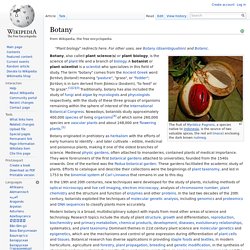
A botanist or plant scientist is a scientist who specializes in this field of study. The term "botany" comes from the Ancient Greek word βοτάνη (botanē) meaning "pasture", "grass", or "fodder"; βοτάνη is in turn derived from βόσκειν (boskein), "to feed" or "to graze". Traditionally, botany has also included the study of fungi and algae by mycologists and phycologists respectively, with the study of these three groups of organisms remaining within the sphere of interest of the International Botanical Congress. Still room. The still room is a distillery room found in most great houses, castles or large establishments throughout Europe dating back at least to medieval times.
Medicines were prepared, cosmetics and many home cleaning products created, and home-brewed beer or wine was often made. Ethnobotany. Ethnobotany (from ethnology, study of culture,[1] and botany, study of plants) is the scientific study of the relationships that exist between peoples and plants.
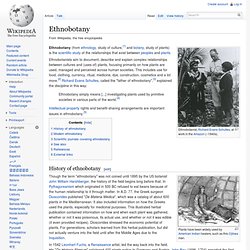
Ethnobotanists aim to document, describe and explain complex relationships between cultures and (uses of) plants, focusing primarily on how plants are used, managed and perceived across human societies. This includes use for food, clothing, currency, ritual, medicine, dye, construction, cosmetics and a lot more.[2] Richard Evans Schultes, called the "father of ethnobotany",[3] explained the discipline in this way: Ethnobotany simply means [...] investigating plants used by primitive societies in various parts of the world.[4] Intellectual property rights and benefit-sharing arrangements are important issues in ethnobotany.[5]
The Gardener's Rake » Build a simple Mini-hothouse. I always start certain seeds early.
It helps me to produce more plants and crops in my cooler zone 5 climate. photo credit: ricoeurian If you don’t have room for a greenhouse or just want to start a few plants you can make a mini-hothouse by using a plastic tub. It’s reasonably priced and easy to move around. I would use a plastic tub about two-foot by three foot. Prepare your pots. Regular clay or plastic pots.Make sure the pots are disinfected and completely dry. Peat potsFill the peat pots three-fourths full with potting soil.
Jiffy potsPlace the Jiffy pots on the bottom of the tub in a single layer and add boiling water until the pots expand. Next cover the top of the tub with plastic wrap. Place the tub in a warm, sunny location that is close but out of the way so you are not moving it all the time. It’s time to remove the plastic wrap when the seedlings have reached two inches in height and have formed their secondary leaves.