
FLP Vol. I Table of Contents. Touch Effects. This is What Happens When You Run Water Through a 24hz Sine Wave. What!?

How is this even possible? Because science, my friends. Brusspup’s (previously) latest video explores what happens when a stream of water is exposed to an audio speaker producing a loud 24hz sine wave. If I understand correctly the camera frame rate has been adjusted to the match the vibration of the air (so, 24fps) thus creating … magic zigzagging water. Or something. Run the rubber hose down past the speaker so that the hose touches the speaker. Brusspup did a similar experiment last year where it looked as if the water was flowing in reverse.
量子物理. Weekend Diversion: Lift me up, Quantum-style! “I see miracles all around meStop and look, it’s all astoundingWater, fire, air and dirtFucking magnets, how do they work?

And I don’t wanna talk to no scientist,Y’all motherfuckers lyin’, and gettin’ me pissed.” -Insane Clown Posse While music certainly has the power to be uplifting, the Insane Clown Posse simply won’t make the cut for this site. You’d do better listening to LZ Love‘s song, Lift Me Up, which just might do it for you. I first ran into it at Greg’s place, and was sure it wouldn’t be long before a scientist filled in the details for everyone. Even though scientists will claim otherwise, magnetism isn’t great (sic) understood. This declaration of ignorance is followed by a — let’s be generous — partially correct explanation of how this “quantum levitation” works. Image credit: Robert Krampf. Ferromagnetism is how permanent magnets work, from iron blocks capable of picking up paper clips to the magnets sticking to your refrigerator. Image credit: Wiley. Glass Half Empty.
What if a glass of water was, all of a sudden, literally half empty?
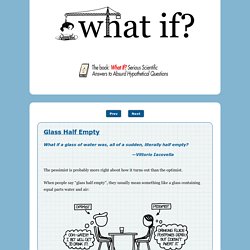
—Vittorio Iacovella The pessimist is probably more right about how it turns out than the optimist. When people say “glass half empty”, they usually mean something like a glass containing equal parts water and air: Traditionally, the optimist sees the glass as half full while the pessimist sees it as half empty. This has spawned a zillion joke variants—e.g., the engineer sees a glass that’s twice as big as it needs to be, the surrealist sees a giraffe eating a necktie, etc. But what if the empty half of the glass were actually empty—a vacuum? The vacuum would definitely not last long. For our scenario, we’ll imagine three different half-empty glasses, and follow what happens to them microsecond by microsecond.
In the middle is the traditional air/water glass. We’ll imagine the vacuums appear at time t=0. For the first handful of microseconds, nothing happens. When the bottle is struck, it’s pushed suddenly downward.
Brian Josephson's home page. Latest | publications | videos/audios | astronomical | parapsychology | search | cultural How observers create reality Wheeler proposed that repeated acts of observation give rise to the reality that we observe, but offered no detailed mechanism for this.

In this paper this creative process is accounted for on the basis of the idea that nature has a deep technological aspect that evolves as a result of selection processes that act upon observers making use of the technologies, leading to the conclusion that our universe is the product of agencies that use these evolved technologies to suit particular purposes. Link of the day: The latest issue of Current Science features a special section on Low Energy Nuclear Reactions (cold fusion) research.
Previous 'links of the day' are available in this archive. Latest publication: Biological Observer-Participation and Wheeler's 'Law without Law' The publications list has been reorganised. Cultural Area.
相對論. 時空旅行.