
Muzio Gambit. Scotch Gambit. Chess Traps- Fishing Pole. Kings Gambit, Muzio Gambit. Available languages: Schach - Deutsch Шахматы - Русский Шахи - Українська Chess - English Ajedrez - Español Échecs - Français Scacchi - Italiano Sakk - Magyar Schaken - Nederlands Szachy - Polski Help us finish translating: My language is not listed We are working hard to make Chess.com available in over 70 languages.

Check back over the year as we develop the technology to add more, and we will try our best to notify you when your language is ready for translating! Chess Openings- The King's Gambit. Encyclopaedia of Chess Openings. ECO volume E.

The first line of moves means that it contains openings beginning 1.d4 Nf6 2.c4 e6. The second line means it contains openings with 1.d4 Nf6 2.c4 g6, without an early d7–d5. The Encyclopaedia of Chess Openings (or ECO) is a classification system for the opening moves in chess. It is presented as a five-volume book collection (now also a computer database) describing chess openings. The moves were taken from hundreds of thousands of games between masters, from published analysis in the Chess Informant since 1966, and then compiled by notable chess players.
The books contain only a small amount of text, which is in eight languages. Instead of the traditional names for the openings, ECO has developed a unique coding system that has also been adopted by other chess publications. ECO code is a registered trademark of Chess Informant. Openings covered[edit] Volume A: Flank openings[edit] Volume B: Semi-Open Games other than the French Defense[edit] Volume E: Indian Defenses[edit] The art of defense. Pascal's law about how to defy a huge pressureP Charbonneau vs Anand, 2006 (B44) Sicilian, 43 moves, 1-0 Single N holds 4 pawns!

T L Petrosian vs B Vuckovic, 2008 (D17) Queen's Gambit Declined Slav, 66 moves, 1/2-1/2 Defending with a pawn down on each side of the boardShirov vs Aronian, 2007 (C84) Ruy Lopez, Closed, 84 moves, 1/2-1/2 An unstoppable attack? (C34) King's Gambit Accepted, 23 moves, 1/2-1/2 Weathering the stormKasparov vs Petrosian, 1981 (D25) Queen's Gambit Accepted, 42 moves, 0-1 Another fierce attack stopped coldlySimagin vs Petrosian, 1955. Algebraic notation (chess) Algebraic notation Algebraic notation (or AN) is a method for recording and describing the moves in a game of chess.

It is now standard among all chess organizations and most books, magazines, and newspapers. In English-speaking countries, algebraic notation replaced the parallel method of descriptive notation, which became common in the 19th century and continued with sporadic use as recently as the 1980s or 1990s. European countries, except England, used algebraic notation before the period when descriptive notation was common.[1] Each square of the chessboard is identified by a unique coordinate pair—a letter and a number. Other languages may employ different letters, for example, French players use F for bishop (from fou). En passant captures are indicated by specifying the capturing pawn's file of departure, the "x", the destination square (not the square of the captured pawn), and (optionally) the suffix "e.p. " indicating the capture was en passant.[3] For example, exd6e.p. 2... 3. 10 Chess Openings to Know - Common Chess Openings.
There are an endless number of possible variations in chess, even after just a few moves have been played.
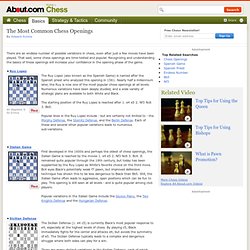
That said, some chess openings are time-tested and popular. Recognizing and understanding the basics of these openings will increase your confidence in the opening phase of the game. Ruy Lopez All diagrams © Ed Scimia The Ruy Lopez (also known as the Spanish Game) is named after the Spanish priest who analyzed this opening in 1561. The starting position of the Ruy Lopez is reached after 1. e4 e5 2. Popular lines in the Ruy Lopez include - but are certainly not limited to - the Morphy Defense, the Steinitz Defense, and the Berlin Defense.
Italian Game.