
20 Drupal Modules to Boost Your Website’s Functionality. By Monica S.
Flores Drupal is a robust content management system that can do nearly anything you throw at it. Hundreds of Drupal modules–add-ons that extend the functionality of Drupal core–exist to help you create a powerful website. This is a roundup of some excellent Drupal modules covering the following areas: Managing and displaying contentUser engagement and game mechanicsUser registration Managing and Displaying Content 1. In many pre-built Drupal themes, the primary navigation bar (typically displayed across the top of the page) shows only top-level links. However, with the Menu Block Drupal module, you can easily add a new block that pulls all relevant navigation links together, and then you can place that new block anywhere on the page–in the content section, for example, or perhaps in the left or right sidebar.
Here’s a menu block set-up page that pulls links from the equivalent navigation menu and displays it as specified: 2. 3. Some ideas: 4. 5. Caching: Modules that make Drupal scale. There are many ways to improve the performance & scalability of Drupal.
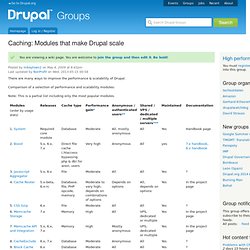
Comparison of a selection of performance and scalability modules: Note: This is a partial list including only the most popular modules. Notes (*) Performance gain is moderate for the default database cache, and usually high for file, PHP opcode, proxy and memory caches if affecting most data. The use of cache reduces PHP processing and/or database querying, and therefore increases speed, performance and scalability. (**) Often, two or more complementary caches can be used at the same time, for anonymous and authenticated users. (***) File and database caches can be used with all hosting types, including shared. Descriptions Authcache offers page caching for both anonymous users and logged-in authenticated users. Modules for monitoring and troubleshooting Performance benchmarks See also To do List of requirements of each package: memory, etc...
Additional modules Several cache technologies: 6 ways to make Drupal easier for non-technical admins. Over the years, I've created a list of ways to make Drupal easier for one of my target audiences: the non-technical admins and editors that run the day-to-day operations of a website.
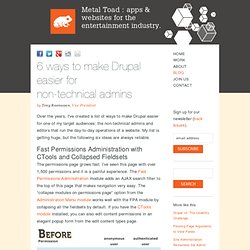
My list is getting huge, but the following six ideas are always reliable. Fast Permissions Administration with CTools and Collapsed Fieldsets The permissions page grows fast. I've seen this page with over 1,500 permissions and it is a painful experience. The Fast Permissions Administration module adds an AJAX search filter to the top of this page that makes navigation very easy. Panels with inline contextual links Protest your inner desire to create custom page callbacks. Hierarchical Select The Hierarchical Select module hits a few birds with one stone. Better Formats Input Formats have confused just about every non-technical admin I have ever met. Rubik + Vertical Tabs Rubik has reduced the Drupal learning curve of many non-technical admins. Admin Views (a submodule of Administration Menu module)