
LA84. Olympic Results. Ancient Olympic Games. During the celebration of the games, an Olympic Truce was enacted so that athletes could travel from their countries to the games in safety.
The prizes for the victors were olive leaf wreaths or crowns. The games became a political tool used by city-states to assert dominance over their rivals. Politicians would announce political alliances at the games, and in times of war, priests would offer sacrifices to the gods for victory. The games were also used to help spread Hellenistic culture throughout the Mediterranean. The Olympics also featured religious celebrations and artistic competitions. Origins An artist's impression of ancient Olympia Another myth, this one occurring after the aforementioned myth, is attributed to Pindar. History. Ancient Olympics. Ceremonies. Olympic Games ceremonies were an integral part of the Ancient Olympic Games.
Some of the elements of the modern ceremonies harken back to the Ancient Games from which the Modern Olympics draw their ancestry. An example of this is the prominence of Greece in both the opening and closing ceremonies. Summer. The Summer Olympic Games or the Games of the Olympiad (French: Jeux olympiques d'été [1]), first held in 1896, are an international multi-sport event, occurring every four years, organized by the International Olympic Committee.
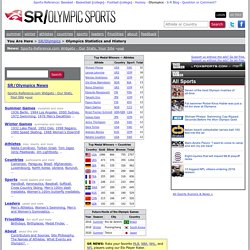
Medals are awarded in each event, with gold medals for first place, silver for second and bronze for third, a tradition that started in 1904. The Winter Olympic Games were also created due to the success of the Summer Olympics. The Olympics have increased from a 42-event competition with fewer than 250 male athletes from 14 nations to a 300-event sporting celebration with over 10,000 competitors from 205 nations. Organizers for the 2008 Summer Olympics in Beijing expected approximately 10,500 athletes to take part in the 302 events on the program for the games.[2] The United States has hosted four Summer Olympic Games, more than any other nation. Qualification[edit] History[edit] Early years[edit] Dorando Pietri finishes the modern marathon at the current distance. Winter. Reference. Summer Games medalists and more1936 Berlin, 1984 Los Angeles, 2000 Sydney, 1972 Swimming, 1976 Men's Decathlon … Winter Games summaries and more1932 Lake Placid, 1952 Oslo, 1998 Nagano, 1980 Speed Skating, 1988 Women's Downhill … Athletes bios, results, and moreNadia Comăneci, Torben Grael, Tom Jager, Jerzy Pawłowski, Jim Lightbody, … Countries participants and moreCameroon, Paraguay, Brazil, Afghanistan, Luxembourg, North Korea, Ukraine, Burundi, … Sports medal leaders and moreHandball, Aeronautics, Baseball, Softball, Cross Country Skiing, Men's 100m dash medalists, Women's 100m butterfly medalists, … Leaders career and moreMen's Athletics, Women's Swimming, Men's and Women's Gymnastics, …
Sports. Olympic sports are sports contested in the Summer and Winter Olympic Games.
The 2012 Summer Olympics included 26 sports, with two additional sports due to be added to the 2016 Summer Olympics. The 2014 Winter Olympics will include seven sports.[1] The number and kinds of events may change slightly from one Olympiad to another. Each Olympic sport is represented by an international governing body, namely an International Federation (IF).[2] Previous Olympic Games included sports which are no longer present on the current program, like polo and tug of war.[5] These sports, known as "discontinued sports", were later removed either because of lack of interest or absence of an appropriate governing body.[2] Archery and tennis are examples of sports that were competed at the early Games and were later dropped by the IOC, but managed to return to the Olympic program (in 1972 and 1988, respectively).
Medalists. This article includes lists of all Olympic medalists since 1896, organized by each Olympic sport or discipline, and also by Olympiad.
Medalist with most medals by sport[edit] Summer Olympic sports[edit] Winter Olympic sports[edit] ^ A. Including military patrol event at 1924 Games, which IOC now refers to biathlon.^ B. Discontinued summer sports[edit] Medalist with most medals by Olympiad[edit] Cities. Since the Modern Olympics began in 1896, there have been 27 Summer Olympic Games held in 22 different cities and 22 Winter Olympic Games held in 19 different cities.
In addition, three summer and two winter editions of the Games were scheduled to take place but were later cancelled due to war: Berlin (summer) in 1916, Tokyo (summer) and Sapporo (winter) in 1940, and London (summer) and Cortina d'Ampezzo, Italy (winter) in 1944. Olympic Games. The modern Olympic Games (French: Jeux olympiques[1]) are the leading international sporting event featuring summer and winter sports competitions wherein thousands of athletes variously compete.
The Olympic Games are considered the world's foremost sports competition with more than 200 nations participating.[2] The Olympic Games are held every four years, with the Summer and Winter Games alternating by occurring every four years but two years apart. IOC - Wiki. Coordinates: The International Olympic Committee (IOC) (French: Comité international olympique, CIO) is a Swiss non-profit, non-governmental organization based in Lausanne, Switzerland, created by Pierre, Baron de Coubertin, on 23 June 1894 with Demetrios Vikelas as its first president.
Today its membership consists of 100 active members, 33 honorary members, and 1 honour member. IOC.