
Cognitive bias cheat sheet. RSA Animate: The Truth About Dishonesty. This column will change your life: why are ethicists so unethical? Michael Shermer: The pattern behind self-deception. Need to Solve a Personal Problem? Try a Third-Person Perspective - Association for Psychological Science. Surprise journal: Notice the unexpected to fight confirmation bias for science and self-improvement. Photo by Ridofranz/Thinkstock If I could ensure that kids come away from science class with one thing only, it wouldn’t be a set of facts.

It would be an attitude—something that the late physicist Richard Feynman called “scientific integrity,” the willingness to bend over backward to examine reasons your pet theories about the world might be wrong. The Value of “Cognitive Humility” Researchers Find Everyone Has a Bias Blind Spot-CMU News. Monday, June 8, 2015 It has been well established that people have a “bias blind spot,” meaning that they are less likely to detect bias in themselves than others.
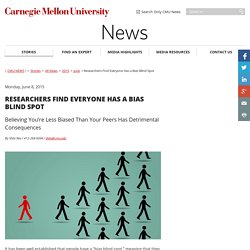
However, how blind we are to our own actual degree of bias, and how many of us think we are less biased than others have been less clear. Published in Management Science, researchers from Carnegie Mellon University, the City University London, Boston University and the University of Colorado, Boulder, have developed a tool to measure the bias blind spot, and revealed that believing you are less biased than your peers has detrimental consequences on judgments and behaviors, such as accurately judging whether advice is useful. Explaining the Unexplainable - Issue 4: The Unlikely. During the Enlightenment, the French philosopher Voltaire called superstition a “mad daughter” and likened it to astrology.

The leading thinkers of the time espoused reason and sought to explain the world through the scientific method. Today, we take a certain pride in approaching the world analytically. When faced with a confusing event, we search for its cause and effect. No coincidence? Statistics and the outrageously unlikely - physics-math - 18 March 2014. By Jonathon Keats In his superlative The Improbability Principle, David J.
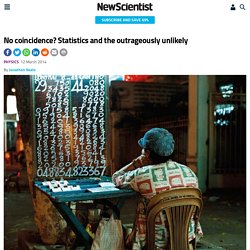
Hand makes sense of bizarre patterns in Bible codes, lightning strikes and even drug trials. THE WORLD QUESTION CENTER 2011— Page 1. GEORGE LAKOFF Cognitive Scientist and Linguist; Richard and Rhoda Goldman Distinguished Professor of Cognitive Science and Linguistics, UC Berkeley; Author, The Political Mind Conceptual Metaphor Conceptual Metaphor is at the center of a complex theory of how the brain gives rise to thought and language, and how cognition is embodied.

All concepts are physical brain circuits deriving their meaning via neural cascades that terminate in linkage to the body. That is how embodied cognition arises. Primary metaphors are brain mappings linking disparate brain regions, each tied to the body in a different way. Complex conceptual metaphors arise via neural bindings, both across metaphors and from a given metaphor to a conceptual frame circuit. Cognitive biases potentially affecting judgment of global risks.
List of cognitive biases. Systematic patterns of deviation from norm or rationality in judgment Cognitive biases are systematic patterns of deviation from norm and/or rationality in judgment. They are often studied in psychology, sociology and behavioral economics.[1] Although the reality of most of these biases is confirmed by reproducible research,[2][3] there are often controversies about how to classify these biases or how to explain them.[4] Several theoretical causes are known for some cognitive biases, which provides a classification of biases by their common generative mechanism (such as noisy information-processing[5]).
Gerd Gigerenzer has criticized the framing of cognitive biases as errors in judgment, and favors interpreting them as arising from rational deviations from logical thought.[6] Explanations include information-processing rules (i.e., mental shortcuts), called heuristics, that the brain uses to produce decisions or judgments.
Belief, decision-making and behavioral[edit] Social[edit] [edit] Science confirms: Politics wrecks your ability to do math. Everybody knows that our political views can sometimes get in the way of thinking clearly.
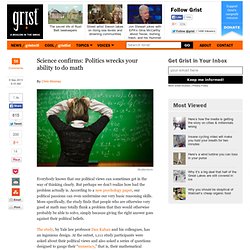
But perhaps we don’t realize how bad the problem actually is. According to a new psychology paper, our political passions can even undermine our very basic reasoning skills. More specifically, the study finds that people who are otherwise very good at math may totally flunk a problem that they would otherwise probably be able to solve, simply because giving the right answer goes against their political beliefs.
8 Common Thinking Mistakes Our Brains Make Every Day and How to Prevent Them. 12.3K Flares Filament.io 12.3K Flares ×
Seven tricks your brain is playing on you. (NaturalNews) We all want to believe we are tough to fool.
The problem is, even if you are not so gullible, your brain still works a certain way, making associations that create vulnerability to being easily fooled, or fooling yourself. It takes work to release yourself from these natural assumptions that are presumed to originate from a mix of hard wiring and cultural conditioning. Getting beyond them is surely a worthwhile thing to do, however. Teller Reveals His Secrets. The Strange Powers of the Placebo Effect. How Our Delusions Keep Us Sane: The Psychology of Our Essential Self-Enhancement Bias. You Are Not So Smart.
Emotional Economics. OVERVIEW. Applied Bayes' Theorem: Reading People. Why Intelligent People Drink More Alcohol. Drinking alcohol is evolutionarily novel, so the Hypothesis would predict that more intelligent people drink more alcohol than less intelligent people.
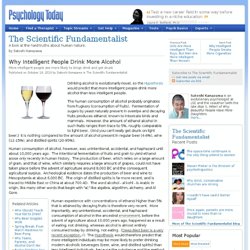
The human consumption of alcohol probably originates from frugivory (consumption of fruits). Fermentation of sugars by yeast naturally present in overripe and decaying fruits produces ethanol, known to intoxicate birds and mammals. However, the amount of ethanol alcohol in such fruits ranges from trace to 5%, roughly comparable to light beer. (And you can't really get drunk on light beer.) It is nothing compared to the amount of alcohol present in regular beer (4-6%), wine (12-15%), and distilled spirits (20-95%). Michael Lewis on the King of Human Error. We’re obviously all at the mercy of forces we only dimly perceive and events over which we have no control, but it’s still unsettling to discover that there are people out there—human beings of whose existence you are totally oblivious—who have effectively toyed with your life.
I had that feeling soon after I published Moneyball. The book was ostensibly about a cash-strapped major-league baseball team, the Oakland A’s, whose general manager, Billy Beane, had realized that baseball players were sometimes misunderstood by baseball professionals, and found new and better ways to value them. The book attracted the attention of a pair of Chicago scholars, an economist named Richard Thaler and a law professor named Cass Sunstein (now a senior official in the Obama White House). “Why do professional baseball executives, many of whom have spent their lives in the game, make so many colossal mistakes?” They asked in their review in The New Republic. The Pyschology of Human Misjudgment by Charlie Munger. The Most IMPORTANT Video You'll Ever See (part 1 of 8)
How Your Brain Decides Without You - Issue 19: Illusions.