
Eye of Horus. The Wedjat, later called The Eye of Horus The Eye of Horus is an ancient Egyptian symbol of protection, royal power and good health. The eye is personified in the goddess Wadjet (also written as Wedjat,[1][2][3] or "Udjat",[4] Uadjet, Wedjoyet, Edjo or Uto[5]). It is also known as ''The Eye of Ra''.[6] Funerary amulets were often made in the shape of the Eye of Horus. The Wadjet or Eye of Horus is "the central element" of seven "gold, faience, carnelian and lapis lazuli" bracelets found on the mummy of Shoshenq II.[3] The Wedjat "was intended to protect the pharaoh [here] in the afterlife"[3] and to ward off evil. Horus[edit] Horus was the ancient Egyptian sky god who was usually depicted as a falcon, most likely a lanner or peregrine falcon.[10] His right eye was associated with the sun god, Ra.
The eye as hieroglyph and symbol[edit] Mathematics[edit] Arithmetic values represented by parts of the Eye of Horus Fractions drawn as portions of a square. Typhon. Typhon was described in pseudo-Apollodorus, Bibliotheke, as the largest and most fearsome of all creatures.
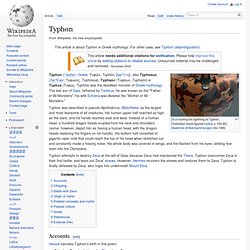
His human upper half reached as high as the stars, and his hands reached east and west. Instead of a human head, a hundred dragon heads erupted from his neck and shoulders (some, however, depict him as having a human head, with the dragon heads replacing the fingers on his hands). His bottom half consisted of gigantic viper coils that could reach the top of his head when stretched out and constantly made a hissing noise. His whole body was covered in wings, and fire flashed from his eyes, striking fear even into the Olympians. Accounts[edit] Hesiod narrates Typhon's birth in this poem: mother Earth bore her youngest child Typhoeus of the love of Tartarus, by the aid of golden Aphrodite.
—Hesiod, Theogony 820–822. Offspring[edit] Battle with Zeus[edit] Typhon started destroying cities and hurling mountains in a fit of rage. Origin of name[edit] Related concepts and myths[edit] Sopona. This carved wooden statue of Sopona was one of approximately 50 created by a traditional healer as commemorative objects for the CDC, WHO, and other public health experts attending a 1969 conference on smallpox eradication.
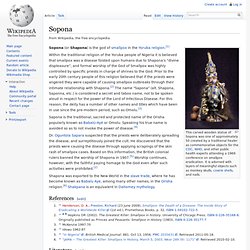
It is adorned with layers of meaningful objects such as monkey skulls, cowrie shells, and nails. Sopona (or Shapona) is the god of smallpox in the Yoruba religion.[1] Within the traditional religion of the Yoruba people of Nigeria it is believed that smallpox was a disease foisted upon humans due to Shapona’s “divine displeasure”, and formal worship of the God of Smallpox was highly controlled by specific priests in charge of shrines to the God. Prior to the early 20th century people of this religion believed that if the priests were angered they were capable of causing smallpox outbreaks through their intimate relationship with Shapona.[2] The name "Sapona" (alt. Dr. References[edit] Jump up ^ Henderson, D.