
Apiaceae. Lovage. Lovage (/ˈlʌvɨdʒ/), Levisticum officinale, is a tall perennial plant, the sole species in the genus Levisticum in the family Apiaceae, subfamily Apioideae, tribe Apieae.[1][2] Distribution[edit] Characteristics[edit] Lovage flowers Lovage is an erect, herbaceous, perennial plant growing to 1.8–2.5 m tall, with a basal rosette of leaves and stems with further leaves, the flowers being produced in umbels at the top of the stems.

The stems and leaves are shiny glabrous green to yellow-green and smell of lime when crushed. Uses[edit] The leaves can be used in salads, or to make soup or season broths, and the roots can be eaten as a vegetable or grated for use in salads. The roots, which contain a heavy, volatile oil, are used as a mild aquaretic. Etymology[edit] Leaf Lovage plant References[edit] Jump up ^ Pimenov, M. External links[edit] Media related to Levisticum officinale at Wikimedia Commons. RHS Plant Selector Angelica gigas. Aegopodium podagraria. Aegopodium podagraria L. commonly called ground elder, herb gerard, bishop's weed, goutweed, and snow-in-the-mountain, is a perennial plant in the carrot family (Apiaceae) that grows in shady places.

The name "ground elder" comes from the superficial similarity of its leaves and flowers to those of elder (Sambucus), which is unrelated. It is the type species of the genus Aegopodium. This species is native to Eurasia, and has been introduced around the world as an ornamental plant, where it occasionally poses an ecological threat as an invasive exotic plant.[1] Description[edit] A. podagraria is perennial, growing to a height of 100 cms with rhizomes.
Invasive habit[edit] Seed dispersal and seedling establishment is typically limited by shading, and new establishments from seed are restricted to disturbed areas. Status as an invasive exotic plant[edit] Control[edit] Once established, goutweed is difficult to eradicate. Cicuta. Cicuta, commonly known as water hemlock, is a small genus of four species of highly poisonous plants in the family Apiaceae.

They are perennial herbaceous plants which grow up to 2.5 meters (8.2 ft) tall, having distinctive small green or white flowers arranged in an umbrella shape (umbel). Plants in this genus may also be referred to as cowbane or poison parsnip. Cicuta is native to temperate regions of the Northern Hemisphere, mainly North America and Europe, typically growing in wet meadows, along streambanks and other wet and marshy areas.
These plants bear a close resemblance to other members in the family Apiaceae and may be confused with a number of other edible and poisonous plants. The common name hemlock may also be confused with poison hemlock (Conium maculatum). Caraway. The plant is similar in appearance to other members of the carrot family, with finely divided, feathery leaves with thread-like divisions, growing on 20–30 cm stems.

The main flower stem is 40–60 cm tall, with small white or pink flowers in umbels. Caraway fruits (erroneously called seeds) are crescent-shaped achenes, around 2 mm long, with five pale ridges. Names and history[edit] The etymology of caraway is complex and poorly understood. Caraway has been called by many names in different regions, with names deriving from the Latin cuminum (cumin), the Greek karon (again, cumin), which was adapted into Latin as carum (now meaning caraway), and the Sanskrit karavi, sometimes translated as "caraway" but other times understood to mean "fennel".[7] English usage of the term caraway dates back to at least 1440,[8] and is considered by Skeat to be of Arabic origin, though Katzer believes the Arabic al-karawya (cf.
Uses[edit] Caraway fruits A magnified view of caraway fruits used as a spice. Fennel. It is a highly aromatic and flavorful herb with culinary and medicinal uses and, along with the similar-tasting anise, is one of the primary ingredients of absinthe.
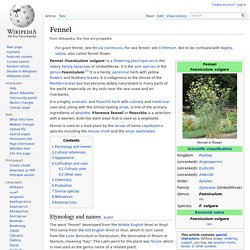
Florence fennel or finocchio is a selection with a swollen, bulb-like stem base that is used as a vegetable. Fennel is used as a food plant by the larvae of some Lepidoptera species including the mouse moth and the anise swallowtail. Etymology and names[edit] The word "fennel" developed from the Middle English fenel or fenyl. This came from the Old English fenol or finol, which in turn came from the Latin feniculum or foeniculum, the diminutive of fenum or faenum, meaning "hay".
Cultural references[edit] Fennel, from Koehler's Medicinal-plants (1887)