
Internet+minute+1.jpg (JPEG Image, 830x600 pixels) The Internet Map: 350,000 Websites In 1 Stunning Visualization. What’s the relationship between the BBC and Amazon? What about Edudemic and Baidu? Scratching your head yet? The answers can be found in an incredible interactive new tool called The Internet Map . The Internet Map displays 350,000 websites based on their popularity and relativity. For example, there’s a whole universe built around mega-sites like Twitter , Craigslist , and Facebook . I’ve honestly never seen something so simple explain something so complicated. Wondering how the map works? Like any other map, The Internet map is a scheme displaying objects’ relative position; but unlike real maps (e.g. the map of the Earth) or virtual maps (e.g. the map of Mordor), the objects shown on it are not aligned on a surface.
A Map of the Internet. I recently discovered this map of the internet through Stephen Downes’ newsletter, OLDaily.

Downes says, “It’s mostly eye-candy, but it’s good eye-candy”. I prefer to think of it as “interesting” eye-candy. It’s visually attractive, but what I find interesting is the fact that the descriptions are not necessarily value-free. The Outernet. Internet on rikki: Se tarjoaa ihmisille vain sen, minkä arvelee heidän tarvitsevan. Onko nettilogiikka tieteen tuho? The Top 3.77 Annoying Things About Top Lists. Can We Win the Race Against the Machines? What's the Big Idea? The concept of man versus machine is at least as old as the industrial revolution, but this phenomenon tends to be most acutely felt during economic downturns and fragile recoveries. And yet, it would be a mistake to think we are right now simply experiencing the painful side of a boom and bust cycle.
Certain jobs have gone away for good, outmoded by machines. Since technology has such an insatiable appetite for eating up human jobs, this phenomenon will continue to restructure our economy in ways we can't immediately foresee. When there is exponential improvement in the price and performance of technology, jobs that were once thought to be immune from automation suddenly become threatened. It’s our duty — all of us — to fight for the open web. When you use an app, or a platform like a mobile phone, or a social network, or a web service — whether it’s from Google or Apple or Amazon or Facebook — do you think about the extent to which it is open or closed?
Or do you just think about how it looks, or what it lets you do, or whether your friends are using it? Most of us probably fall into the latter category, but as veteran blogger Anil Dash and others have pointed out recently, there are some good reasons why we should care about the future of the open web, and be concerned about a trend towards more closed networks. As natural as that trend might be from a commercial point of view, it is the antithesis of what made the internet so powerful. 1) Control over our online identities 2) Control over our personal data. Internet : les empires contre-attaquent. 10 Ways The Internet Is Bad For You. Do you sometimes feel fatigued and worn out after prolonged Internet usage? Do you think looking up medical answers is making you healthier?
A new infographic might be a bit alarming for you. See Also: How To Avoid The Dangers Of Sitting For Long Periods If you’re a connected educator or student, you already know that sitting for extended periods is bad for your health, your eyes can suffer from being strained, and more. But what about the long-term side effects of using the Internet? Source: Insurance.com. Tussitaikurit - Hukutaan informaatiotulvaan. - Comment ne pas sombrer sous l’information ? Le flot continu de l’info – Crédit ©steeljam via flickr.com Nous n’avons jamais eu autant de sources d’information à notre disposition.
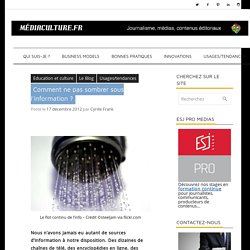
Des dizaines de chaînes de télé, des encyclopédies en ligne, des journaux gratuits sur Internet. Oletko sinä tietämättäsi nettihyökkääjä? Détecter les faux avis en ligne. Détecter les faux avis en ligne Les achats sur internet représentent aujourd’hui une très grosse part de marché pour les entreprises et pour vous une chance de pouvoir acheter un produit désiré à faible prix ou sur un coup de tête.
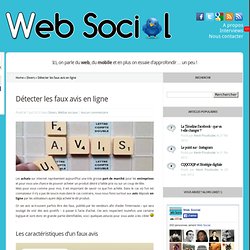
Mais pour vous comme pour moi, il est important de savoir ce que l’on achète. Dans le cas où l’on est connaisseur il n’y a pas de soucis mais dans le cas contraire, nous nous fions surtout aux avis déposés en ligne par les utilisateurs ayant déjà acheté le-dit produit. Are trolls killing the internet? (with images, tweets) · ajstream. Don’t feed the troll. Don’t feed the troll N’y voyez aucun rapport avec les chères créatures que vous pourrez trouver dans de nombreux ouvrages comme par exemple Le Seigneur des Anneaux de J.R.R Tolkien.

Le troll présent dans la Moria n’a en effet aucune raison d’être ici si ce n’est pour aiguillez vos sens et associer une image aux personnes/messages que nous allons commencer à décrire. Why Do Internet Trolls Exist? [INFOGRAPHIC] As you've probably discovered, there are people lurking all over the web who find great joy in humiliating and attacking others.
![Why Do Internet Trolls Exist? [INFOGRAPHIC]](http://cdn.pearltrees.com/s/pic/th/internet-trolls-infographic-51134730)
This insightful infographic describes the inner workings of Internet trolls, explaining why they decide to spend their online time in attack mode. Tapping the expertise of psychologists and experts, it offers solid reasons why this scourge of the Internet continues. We all like to think that most people mean well, and are inherently good. Even if that's true, the infographic shows us instances where even some good people can quickly turn bad, all because of a variety of situations related to mob behavior. Så lällällällällieru för såna som hatar! #vihapuhe #näthat. About these ads Tykkäätkö? Jaa Tykkää tästä: This entry was posted in Argh! , Kielet . Vastaa. Jyrki Kasvi: Strategia joka katosi. Digitaalisesta rintamasta on tullut osa turvallisuuspolitiikkaa.

Kyberturvallisuutta kansalaisen näkökulmasta. Minulta kysytään usein, pitääkö yksittäisen kansalaisen ymmärtää jotain kyberturvallisuudesta.

Hakkeri murtaa liian helpon salasanan muutamassa tunnissa - Tekniikka - Päivän lehti. Sinä päätät. A Letter To Parents Of Digital Age Children. A Letter To Parents Of Digital Age Children by Susan Lucille Davis first appeared on gettingsmart.com First, let me thank you for entrusting me with teaching your children, honoring the amazing individuals they are, and helping them discover the confident and empowered young people they can be.

Providing a rich and engaging environment for your children to learn in is my utmost concern, but Iately I have had to acknowledge that the young people I see every day do much of the learning that is important to them when they leave the parking lot and head home from school. Thus, I am writing to solicit your help. FOSI - Go Figure 3. 5 Ways to Use the Internet for Self-Improvement. For most, the Internet has become a ubiquitous part of daily life.

Many people work online all day and then spend evenings streaming movies. With the convenience of online banking, fewer customers step inside their local banks, while millions of shoppers make purchases without leaving home. And the Internet has replaced the phone as a quick way to stay in touch with family and friends. Kun virtuaalinen ja todellinen sekoittuvat. Elämme hurjan mielenkiintoista aikaa. Disruptio ja miten tulla toimeen sen kanssa.
Muutosvastarinta. Yksi käyttää ja toinen ei. Nimittäin Evernotea, Google Plussaa, Dropboxia, Facebookia, Twitteriä, Flickriä. Yksi twiittaa, bloggaa ja livestriimaa, toinen ei ole sellaisesta kuullutkaan. Kotitietokone on hankala perintökalleus. Top 10 Good Tech Habits Everyone Should Have. Number 9 is a good one to keep in mind. There is a very popular store which I almost referred to as a retail outlet. I had to correct myself because I have known them to charge more than the Manufactured Suggested Retail Price, which should be the most that anyone should reasonably pay for any non-difficult-to-find item. They also have another shady practice. How Much Does The Web Know About You? Have you ever googled your own name or that of someone else? About two years ago I searched the name of a friend. I was hoping to find his travel photos, but what I discovered were his criminal records.
9 Tips to Stay Safe on Public Wi-Fi. Your bank calls you to verify your recent $750 bill at an out-of-state Taco Bell, but you haven’t left town in weeks. You quickly contest the charge and request a new credit card, but when you check your wallet the compromised card is still there. You try to think of shady ATMs or recent cashiers, but nothing comes to mind. Nothing, except the online purchase you made while browsing the Internet at your local coffee shop. The number of free public Wi-Fi hotspots is growing, but not every hotspot can provide the protection of a private home network. Is a File System Just a Bunch of Folders? (File Systems Explained) Hanki dataa – hankit samalla valtaa - Tiede - Päivän lehti. CSS:ää humanisteille. 5 Ways Rapid Technology Change Impacts Education. The Single Biggest Benefit Of Early Technology Adoption. Les chroniques suédoises.