
Flow Learning: A New Teaching Phenomenon. Joseph Cornell, author of six books and founder of the Sharing Nature Foundation, is a steady, gentle man with an eye for the beauty in life and the enthusiasm to share his vision.
In his depth of perception he reminds us of the renowned naturalist John Muir. Cornell illustrates his teaching method, called Flow Learning™, largely through illustrations drawn from the teaching of Nature. But Flow Learning is currently being used by thousands of teachers in scores of countries, not only for science but for all subjects — even mathematics. His first book, Sharing Nature with Children, has been published in over fifteen foreign languages and is used by parents and teachers all over the globe.
Lora: In a review of Sharing Nature with Children I read that your ideas have sparked a worldwide revolution in nature education. Joseph: For a long time, people have related to Nature scientifically, trying to understand it with the mind. Lora: That's beautiful. The second stage is to focus attention. Educational Networking: The Important Role Web 2.0 Will Play in Education. Connected Learning: The Power Of Social Learning Models. Connected-Learning-Model. A Visual: The Workflow of Social Learning. Paras tapa oppia yksilöllisesti: PLE. Verkko-opiskelun keskeinen lupaus on yksilöllisyyden lisääntyminen.
Siihen kuuluvat mm. henkilökohtaiset oppimispolut, opiskelu omaan tahtiin ja itse valituilla välineillä. Faciliter le travail étudiant avec Pearltrees. Recherche documentaire, travail à distance, Internet est vite indispensable et regorge d’outils, parfois peu connus, qui peuvent faciliter le travail étudiant.
Il vous est déjà arrivé de perdre un lien, de vous lancer dans une recherche documentaire et de vous perdre dans les onglets ? En 2009 Patrice Lamothe lance Pearltrees et réactualise le vieux système des favoris. Gratuit, il est en outre facile à apprivoiser. L'inscription peut se faire via les réseaux sociaux. N'importe quel internaute peut organiser des liens, notes ou même photos comme il le souhaite. «Je l'utilise assez régulièrement, surtout pour être certain de ne pas perdre telle ou telle page internet, pour m'assurer que mes pages favorites restent en sécurité.» confie Romain, étudiant. Un outil collaboratif L'outil facilite également le travail en groupe, une fois un «arbre» créé, il est possible d'inviter n'importe quelle personne à le compléter.
L'inscription est simple et peut se faire via les réseaux sociaux. The 6 Hottest Teaching Trends (And How Teachers Are Adopting Them) The Current State Of Technology In K-12 6.95K Views 0 Likes. 50 Education Technology Tools Every Teacher Should Know About. Technology and education are pretty intertwined these days and nearly every teacher has a few favorite tech tools that make doing his or her job and connecting with students a little bit easier and more fun for all involved. Yet as with anything related to technology, new tools are hitting the market constantly and older ones rising to prominence, broadening their scope, or just adding new features that make them better matches for education, which can make it hard to keep up with the newest and most useful tools even for the most tech-savvy teachers.
Here, we’ve compiled a list of some of the tech tools, including some that are becoming increasingly popular and widely used, that should be part of any teacher’s tech tool arsenal this year, whether for their own personal use or as educational aids in the classroom. Wikit opetuksessa ja yhteisöllisessä tuottamisessa. Social media helps schools build bridges SmartBlogs. Like all public entities, public schools are under attack from a skeptical public.
The talking point that resonates: The district needs to rein in costs and make do with what it has. All the while, a need for communication is increasing at an exponential rate. This means communicating with the public in ways that it wants to receive information immediately, in real time. Using Social Media In The Classroom For Real-World Learning. Engaging Students Through Social Media by Rob James first appeared on gettingsmart.com; Using Social Media In The Classroom For Real-World Learning Social media has become an essential part of most people’s everyday lives, from checking Facebook and Twitter to posting blogs, Pinterest listings, and uploading YouTube videos.
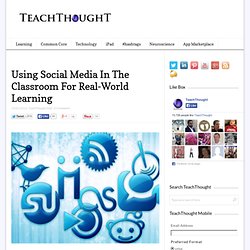
However, and with smartphones making it easier than ever to spend time on social media networks, in what ways can these networks be leveraged to engage and build a foundation for future student learning? While the potential of distraction is there, the right social media teaching strategies can lead to creative learning, and a productive approach to making social media part of ongoing professional development. 7 Ways Universities Can Effectively Use Social Media. The official opening of the Harvard Innovation Lab was shared all over social media channels. Source: Harvard Innovation Lab If compared to the majority of businesses out there, universities and colleges have an advantage when it comes to social media: the student community. For the majority of students, the years spent at university is usually one of the most important and remarkable times.
This makes it a good start point for colleges in social media – when you have a happy community of consumers who like what you have to offer, things are much easier. However, for colleges, the benefits of social media go beyond student and community engagement. Infographics. Some by Sini Ventä on Prezi.
Sosiaalisen median opetuskäytön pedagoginen suunnittelu. Kun sosiaalista mediaa halutaan soveltaa opetuksessa, on hyvä pohtia tarkkaan miksi uusia välineitä halutaan soveltaa ja mitä niiden avulla halutaan saada aikaan.
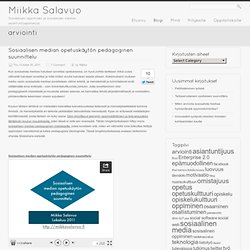
Miten arvioida sosiaalista mediaa hyödyntävää oppimistoimintaa? Arviointimalli. Someoppi. Edmodo verkkoympäristö opetuskäyttöön. Vuonna 2008 perustettu Edmodo on ilmainen koulujen käyttöön tarkoitettu amerikkalainen verkkosovellus.
Saamieni koulutuspyyntöjen perusteella työkalun suosio on kasvussa, joten päätin vihdoin kolme vuotta ensitestien jälkeen ottaa ympäristön koulutusrepertuaariini. Edmodon kasvava suosio ei ole ihme, sillä moni on kaivannut Facebookia muistuttavaa, mutta koulukäyttöön suunniteltua työkalua. Moni kysyy koulukäyttöön soveltuvaa sosiaalisen median alustaa. Ning ja Elgg ovat sitä, Edmodo on sitä varauksin. Oppimisen organisointia ja vuorovaikutusta Edmodolla.
PLN. Educators as Social Networked Learners. This fall, I am getting the opportunity to design and teach a graduate course for Boise State University’s Education Technology Program entitled, Social Networked Learning.
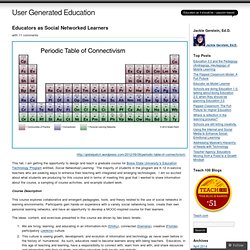
The majority of students in the program are K-12 in-service teachers who are seeking ways to enhance their teaching with integrated and emerging technologies. I am so excited about what students are producing for this course and in terms of meeting this goal that I wanted to share information about the course, a sampling of course activities, and example student work. Course Description This course explores collaborative and emergent pedagogies, tools, and theory related to the use of social networks in learning environments. 6 Ways For Teachers To Effectively Use Social Media. How Teachers Are Using Social Media Right Now. How Teachers Can Best Use Education Technology 4.66K Views 0 Likes Edtech isn't the final solution for education's problems. It's a powerful addition to classrooms though, so it's time to ask: what is the point of education technology?
25 Ways Teachers Can Integrate Social Media Into Education. 6 Things To Teach Students About Social Media. 10 Ways To Become A Better Online Learner 9.10K Views 0 Likes There are some quick and easy ways to become a better online learner. Whether you're taking a class or just researching, here are the DOs and DON'Ts. How to use Youtube Video Editor Tutorial - Edit Youtube Videos Online 2012. Cómo hacer in vídeo interactivo en Youtube. Youtube nos permite hacer un vídeo interactivo que nos permite enlazarlo conOtro vídeoUn canal de youtubeUna página o perfil de youtubeSuscribirse a nuestro canalRecaudar fondos para una causaAl elegirenlazar a un vídeo simplementeconstruir una historia interactiva en la que el espectador va eligiendo posibles desenlacesque los alumnos construyan una historia con desenlaces alternativos o cualquier otra cuestión que nuestra imaginación nos sugieraEs sencillo.
Veamos los pasos. 0. Vamos a uno de nuestros vídeos y picamos en editar. 0. Blubbr- Great Tool to Create Quizzes from YouTube Videos. Blubbr is a cool web tool that allows users to create quizzes around YouTube videos.
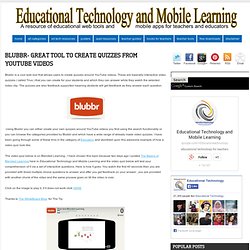
These are basically interactive video quizzes ( called Trivs ) that you can create for your students and which they can answer while they watch the selected video clip. The quizzes are also feedback supported meaning students will get feedback as they answer each question. Using Blubbr you can either create your own quizzes around YouTube videos you find using the search functionality or you can browse the categories provided by Blubbr and which have a wide range of already made video quizzes. I have been going through some of these trivs in the category of Education and stumbled upon this awesome example of how a video quiz look like. Click on the image to play it, if it does not work click HERE.
Blubbr. Proposer des quizz video a vos eleves. AVO Animoto. Popcorn Maker. 8 Great Tools for Teachers to Add Interactive Animations to Videos. Gone are the days when you would have to pay so much to buy a software to create videos. With web 2.0 tools you can get your videos up and viral within minutes and right from your browser without having to install any software and in most of the times for free. Educational Technology and Mobile Learning has reviewed several video creation tools over the past couple of years and you can check this section here for more resources. Today, I am sharing with you some cool web tools that you can use to add animation to your videos and render them much more interactive.
Check out the list below and don't forget to share with us your feedback. Enjoy. 5 Ways to Add Interactive Elements to Your Videos. Over the last few days I've featured a couple of free tools for adding interactive elements to your videos. In the last year I've reviewed a few other services and methods for doing the same thing. Viikon e-vinkki. Webinaariesiintyjän selviytymispaketti. StatusNet. Public timeline - Identi.ca. 10 Innovative Ways to Use ThingLink in the Classroom. Design Your Own Digital Self - A Guided Learning Adventure thinglinktoolkit.wikispaces.com Something I Enjoyed Watching: The Axis of Awesome: 4 Chords Original Music Video My Favorite Device: iPhone Earn a Badge for Digital Literacy soxnevad.edu.glogster.com My Blog: Cool Tools for 21st Century Learners d97cooltools.blogspot.com I blog on GettingSmart.com. Get Started with ThingLink.