
No es bueno para la salud mental pensar mucho, según estudio. Cerebellum: Development and Medulloblastoma. New neurons help us to remember fear. Fear burns memories into our brain, and new research by University of California, Berkeley, neuroscientists explains how.
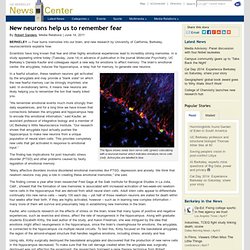
Scientists have long known that fear and other highly emotional experiences lead to incredibly strong memories. In a study appearing online today (Tuesday, June 14) in advance of publication in the journal Molecular Psychiatry, UC Berkeley’s Daniela Kaufer and colleagues report a new way for emotions to affect memory: The brain’s emotional center, the amygdala, induces the hippocampus, a relay hub for memory, to generate new neurons. The figure shows newly born nerve cells (green) colocalizing with a neuronal marker which indicates immature nerve cells (red). Astrocytes are labelled in blue. Revisiting philosophy with fMRI. Harvard University philosopher Joshua Greene, PhD, is working to resolve a long-standing philosophical paradox: Do people ultimately base their mature moral judgments on their passions, as sentimentalists such as 18th century David Hume argued, or on reason and logic, as rationalists such as Immanuel Kant believed?

To find out, Greene decided to tap a reliable research tool — fMRI — to look at people’s brains as they made decisions about some classic moral dilemmas. His work showed that both arguments are correct to some degree: In most situations, people appear to use logic, but there are times when emotions seem to override logic. Greene is among a growing faction of philosophers who are taking their field back to its empirical roots. For many, that means collaborating with psychologists, neuroscientists, anthropologists and economists who can help them design theoretically interesting, as well as methodologically sound, studies. Neuroimages of our morality.