
Permutation. The 6 permutations of 3 balls In mathematics , the notion of permutation is used with several slightly different meanings, all related to the act of permuting (rearranging) objects or values. Informally, a permutation of a set of objects is an arrangement of those objects into a particular order. For example, there are six permutations of the set {1,2,3}, namely (1,2,3) , (1,3,2), (2,1,3), (2,3,1), (3,1,2), and (3,2,1). For example, an anagram of a word is a permutation of its letters. The study of permutations in this sense generally belongs to the field of combinatorics . The number of permutations of n distinct objects is n ×( n − 1)×( n − 2)×⋯×2×1 , which is commonly denoted as " n factorial " and written " n !
". Permutations occur, in more or less prominent ways, in almost every domain of mathematics. In elementary combinatorics, the k -permutations, or partial permutations , are the sequences of k distinct elements selected from a set. . [ edit ] History [ edit ] Generalities. Calculating Permutations. The permutation of a set is the number of ways that the items in the set can be uniquely ordered.

For example, the permutations of the set { 1, 2, 3} are { 1, 2, 3}, { 1, 3, 2}, { 2, 1, 3}, { 2, 3, 1}, { 3, 1, 2} and { 3, 2, 1}. For N objects, the number of permutations is N! (N factorial, or 1 * 2 * 3 * ... N). Aside from theoretical interest in set theory, permutations have some practical use. Figure 1, An Omega permuation network, from Interconnection Networks: an engineering approach. by Duato, Yalamanchili and Ni, Morgan Kaufmann, 2003, Pg. 32 Permutation Algorithms and Job Interview Questions I wrote this web page as a result of a job interview. If you take a look at my resume you'll see that I've worked at a number of different companies, so I've done a fair amount of interviewing.
Those interviewing a candidate for a software engineering position understandably would like to discover whether the candidate can write software. The Microsoft style interview seems to be spreading. Content-based addressing. Handbook of Applied Cryptography. Alfred J.
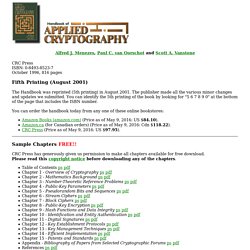
Menezes, CRC Press ISBN: 0-8493-8523-7 October 1996, 816 pages Fifth Printing (August 2001) The Handbook was reprinted (5th printing) in August 2001. The publisher made all the various minor changes and updates we submitted. You can identify the 5th printing of the book by looking for "5 6 7 8 9 0" at the bottom of the page that includes the ISBN number. You can order the handbook today from any one of these online bookstores: Amazon Books (amazon.com) (Price as of May 9, 2016: US $84.10). Amazon.ca (for Canadian orders) (Price as of May 9, 2016: Cdn $118.22).