
ITU: There Are Now Over 1 Billion Users Of Social Media Worldwide, Most On Mobile. What does it mean when Facebook says it has 901 million monthly active users on its network?

According to figures out from the International Telecommunication Union, it effectively signifies that Facebook is the world’s largest social network by a very long shot. The ITU says in a new report that that the number of people using all social media services have passed the 1 billion mark. That is just 100 million shy of Facebook’s usage figure, giving Facebook a 90 percent share of all social networkers. In contrast to the very biggest players of all — Facebook (900m+ users), Twitter (200m+ users) and LinkedIn (120m+ 150m+users) — the rest of the playing field is heavily localized, with services like QQ in China, Vkontakte in Russia, Mixi in Japan, and Google’s Orkut in Brazil, India, and Paraguay among those competing in the space, the ITU notes. But broadband growth remains very uneven. The Conversation Prism.
When Jesse Thomas and Brian Solis initially mapped "the conversation" in 2008, they recognized that the act of categorizing social networks within a visually rich graphic would be momentary at best.[2] Their goal has been to observe, analyze, dissect, and present the dynamics of conversations, how and where they transpired. They knew the graphic would demand endless iterations in order to accurately document evolving and shifting online conversations as well as the communities that promote them.
An updated "version 2.0" of The Conversation Prism was released in March 2009.[3] In 2013, "version 4.0" of The Conversation Prism was released.[4] The Conversation Prism has been translated into several languages other than English, including French and Japanese.[5] Services[edit] References[edit] External links[edit] The Conversation Prism by Brian Solis and JESS3. This is the first rev of Conversation Prism (1.0). 3.0 is Now Available - www.theconversationprism.com.
Social media. Diagram depicting the many different types of social media There are many effects that stem from internet usage.
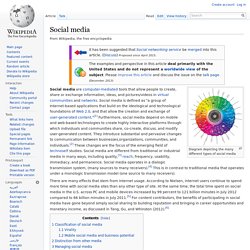
According to Nielsen, internet users continue to spend more time with social media sites than any other type of site. At the same time, the total time spent on social media in the U.S. across PC and mobile devices increased by 99 percent to 121 billion minutes in July 2012 compared to 66 billion minutes in July 2011.[5] For content contributors, the benefits of participating in social media have gone beyond simply social sharing to building reputation and bringing in career opportunities and monetary income, as discussed in Tang, Gu, and Whinston (2012).[6] Classification of social media[edit] Social media technologies take on many different forms including blogs, business networks , enterprise social networks, forums, microblogs, photo sharing, products/services review, social bookmarking, social gaming, social networks, video sharing and virtual worlds.[7] Memsic.ccsd.cnrs.fr/docs/00/57/42/59/PDF/CREFF.pdf.
Le design de la visibilité : un essai de typologie du web 2.0. La manière dont est rendue visible l’identité des personnes sur les sites du web 2.0 constitue l’une des variables les plus pertinentes pour apprécier la diversité des plateformes et des activités relationnelles qui y ont cours.
Que montre-t-on de soi aux autres ? Comment sont rendus visibles les liens que l’on a tissés sur les plateformes d’interaction ? Comment ces sites permettent-ils aux visiteurs de retrouver les personnes qu’ils connaissent et d’en découvrir d’autres ? Dominique Cardon, sociologue au laboratoire Sense d’Orange Labs, propose ici une typologie des plateformes relationnelles du web 2.0 qui s’organise autour des différentes dimensions de l’identité numérique et du type de visibilité que chaque plateforme confère au profil de ses membres.
La décomposition de l’identité numérique L’identité numérique est une notion très large. Le paravent. Le clair-obscur. Le phare. Le post-it. La lanterna magica. De cette typologie, on peut suggérer quatre lectures : 1. 2. 3. 23 Types of Social Media Sites. February 17th, 2010 | Wednesday is Friends Day It’s easier to navigate the maze of online social media sites if you understand the different site categories and the purpose of each type.

The social media world consists of two segments: social and media. To optimize your experience with each type of social media, it’s best to participate in the communities you choose to join. Panorama Medias Sociaux Midi Pyrenees. Votre agence web » Blog Archive » Social Media à l’honneur chez Bluevision. SocialMediaLandscape.jpg (600×450) Social media - Google Images.