
General relativity. General relativity, or the general theory of relativity, is the geometric theory of gravitation published by Albert Einstein in 1916[1] and the current description of gravitation in modern physics.
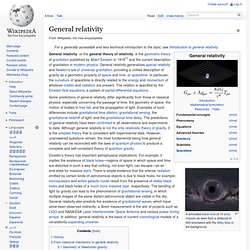
General relativity generalizes special relativity and Newton's law of universal gravitation, providing a unified description of gravity as a geometric property of space and time, or spacetime. In particular, the curvature of spacetime is directly related to the energy and momentum of whatever matter and radiation are present.
The relation is specified by the Einstein field equations, a system of partial differential equations. Supergravity. Gravitons[edit] History[edit] Gauge supersymmetry[edit] The first theory[1] of local supersymmetry was proposed in 1975 by Dick Arnowitt and Pran Nath and was called gauge supersymmetry.

Antigravity, Gravity Control. Introduction If you were born between 1930 something and 1960 you were a part of the ufo phenomenon that swept the world in the fifties.

And many contemplated the idea of antigravity such as Thomas Townsend-Brown and before him Nikola Tesla and before him John Worrell Keely, who takes us to a place before any of us were born, the 1880's.