
Māori language. Maori or Māori /ˈmaʊri/ is the Polynesian language of the indigenous Maori (Māori) ethnic group of New Zealand.
Since 1987, it has been one of New Zealand's official languages. It is a member of the Eastern Polynesian languages, closely related to Cook Islands Māori, Tuamotuan, and Tahitian. According to a 2001 survey on the health of the Māori language, the number of very fluent adult speakers was about 9% of the Māori population, or 29,000 adults.[3] A national census undertaken in 2006, however, suggested that the percentage was then about 4% of the entire New Zealand population,[4] or 23.7% of the Maori population.[5] Name[edit] The spelling "Maori" (without macron) is standard in English outside New Zealand in both general[6] and linguistic[7] usage. The English word comes from the Maori language, where it is spelled "Māori" and pronounced [ˈmaː.ɔ.ɾi]. Official status[edit] An interpreter is on hand at sessions of Parliament, in case a Member wishes to speak in Māori.
History[edit] The Origins of Writing. The alluvial plains of southern Mesopotamia in the later half of the fourth millennium B.C. witnessed a immense expansion in the number of populated sites.
Scholars still debate the reasons for this population increase, which seems to be too large to be explained simply by normal growth. One site, the city of Uruk, surpassed all others as an urban center surrounded by a group of secondary settlements. It covered approximately 250 hectares, or .96 square miles, and has been called "the first city in world history. " The site was dominated by large temple estates whose need for accounting and disbursing of revenues led to the recording of economic data on clay tablets. The city was ruled by a man depicted in art with many religious functions. Recent archaeological research indicates that the origin and spread of writing may be more complex than previously thought. This new way of interpreting signs is called the rebus principle. Cuneiform. Egyptian hieroglyphs. Etymology History and evolution Hieroglyphs emerged from the preliterate artistic traditions of Egypt.
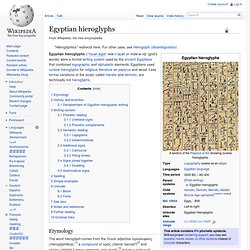
For example, symbols on Gerzean pottery from ca. 4000 BCE resemble hieroglyphic writing. In 1998, a German archaeological team under Günter Dreyer excavating at Abydos (modern Umm el-Qa'ab) uncovered tomb U-j of a Predynastic ruler, and recovered three hundred clay labels inscribed with proto-hieroglyphs, dating to the Naqada IIIA period of the 33rd century BCE.[5] The first full sentence written in hieroglyphs so far discovered was found on a seal impression found in the tomb of Seth-Peribsen at Umm el-Qa'ab, which dates from the Second Dynasty. Uraeus. The Uraeus is a symbol for the goddess Wadjet, who was one of the earliest Egyptian deities and who often was depicted as a cobra.
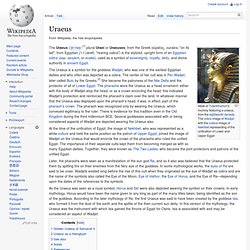
The center of her cult was in Per-Wadjet, later called Buto by the Greeks.[2] She became the patroness of the Nile Delta and the protector of all of Lower Egypt. The pharaohs wore the Uraeus as a head ornament: either with the body of Wadjet atop the head, or as a crown encircling the head; this indicated Wadjet's protection and reinforced the pharaoh's claim over the land. In whatever manner that the Uraeus was displayed upon the pharaoh's head, it was, in effect, part of the pharaoh's crown. The pharaoh was recognized only by wearing the Uraeus, which conveyed legitimacy to the ruler. There is evidence for this tradition even in the Old Kingdom during the third millennium BCE.
Golden Uraeus of Senusret II[edit] In 1919, after only a half-hour of excavation, the Qufti worker Hosni Ibrahim held in his hands the solid-gold Golden Uraeus of Senusret II. Pschent. The Pschent The Pschent represented the pharaoh's power over all of unified Egypt.[2] It bore two animal emblems: An Egyptian cobra, known as the uraeus, ready to strike, which symbolized the Lower Egyptian goddess Wadjet, and an Egyptian vulture representing the Upper Egyptian tutelary goddess Nekhbet.
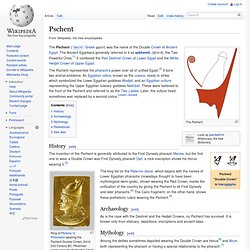
These were fastened to the front of the Pschent and referred to as the Two Ladies. Later, the vulture head sometimes was replaced by a second cobra. [citation needed] Ancientlatin.gif (GIF Image, 598x190 pixels) File:Wadi el-Hol inscriptions drawing.jpg. Manuel de Codage. Hieroglyphic text basically consists of rows of signs arranged in horizontal lines or vertical columns.
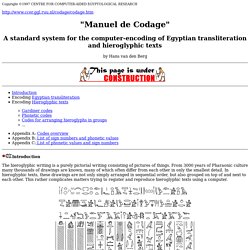
Within a row the signs are placed individually or grouped, upper having precedence over lower. The encoding system treats hieroglyphic text no different from the way the Ancient Egyptians and modern Egyptologists regarded their reading. So, is encoded in the order , just like it is read. The following codes are basic for the arrangement of single signs and groups of signs: To be continued... The following is a temporary continuation of the text extracted from the Glyph for Windows manual: Hieroglyphic groups like and where signs are placed next to and on top of each other can be constructed using the codes ":" (subdivision) and "*" (juxtaposition).
The code ":" is used to place one sign (or sign group) over another. is achieved by the simple code x:r (or Aa1:D21). The code "*" is used to put two (or more) signs next to each other in a group. is achieved by p*t:pt, while and Htp:t*p*t group. ).