
Who is holding the shitbag? Silicon Valley protecting yourPrivacy? ; "the_conspiracy" NSA Snowden - mass 'surveillance'- spying. Court oversight? a look inside a secret and empty process. PRISM.GOV Spyware Launching. XKeyscore. Privacy Disaster. Why Facebook Home bothers me: It destroys any notion of privacy. Facebook Facial Recognition: Its Quiet Rise and Dangerous Future.
In early April, Engadget posted a short article confirming a rumor that Facebook would be using facial recognition to suggest the names of friends who appeared in newly uploaded photos.
You’d be allowed to opt out of tagging, and only friends would be able to tag each other in albums. Nevertheless, a commenter beneath the story quipped, “Awesome! Why Facebook's Facial Recognition is Creepy. I'm not sure if you've heard the news, but Facebook is officially getting super-creepy.

Facebook announced Tuesday that it will be implementing facial recognition technology for all users in the next few weeks, semi-automating the photo-tagging process. Sure, you can "opt-out" of the service, but it's a pretty weak consolation. After all, opting out won't keep Facebook from gathering data and recognizing your face--it'll just keep people from tagging you automatically. The new facial recognition technology, which was announced in December but only introduced to a small test group, is basically Facebook's way of creating a huge, photo-searchable database of its users.
NSA's XKeyscore gives one-click real-time access to almost any internet activity. 5 Reasons You Should Be Scared of Google. Google Has All The Answers (About You) The Misconception: Before Google, if you were curious about some weird sexual position or the dangers of sticking glass rods down your pee hole, you had to go to an older sibling or classmate.

This would result in either hilarious but ultimately fulfilling sexual misadventure or, if you didn't go to high school in a teen comedy, a mortifying nickname that followed you all the way to college. Google wasn't the first search engine to take the human interaction out of that process, it was just the best at finding the information you were looking for. As millions vape, e-cigarette researchers count puffs, scour Facebook. NEW YORK (Reuters) - One team of researchers assessing the risks of electronic cigarettes is counting the puffs taken by volunteer "vapers.

" Another will comb Facebook for posts on how people are tinkering with e-cigarettes to make the devices deliver extra nicotine. A third is building a virtual convenience store for 13-to-17-year-olds, measuring how e-cigarette displays and price promotions influence whether minors buy the increasingly popular devices. The U.S. Food and Drug Administration is spending $270 million on these and 45 other research projects to determine the risks of e-cigarettes before millions more Americans become hooked on the devices. Social Media Strategy of the Day: State Department Spent $630,000 on Facebook 'Likes' Visionary internet activist Aaron Swartz found dead; was this brilliant internet revolutionary 'taken out?' (NaturalNews) Adding to the list of mysterious deaths that have happened over the last few days, internet visionary and brilliant internet activist Aaron Swartz was found dead yesterday.

Swartz, only 26 years old, was the co-founder of Reddit.com, the co-creator of RSS technology, and the key activist who achieved a stunning defeat of the freedom-crushing SOPA / PIPA bills in the U.S. Congress. Swartz was found dead yesterday, and the official story is that he committed suicide. But Swartz himself would have wanted us to question the official story and dig deeper. Why I've built a search engine that doesn't follow you - opinion - 20 June 2013.
Revelations about governments' online snooping have been good news for Gabriel Weinberg, builder of DuckDuckGo – a search engine that doesn't track its users What made you set up DuckDuckGo?

I started it a little over five years ago, just intending to build a better search engine. My initial focus was to reduce spam and prevent irrelevant sites from coming up in links, and also to make better instant answers. A lot of times you want stuff from Wikipedia, so that was the first place I tried to give you an answer from. After I launched, I started getting questions about search privacy. » United Nations Calls for Internet Big Brother System to Combat Terrorism Alex Jones. Kurt Nimmo Infowars.com October 23, 2012 Under the rubric of combating international terrorism, the United Nations is calling for pervasive and widespread internet surveillance, Declan McCullagh reported on Monday.
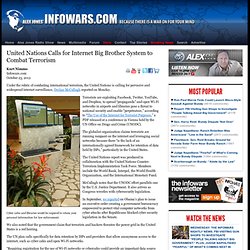
Cyber cafes and libraries would be required to retain your personal information for law enforcement. Skype with care – Microsoft is reading everything you write. Anyone who uses Skype has consented to the company reading everything they write.

23 Popular Websites (10 Years from Now) Slideshow. I Was a Paid Internet Shill. Thread is close and hoaxed.
The author admitted in a private exchange that the entire story was fabricated. I am writing here to come out of the closet as a paid shill. For a little over six months, I was paid to spread disinformation and argue political points on the Internet. Wikipedia - Israel Is Training Internet Workers To Manipulate Online Content. REVEALED: Hundreds of words to avoid using online if you don't want the government spying on you.
Department of Homeland Security forced to release list following freedom of information requestAgency insists it only looks for evidence of genuine threats to the U.S. and not for signs of general dissent By Daniel Miller Published: 09:32 GMT, 26 May 2012 | Updated: 17:46 GMT, 26 May 2012 Revealing: A list of keywords used by government analysts to scour the internet for evidence of threats to the U.S. was released under the Freedom of Information Act The Department of Homeland Security has been forced to release a list of keywords and phrases it uses to monitor social networking sites and online media for signs of terrorist or other threats against the U.S.

Feds tell Web firms to turn over user account passwords. The U.S. government has demanded that major Internet companies divulge users' stored passwords, according to two industry sources familiar with these orders, which represent an escalation in surveillance techniques that has not previously been disclosed. If the government is able to determine a person's password, which is typically stored in encrypted form, the credential could be used to log in to an account to peruse confidential correspondence or even impersonate the user.
Obtaining it also would aid in deciphering encrypted devices in situations where passwords are reused. "I've certainly seen them ask for passwords," said one Internet industry source who spoke on condition of anonymity. How NSA weakens encryption to access internet traffic - tech - 06 September 2013. The internet is full of holes. The spy agencies in the US and UK have forced technology suppliers to deliberately weaken security measures in the online computing systems that everyone uses. As a result they may have compromised everybody's security - since the vulnerabilities can be exploited by anybody who discovers them. The revelations appear in the latest batch of NSA and GCHQ documents leaked by the former NSA contractor Edward Snowden, now an exile in Russia. Leaked letter shows government leaning on ISPs over internet filtering.
A leaked government letter has cast a spotlight on the tensions between UK internet service providers (ISPs) and the government around home broadband filtering. The Department for Education letter, leaked to the BBC, was reportedly sent on Prime Minister David Cameron's behalf to the four major ISPs BSkyB, TalkTalk, Virgin Media and BT, though they are not explicitly named. 6 Terrifying User Agreements You've Probably Accepted. Australian Government Now Spies on Its Citizens More than the US Government Does. 4th October 2012. Like Privacy? Privacy Policy Last modified: November 11, 2011 This Privacy Policy is continually under review to ensure your privacy and security.
Don't let internet companies hoard the wealth of big data - opinion - 14 November 2013. Blog Archive » If You Can’t See It, It Can’t See You. Swartz Stole Academic Articles? Why Weren’t They Free In The First Place? Posted by Bob Warfield on July 19, 2011. Aaronsw. Jasmina Tesanovic at 3:35 am Tue, Apr 1, 2014 • 3. Swartz’s Suicide Prompts Proposals To Curb DOJ’s Prosecutorial Power. Jay Rockefeller: Internet should have never existed. ILLUMINATI AND FACEBOOK. Facebook bans Gandhi quote as part of revisionist history purge. (NaturalNews) The reports are absolutely true.
Facebook suspended the Natural News account earlier today after we posted an historical quote from Mohandas Gandhi. Adobe Flash, The Spy in Your Computer – Part 1. Adobe Flash is, in my opinion, the most ubiquitous spyware in the world and no products detect it as such. Monitoring Internet Usage Patterns Has Privacy Implications Too. The New York Times Sunday Review included a striking op ed suggesting that universities could one day deploy software to analyze students’ internet usage for the purpose of assessing their mental health.
Big Data: NSA, Facebook—and My University? The internet is a threat to human civilization: Julian Assange’s A Call to Cryptographic Arms. Stop Government From Restricting Internet Freedom. Privacy is Non-negotiable: Tell congress to oppose CISPA 2.0. Mozilla rallies for opposition against secret Internet treaty. Like Privacy? EUROPE STOP ACTA NOW - as citizens we must urge our representatives to stop #ACTA. IiNet wins copyright battle. Anonymous And The War Over The Internet. Anonymous & Lulz Security Statement. Facebook logins toxic for employers, violate security and privacy principles. Google spying on you for NSA? Judge: 'None of your business' 'Sneakers,' the movie that inspired a lot of techies, might have been real, just a little.