
LEARNING STYLES AND E-LEARNING. v7i2languagearts1. Conditions+for+Classroom+Technology+Innovations. Journal of the Scholarship of Teaching and Learning. The PDF file you selected should load here if your Web browser has a PDF reader plug-in installed (for example, a recent version of Adobe Acrobat Reader).

If you would like more information about how to print, save, and work with PDFs, Highwire Press provides a helpful Frequently Asked Questions about PDFs. Alternatively, you can download the PDF file directly to your computer, from where it can be opened using a PDF reader. To download the PDF, click the Download link above. Fullscreen Fullscreen Off This work is licensed under a Creative Commons Attribution 3.0 License. DWeesFramingIssuesModuleA. Technology Is Changing How Students Learn, Teachers Say. The researchers note that their findings represent the subjective views of teachers and should not be seen as definitive proof that widespread use of computers, phones and video games affects students’ capability to focus.
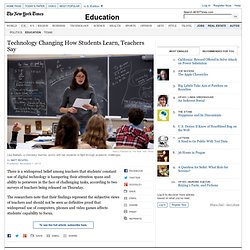
Even so, the researchers who performed the studies, as well as scholars who study technology’s impact on behavior and the brain, say the studies are significant because of the vantage points of teachers, who spend hours a day observing students. The timing of the studies, from two well-regarded research organizations, appears to be coincidental. One was conducted by the Pew Internet Project, a division of the that focuses on technology-related research. The other comes from Common Sense Media, a nonprofit organization in San Francisco that advises parents on media use by children. Teachers who were not involved in the surveys echoed their findings in interviews, saying they felt they had to work harder to capture and hold students’ attention. “I’m an entertainer. Dr. Artifact: What is the Effect of Technology Training for Teachers on Student Achievement? (Download a copy of this here) Abstract This paper discusses the importance of teacher training in technology.
One important question is looked at, specifically; does training in technology lead to increased student achievement? First we focus on the effectiveness of teacher training in technology, and then we look at the effectiveness of the use of technology on student learning. Introduction One thing my colleagues are always complaining about when it comes to technology is a lack of adequate training in how to use technology. Review of Current Literature An important part of answering this question is addressing the issue of how well educational research is done in the area of technology since we need to know how good the tools are that will be used to answer this question. To paraphrase Brand, G. Pdf-naesp1745_technologyandstudentachievemen. Learning%20Styles%20Higher%20Ed%20and%20Adult. School_tech. Experiential Learning in Teams.
Teamwork is prevalent in organizations, yet it has pitfalls such as social loafing, groupthink, overdependence on a dominant leader, overcommitment to goals, and diffusion of responsibility.

Such negative factors can be overcome and team effectiveness improved when teams intentionally focus on learning. This article draws on nearly four decades of research and theory on experiential learning theory in teams. We identify learning as the key component of six aspects of team development: purpose, membership, role leadership, context, process, and action. Teams learn differently in early versus later stages of development. The Kolb Team Learning Experience addresses all six aspects through a structured written simulation. Download Now. Team Based Learning. PlanningforNeomillenniallearningstylesDede2004.
Student Achievement. Does technology improve student learning?

Computers in schools help students accomplish their schoolwork both effectively and efficiently. Research has shown that when computers are integrated correctly into the curriculum students show improved motivation and enthusiasm for school. Critical thinking, problem solving, independent learning skills, content knowledge, and the ability to compete in the work force are all enhanced (Rockman 3). Computers can enhance student achievement by engaging and involving students, as they become active participants in a meaningful learning experience. Technology also empowers students to feel pride in their accomplishments and in being producers of knowledge.
The Education Commission of the states asserts that, when integrated effectively, technology can allow students to initiate self-directed research projects or collaborate with other students around the world. Real-world contexts for learning Connections to outside experts Scaffolds for problem solving. JITEv7p185-204Nicholson364. Impact_of_et. Learning%20Styles%20and%20Technology. Planning for Neomillennial Learning Styles: Implications for Investments in Technology and Faculty.
Chris Dede Harvard University © Chris Dede Today's students have been described as having an information-age mindset, being Millennials or members of the Net Generation.

While this portrayal of generational learning styles can be oversimplified, the technology and media used by children during their formative years do have an influence on how they learn, as do the media used by adults. However, technology is no more static than people. How Emerging Media Foster Neomillennial Learning Styles Over the next decade, three complementary interfaces will shape how people learn:2 The familiar "world to the desktop. " Net Generation learning styles stem primarily from the world-to-the-desktop interface; however, the growing prevalence of interfaces to virtual environments and augmented realities is beginning to foster so-called neomillennial learning styles in users of all ages. How Immersive Presence Enhances Learning Situated Learning and Transfer via Psychological Immersion Figure 1. Figure 2.