Response to a Misleading Article on Islam and Sufism. Response to a Misleading Article on Islam and Sufism Assalamu alaikum, The following is a response I wrote to an article, "SUFISM: The Deviated Path" by Yusuf Hijazi, which spreads many lies about Islam and Sufism.
The conclusions I came to regarding this article are: Most of his sources criticizing the Sufis are in fact non-Muslim sources. This author seems to like to use non-Muslim sources to criticize and condemn Muslims, and to weaken the Muslim Ummah. A Study of Al-giiazali's Kitab Adab Al-nikah. Rabi`a's Gifts to Hasan al-Basra. Rabi`a's gifts to Hasan of Basra Once Rabi`a al-Adawiyya sent Hasan of Basra three things - a piece of wax, a needle, and a hair.
"Be like wax," she said. "Illumine the world, and yourself burn. Be like a needle, always be working naked. When you have done these two things, a thousand years will be for you as a hair. " "Do you desire for us to get married? " Souad Hakim: Ibn 'Arabî's Twofold Perception of Woman. In the Name of Allah the Rahman the Rahim It is astonishing that a colossal Islamic scholar, Muhyiddin Ibn 'Arabî (AH 560-638), who lived more than eight centuries ago, should have declared that woman and man are absolutely equal in terms of human potentiality.
He interpreted the "degree" which was given to man over woman[1] as an ontological matter, abolishing singular male images of the universe in favour of a binary conjugal conception, where male and female are coupled together in a necessary cosmic unity on the level of both Creation and Gnosis. The Silsilah - Center for Sufism and Islamic Studies.
Dogs in the Islamic Tradition and Nature By Dr.
Khaled Abou El Fadl. An Introduction to the Principles of Hikmah - Hakim Archuletta (Natural Health Series: Session 1) Is There a Spiritual Solution for Depression? A Muslim Perspective. Can spirituality be a remedy for depression?
Does depression distance us from God? Is depression a lack of faith? Are we nearer to God in happiness than when depressed? I wonder how many of us have struggled with these questions. Virtues of Friday « InTuiTivE MuSliMah. When some of us think of Friday, we sometimes associate this day as “The Day” to sit down on that heavenly lounge chair, sip a nice cup of coffee or tea and lift our feet and know that you could care less what your boss wants you to do.
This is the day where all worries from the week have been kicked up to the following Monday or Tuesday or whatever day just as long as you don’t have to think about it on Friday. This is the onset of the great weekend that you’ve been planning for since the beginning of the week. A day of fun, partying, vacationing, or just enjoying the time with family and friends. This day has become so popular that there’s even a restaurant that is called TGI Fridays the famous acronym that means “Thank Goodness it’s Friday”. Islam and Existentialism « Words. The beauty of Islam lies in its simplicity, its uninterrupted linearity.

The very idea of the oneness of God strikes the mind with immense fresh clarity. That is the answer: one. That is all you need to know. A monotheistic life is a life of clear thinking, radical balance. “And a man’s life’s no more than to say ‘One.’” Dr. Umar Abd-Allah On Spiritual Guidance: Commentary on Ibn Ata'illah's Hikam - 03 Dec 2011. Dr. Umar Abd-Allah: Session of Divine Remembrance, & Commentary on Ibn Ata'illah's Aphorisms.
Eleven Naqshbandi principles. The Eleven Naqshbandi principles or the "rules or secrets of the Naqshbandi", known in their original Persian as the kalimat-i qudsiya ("sacred words" or "virtuous words"),[1] are a system of principles and guidelines used as spiritual exercises,[2] or to encourage certain preferred states of being, in Naqshbandi Sufi schools of mysticism.
Background[edit] There were originally eight principles formulated by the Central Asian Sufi teacher Abdul Khaliq Gajadwani (died 1179), the last three of the eleven being added later by Baha-ud-Din Naqshband Bukhari (1318–1389), founder of the Naqshbandi Order.[3] Both were Khwajagan (Masters) of the Sufi tariqah (path, way or method).
These principles are designed to be borne in mind and used as spiritual practices or exercises in the Naqshbandi system of spiritual development. They are carried out under individual tuition, expertly prescribed, monitored for changes, and carefully adjusted by a teacher, rather than being automatically performed.[2] The Example of Bahauddin Naqshband. The Example of Bahauddin Naqshband When he was at meals he used to pay closest attention to the example of the Prophet.
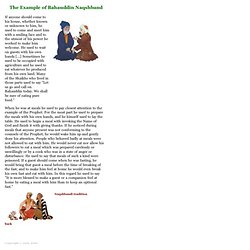
For the most part he used to prepare the meals with his own hands, and he himself used to lay the table. He used to begin a meal with invoking the Name of God and finish it with giving thanks. If he noticed during meals that anyone present was not conforming to the counsels of the Prophet, he would wake him up and gently draw his attention. People who behaved badly at meals were not allowed to eat with him. Dua e Rabbana-Shajarian - Arabic sub Persian. Most Beautiful Dua,Supplication(Arabic+Urdu Translation) Part-1_2.wmv. Hudaybiya: Islam’s Victory by Nonviolent Resistance. By Adnan Majid Which one event does the Qur’an describe as the Prophet Muhammad’s ﷺ (peace be upon him) “manifest victory”?
The Muslim conquest of the entire Arabian Peninsula, Jerusalem, and beyondThe Prophet’s ﷺ re-entry into Mecca and the destruction of the pagan idols in the temple of Abraham`alayhi assalaam (peace be upon him)A nonviolent Muslim movement resulting in a peace treaty and compromise with long-time enemies It may come as a surprise, but the answer is C. True, the Arab Spring showed the world that Muslims can embrace nonviolent resistance to successfully affect change, but this commitment to nonviolence has rarely been described as a religious expression grounded in Islam.
Many in the West have thus raised the fear that Islamic-minded movements in the post-revolutionary Arab world—Tunisia’s Ennahda or Egypt’s Muslim Brotherhood, for instance—simply used nonviolence as a convenient way to assume power, after which they will turn to force and repression. Sufism and the aesthetics of penmanship in Siraj al-Shirazi's Tuhfat al-muhibbin. Prejudices about Islam will be shaken by this show. Ever since the Crusades, when Christians from western Europe were fighting holy wars against Muslims in the near east, western people have often perceived Islam as a violent and intolerant faith – even though when this prejudice took root Islam had a better record of tolerance than Christianity. Recent terrorist atrocities have seemed to confirm this received idea. But if we want a peaceful world, we urgently need a more balanced view. We cannot hope to win the "battle for hearts and minds" unless we know what is actually in them.
Journal of Sufi Studies. What is Tasawwuf ? - World of Tasawwuf. Imam Malik (d. 179) The scholar of Madina, he was known for his intense piety and love of the Beloved Prophet Salla Allahu ta'ala 'alayhi wa aalihi wa Sallam, whom he held in such awe and respect that he would not mount his horse within the confines of Madina out of reverence for the ground that enclosed the Beloved Prophet Salla Allahu ta'ala 'alayhi wa aalihi wa Sallam's body, nor would he relate a hadith without first performing ablution. Ibn al-Jawzi relates in the chapter entitled 'Layer 6 of the People of Madina' of his book Sifat al-safwa: Abu Mus'ab said: I went in to see Malik ibn Anas. Kamran Pasha: Women Retake Islam: The Prophet. Many fans have asked where I have been for the past few months.
I have been a regular blogger for the Huffington Post since 2009, often commenting on issues relating to Islam and the media, which as a Muslim in Hollywood is perhaps appropriate. But I have not written a post either here or on my own personal blog since late last year. Partly, I have been focused on balancing my career as a filmmaker and novelist with the needs of my family. But partly I have been just plain exhausted. أيها المريد (1) مفهوم الإرادة - مقالات ومكتوبات - موقع الداعية الإسلامي الحبيب علي الجفري. Rumi, the movie. At this year's Cannes film festival it was revealed that the Qatar Foundation had pledged $25m for the production for a biopic of Rumi, the Muslim mystic and poet, who is perhaps the leading figure in Sufism and one of Islam's most important cultural ambassadors to the western world. In 2002, Time magazine pointed out that "easily the most successful poetry book published in the west in the past decade" belonged to Rumi (his verses have even been recited by Madonna).
Rumi's cultural influence goes beyond poetry, however. The famous "whirling dervishes" trace themselves back to the poet and he has even inspired Iranian ballet as well as a recent symphony project. Rumi was born in central Asia at the beginning of the 13th century, during the time of the Mongol invasions. Ahmad Sirhindi. Does Islam support the death penalty? Clock Tower in Mecca draws criticism. (un) making Mecca - City of Brass.
The Wahhabi Who Loved Beauty. Sufi Stories: spiritual stories from Islam and Sufism. A Sufi Story. Rūmī and the Hermeneutics of Eroticism. Serving the Guest: A Sufi Cookbook & Art Gallery. Table of Contents. Table of Contents Copyright © 1999 by Doug Marman. Even after all this time, the sun never says to the earth "You owe me."... William C. Chittick, Ph.D.: The Islamic Notion of Beauty. Anyone with the vaguest knowledge of Islamic culture knows that it has produced extraordinary works of art and architecture -- Persian miniatures, the Taj Mahal, the Alhambra. Few are aware, however, that this rich artistic heritage is firmly rooted in a worldview that highlights love and beauty. Eating less meat is more Islamic. Shop owner Boualem Bensalem serves meat at his iftar (fast-breaking) meal.
Photograph: Denis Balibouse/REUTERS. Was Hawa’ (Eve) Created from the Rib of Adam? - Answers. What is the Difference Between the “Heart” (Qalb), “Kindling Heart” (fuaad), and the “Pure Intellect” (lubb)? - Answers. Corrections of Popular Versions. Migration in Germany. The German-born Hülya Kandemir was a successful singer and songwriter, collaborating with major stars. How Islam tells us to deal with grief and loss - by Basharat Abbas. Allahu Akbar. Pain, Loss, and the Path to God. MUSLIMNESS.COM. Chronological Order of Surahs. Doctrine of Abrogation. The American Muslim (TAM) The American Muslim (TAM) Sirr al-Asrar TOC. Reflections of Ibn 'Arabi in Early Naqshbandî Tradition.
Bird Parliament Index. Tales of Wisdom. Imam al-Haddad – al-Wird al-Latif. Sufism, Sufis, and Sufi Orders: Sufism's Many Paths. Cambridge khutbas etc. Bombing Without Moonlight:The Origins of Suicidal Terrorism. Islam, Irigaray, and the retrieval of Gender. Created from a single soul » Spirit21. Sufism and Sufi Brotherhoods in Syria and Palestine. Gaining the the Nearness of Allah (swt) Islamic Spirituality — Dedicated to the lectures and works of Shaykh Kamaluddin Ahmed. Defining Muhabbah.