
"Bodies" Make Up Fake Coral Reef. An Animal’s Place. By Michael PollanThe New York Times Magazine, November 10, 2002 The first time I opened Peter Singer’s “Animal Liberation,” I was dining alone at the Palm, trying to enjoy a rib-eye steak cooked medium-rare.

If this sounds like a good recipe for cognitive dissonance (if not indigestion), that was sort of the idea. Preposterous as it might seem, to supporters of animal rights, what I was doing was tantamount to reading “Uncle Tom’s Cabin” on a plantation in the Deep South in 1852. Singer and the swelling ranks of his followers ask us to imagine a future in which people will look back on my meal, and this steakhouse, as relics of an equally backward age. Eating animals, wearing animals, experimenting on animals, killing animals for sport: all these practices, so resolutely normal to us, will be seen as the barbarities they are, and we will come to view “speciesism”–a neologism I had encountered before only in jokes–as a form of discrimination as indefensible as racism or anti-Semitism.
"Be a Tree; the Natural Burial Guide for Turning Yourself into a Forest": Natural Burial; the Ultimate Back-to-the-Land Movement. The Natural Burial Company supports "Be a Tree" Check out our Updated Natural Funeral Planner, most current version at the link on the right...

The following text is a condensation of my forthcoming book "Be a Tree, the Natural Burial Guide for Turning Yourself into a Forest. " While I'm still wrestling with getting it published (things keep changing, so this may end up being 'it' someday', you can read an overview below and get yourself started on the road to becoming a tree... Natural Burial: The Ultimate Back-to-the-Land Movement 1. In the United Kingdom, for almost 20 years now, a compelling new consumer movement has been underway. Since 2005, when I first began documenting this trend, dozens (if not hundreds) of sites offering some form of natural burial have emerged in the UK, Australia, New Zealand, the US and Canada, with other countries coming on fast. [for a bit more history of the UK origins and the emerging importance of sustainable cemetery management, visit this link] Petting cubs is ALWAYS animal abuse. Cubs belong with moms.
Here our radio ad to educate parents about swimming with cubs: Hear the highlights from this page: Get the full color Cub Petting Fact Sheet The Truth About Tiger Cub Petting Displays in Malls By Howard Baskin, JD, MBA, Advisory Board Chairman of Big Cat Rescue, Tampa, FL Breeders who charge the public to pet and take photos with young tiger cubs tell venues and customers some or all of the following lies: 1) That the exhibitors are “rescuers” and operate “sanctuaries” 2) That the cubs have a good life while being used to make money: a) they enjoy being carted around the country in a semi and repeatedly awakened and handled by dozens of people all day b) that blowing in the cubs face “calms” them down c) that dangling them by holding under their front arms and bouncing them up and down “resets” them Cubs at the mall always = cub abuse d) that close up photos with flash does not harm the cubs 5) that the exhibitor is doing this to promote conservation in the wild.

We Didn’t Have The “Green Thing” Back Then. Infographic: United States of the Environment. In the spirit of two popular infographics that map out the best and worst of all 50 U.S. states — the United States of Awesome and the United States of Shame — MNN decided to see how each state shines or suffers in regard to environmental and public health.
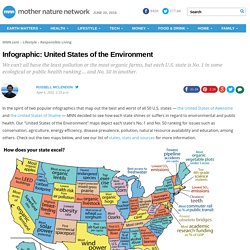
Our "United States of the Environment" maps depict each state's No. 1 and No. 50 ranking for issues such as conservation, agriculture, energy efficiency, disease prevalence, pollution, natural resource availability and education, among others. Check out the two maps below, and see our list of states, stats and sources for more information. Sources for "good U.S. " map:Alabama: Lowest rate of alcohol abuse or dependence (U.S. Substance Abuse and Mental Health Services Administration) Alaska: Most wetlands (U.S.
Geological Survey) Arizona: Most solar power potential (USA Today, National Climatic Data Center) Arkansas: Home of Buffalo River, first U.S.