
The Silk Road Project - Educational Resources. The Silk Road Project has partnered with leading organizations to produce educational materials relating to the Silk Road, music and the arts.

Silk Road Connect is our flagship arts integration program. We have offered weekend institutes in 2012 and 2013, open to all educators and teaching artists, at the Harvard Graduate School of Education; and plans are in the early stages for 2014. Learn more about "The Arts and Passion-Driven Learning. " Materials for Teachers The Silk Road Project has helped produced the following curricula and lesson plans: Photo Gallery: The Journey of a Lifetime. Timeline: Marco Polo’s Journey. UN Security Advisors Based in Cambodia Find out Solution on Flood news phnom penh.
National Geographic Marco Polo: Journey from Venice to China. Marco Polo. History, Pictures, Information, Maps, Game, Blackbeard. Marco Polo, Part I @ nationalgeographic.com. Junger, Sebastian.

“The Lion in Winter,” National Geographic Adventure (March/April 2001), 76-90, 135-139. Montaigne, Fen. “Iran: Testing the Waters of Reform,” National Geographic (July 1999), 2-33. Vesilind, Priit J. How People Affect Ocean Animals and Plants. Cartographic Quilt. This is a Hmong story cloth.

Hmong people are native to southeast Asia, and have a long tradition of embroidery and textile work. Story cloths, however, are not traditional Hmong textiles. Hmong story cloths were only invented in the 1970s, when thousands of Hmong were interred in refugee camps. Hmong had allied themselves with American forces during the Vietnam War. Mount Fuji. Mount Fuji is a symbol of Japan.

The mountain contributes to Japan's physical, cultural, and spiritual geography. Mount Fuji is the tallest mountain in Japan, standing at 3,776 meters (12,380 feet). It is an active volcano, sitting on a "triple junction" of tectonic activity: the Amurian plate (associated with the Eurasian tectonic plate), the Okhotsk plate (associated with the North American plate) and the Filipino plate all converge in the region beneath Mount Fuji. It is only 100 kilometers (62 miles) from Tokyo, Japan's capital and largest city. Asia: Human Geography. Asia is the largest of the world’s continents, covering approximately 30 percent of the Earth’s land area.
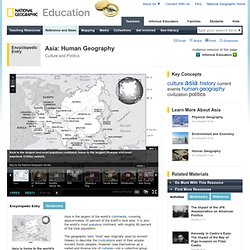
It is also the world’s most populous continent, with roughly 60 percent of the total population. The geographic term “Asia” was originally used by ancient Greeks to describe the civilizations east of their empire. Sediment. Sediment is solid material that is moved and deposited in a new location.

Sediment can consist of rocks and minerals, as well as the remains of plants and animals. It can be as small as a grain of sand or as large as a boulder. Sediment moves from one place to another through the process of erosion. Preah Khan, Angkor, Cambodia. Cambodian Currency Collection. Modern Masterpieces. Interactive Maps. Boueng Kak. This was never my favorite place in , but nevertheless had a pleasant and unique side to it.

The street outside was a higgledy-piggledy track, unpaved until relatively recently, and it looked unlike anything else in the city. Phnom Penh Spatial Data « City of Water. Historical Maps of Phnom Penh. Aerial Photo Around Central Market, 1943 These images are from a report entitled “Phnom Penh développement urbain et patrimoine” or “Phnom Penh, Urban Development and Heritage”.

Urban Expansion 1958 to 1968. Timeline. Churning the Sea of Time. Modern Masterpieces. Sisowath of Cambodia. Sisowath I (Khmer: ព្រះបាទស៊ីសុវតិ្ថ; 7 September 1840 – 9 August 1927) was king of Cambodia from 1904 to his death in 1927.

He was the son of King Ang Duong and half brother of Prince Si Votha and King Norodom. Sisowath Monivong. Life[edit] Born in Phnom Penh in 1875, Sisowath Monivong was the sixth child and the second son of King Sisowath.[2] His mother was Neak Moneang Van, later titled Samdeach Preah Voreachini, the fifth child-bearing wife of Sisowath.

At this time his uncle King Norodom ruled from Odong, the capital of Cambodia. Norodom was a puppet king for the French colonial protectorate. Vann Molyvann. Vann Molyvann (Khmer: វណ្ណ ម៉ូលីវណ្ណ; born November 23, 1926) is a Cambodian architect. During the Sangkum Reastr Niyum regime (1955–1970) Prince Norodom Sihanouk enacted a development policy encompassing the whole kingdom with the construction of new towns, infrastructure and architecture.
Vann was the foremost of a generation of architects who contributed to the unique style of architecture that emerged during this era and that has been coined New Khmer Architecture. Biography[edit] Ancient Cambodia - The Ancient Khmer Civilization. Khmer Civilization & Empire A View of Angkor Wat, perhaps the most famous of South East Asian Ruins. A History of the World - Culture - Buddhist World. Grade 4 SAILON. Math | Science | Language Arts |Social Studies | Fine Arts Math Science - Starting in school year 2010-2011 Back to top Language Arts - After 2009 Back to top Social Studies Fine Arts Art | Music | Theatre Please report any dead links or other problems to sailon@pasadenaisd.org. Museum Box Homepage.
Interactive Historical Thinking Poster for Elementary Teachers. Historical and Cultural Contexts . Intro. Teaching with Timelines. Browse Examples of Historical Thinking.