
PUBLICAGENDA.ORG - Public Agenda Home Page. A Project of the Annenberg Public Policy Center. Vote411.org. Disney and Other Big Brands Need to Address the Real Challenges to Outsourcing - Room for Debate. Michael H.

Posner, the former assistant secretary for democracy, human rights and labor at the U.S. State Department, is a professor of business and society at New York University's Stern School of Business. Some have praised Disney’s decision to pull out of Bangladesh as a step forward for workers’ rights. It's not. Disney’s departure does nothing to address the real challenges, which require a commitment by big global brands to stay in places like Bangladesh and be part of a collective effort to protect the well-being of factory workers.
A senior Disney executive justifies the company’s action by asserting that pulling up stakes in Bangladesh is “the most responsible way to manage the challenges associated with our supply chain.” Ask the workers in those factories, mostly young women, what they want. To address these reasonable aspirations, global brands like Disney need to do three things: Public defender hard at work on furlough week - May. 3, 2013. Santa Lopez, an inspector in the Federal Public Defender's Office in Washington D.C., is currently on a six-day furlough.

WASHINGTON (CNNMoney) That means the government is forcing Lopez to take six days off. Unpaid. And it's mandatory, because it's part of the $85 billion federal spending cuts that kicked in on March 1. But Lopez, who has worked as a federal investigator for 19 years, is not slacking off -- taking calls from accused defendants in jail on cases she's handling. "I'm basically not getting paid for two jobs," said Lopez, 52, with a laugh. Sunlight Foundation. 19 Maps That Will Help You Put The United States In Perspective. The Audacity of Fluff: A Critical Reading of Obama's Inaugural Address - Conor Friedersdorf. The president's words elided inconvenient realities and too often lacked rigor.
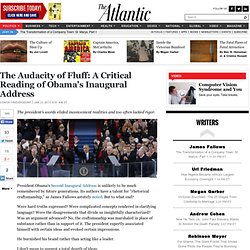
Reuters President Obama's Second Inaugural Address is unlikely to be much remembered by future generations. Its authors have a talent for "rhetorical craftsmanship," as James Fallows astutely noted. But to what end? Were hard truths expressed? He burnished his brand rather than acting like a leader. I don't mean to suggest a total dearth of ideas. The speech's theme: As Americans, we're in this together.
As he often does, Obama proceeded as if leadership is an exercise in eliding disagreements; as if defeating a straw man in argument is persuasive; and sometimes even as if pretty lies are preferable to the truth. What follows are passages I found particularly objectionable (for a variety of reasons). Said Obama: Through it all, we have never relinquished our skepticism of central authority, nor have we succumbed to the fiction that all society's ills can be cured through government alone. Oh really? Obama: Why Congress Is So Dysfunctional. The Sunday talk shows again this week devoted a lot of attention to the dysfunction of Congress. In fact, it was the theme of Face the Nation, which featured two members of the Senate with a reputation for bipartisanship, Democrat Bayh of Indiana and Republican Graham of South Carolina.
The degree of Congressional dysfunction is debatable. Study Finds Free Trade With China Lowered American Manufacturing By 29.6 Percent. By Jeff Spross "Study Finds Free Trade With China Lowered American Manufacturing By 29.6 Percent" AP Photo Around 2001, the raw number of manufacturing jobs in the United States plummeted from just over 17 million to just over 14 million.

After leveling off for a few years, it collapsed to around 11.5 million due to the Great Recession. It’s since seen a small rebound under President Obama’s tenure, but the continuing depression has put the long-term fate of manufacturing back on the national radar. Yesterday, The Washington Post’s Dylan Matthews reported that, according to a new paper, the 2000 normalization of trade relations between China and the United States left domestic manufacturing employment 29.6 percent lower that it would have been without the free trade policy: PNTR did not actually involve much in the way of new tariff reductions, but what it did offer was certainty. As Matthews points out, most economists agree that freer trade, in the long-run, is a net economic gain.