
A Pedagogy of Multiliteracies: Designing Social Futures. Copyright©1996 by the President and Fellows of Harvard College.
All rights reserved. A Pedagogy of Multiliteracies: Designing Social Futures Abstract In this article, the New London Group presents a theoretical overview of the connections between the changing social environment facing students and teachers and a new approach to literacy pedagogy that they call "multiliteracies. " _visual_literacy_paper. DigitalLiteracies. Digital Literacy. Using Technology to Enhance Literacy Instruction. This Critical Issue was coauthored by Ann Holum, Ph.D., and Jan Gahala, M.A.

Holum's doctoral work on the use of interactive media to improve children's story-understanding skills sparked her ongoing interest in integrating technologies in K-12 literacy settings; she currently is an independent educational consultant. Gahala is a technical specialist in NCREL's Communications department. ISSUE: Educational technology is nudging literacy instruction beyond its oral and print-based tradition to embrace online and electronic texts as well as multimedia. Computers are creating new opportunities for writing and collaborating. What digital literacies? Digital Literacy. Information fluency model. Digital Information Fluency (DIF) is the ability to find, evaluate and use digital information effectively, efficiently and ethically.
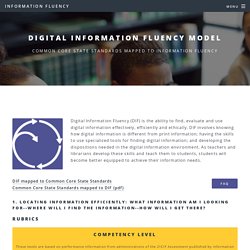
DIF involves knowing how digital information is different from print information; having the skills to use specialized tools for finding digital information; and developing the dispositions needed in the digital information environment. As teachers and librarians develop these skills and teach them to students, students will become better equipped to achieve their information needs. FAQDIF mapped to Common Core State Standards Common Core State Standards mapped to DIF (pdf) DigitalLiteracies.pdf. Teaching multiliteracies across the curriculum.
New media new literacies- Kellner. Information R/evolution.