
Algorithm Tutorials. Introduction to graphs and their data structures: Section 3 By gladiusTopCoder Member ...read Section 2 Finding the best path through a graph Dijkstra (Heap method) Floyd-Warshall Finding the best path through a graph An extremely common problem on TopCoder is to find the shortest path from one position to another.

There are a few different ways for going about this, each of which has different uses. Dijkstra (Heap method) Dijkstra using a Heap is one of the most powerful techniques to add to your TopCoder arsenal. Sidenote: If you haven't seen big-O notation before then I recommend reading this. First however, an introduction to the Priority Queue/Heap structure is in order. The fundamental operations on a Heap are: Add - Inserts an element into the heap, putting the element into the correct ordered location. Void dijkstra(node start) { priorityQueue check for termination condition (have we reached the target node?) #include Define your structure: struct node { int cost; int at; }; Dijkstra's algorithm - in c++ Algorithmus von Dijkstra · blogeum.
Wenn Du über neue Weblog-Einträge Bescheid wissen möchtest, dann abonniere einfach den Atom-Feed oder folge mir bei Twitter.

In der Informatik (speziell bei Datenstrukturen) stößt man bei kantengewichteten Graphen auf ein besonderes Problem: Wie findet man die günstigste (auch billigste) Verbindung zwischen einem Startknoten und allen anderen Knoten im Graphen? Edsger W. Dijkstra, ein niederländischer Informatiker, beschrieb im Jahr 1959 einen Algorithmus, mit dessen Hilfe man die günstigsten Verbindungen in einem solchen Graphen finden kann. Einzige Voraussetzung ist, dass die Kantengewichte nicht negativ sein dürfen. In der Vorlesungen Datenstrukturen hier an der TU bekamen wir die Aufgabe, diesen Algorithmus in C++ umzusetzen, unter der Voraussetzung, dass der Graph in Form einer Adjazenzmatix gegeben ist. C++ Implementation des Dijkstra-Algorithmus #include Der Code ist dokumentiert, sodass man ihn mit Vorkenntnis des Algorithmus’ verstehen sollte. Anwendungen Über den Autor: Christian. C++ Implementation of Hill-climbing and Simulated Annealing applied to Travelling Salesman Problems.
Visual Studio 2010 project is downloadable from here.

Introduction Following from a previous post, I have extended the ability of the program to implement an algorithm based on Simulated Annealing and hill-climbing and applied it to some standard test problems. Once you get to grips with the terminology and background of this algorithm, it’s implementation is mercifully simple. The algorithm can be tweaked such that it can also be implemented as a greedy hill-climing heuristic. Prim's algorithm. Prim's algorithm starting at vertex A.
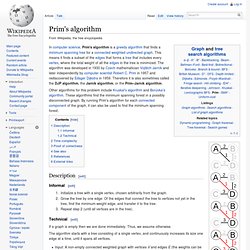
In the second step, BD is chosen to add to the tree instead of AB arbitrarily, as both have weight 2. Afterwards, AB is excluded because it is between two nodes that are already in the tree. Description[edit] Informal[edit] Technical[edit] If a graph is empty then we are done immediately. The algorithm starts with a tree consisting of a single vertex, and continuously increases its size one edge at a time, until it spans all vertices. Time complexity[edit] Prim's algorithm has many applications, such as in the generation of this maze, which applies Prim's algorithm to a randomly weighted grid graph.
A simple implementation using an adjacency matrix graph representation and searching an array of weights to find the minimum weight edge to add requires O(|V|2) running time. Demonstration of proof. Proof of correctness[edit] Let tree Y2 be the graph obtained by removing edge f from and adding edge e to tree Y1. See also[edit] Kruskal's algorithm V. Dijkstra's algorithm. The algorithm exists in many variants; Dijkstra's original variant found the shortest path between two nodes,[3] but a more common variant fixes a single node as the "source" node and finds shortest paths from the source to all other nodes in the graph, producing a shortest-path tree.
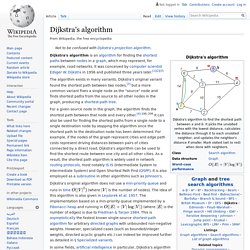
For a given source node in the graph, the algorithm finds the shortest path between that node and every other.[4]:196–206 It can also be used for finding the shortest paths from a single node to a single destination node by stopping the algorithm once the shortest path to the destination node has been determined. For example, if the nodes of the graph represent cities and edge path costs represent driving distances between pairs of cities connected by a direct road, Dijkstra's algorithm can be used to find the shortest route between one city and all other cities. Bellman–Ford algorithm. Algorithm[edit] In this example graph, assuming that A is the source and edges are processed in the worst order, from right to left, it requires the full |V|−1 or 4 iterations for the distance estimates to converge.
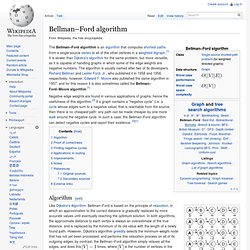
Conversely, if the edges are processed in the best order, from left to right, the algorithm converges in a single iteration. times, where is the number of vertices in the graph. In each of these repetitions, the number of vertices with correctly calculated distances grows, from which it follows that eventually all vertices will have their correct distances.
Bellman–Ford runs in time, where and. White Paper, Traveling Salesman.