
The double bind of open education #edcmooc. For week two of the eLearning and Digital Culture MOOC, one of the assignments is watching Gardner Campbell speak at Open Ed 12 from last October.

Here's the video: One of Gardner's key points of reference is Gregory Bateson, specifically Ecologies of the Mind. Having been up and down the cybernetics business, Bateson is familiar to me from that angle, but my first encounter was through Deleuze and Guattari, right at the start of A Thousand Plateaus, where they write: "A plateau is always in the middle, not at the beginning or the end. A rhizome is made of plateaus. Gregory Bateson uses the word "plateau" to designate something very special: a continuous, self-vibrating region of intensities whose development avoids any orientation toward a culmination point or external end.
" NCTE's 21st century curriculum #edcmooc. Surprisingly, English teachers from K-12 through higher education are not a particularly forward-thinking bunch.

Shocking right? While schoolmarm grammarian is uncharitable, it's probably closer to the mark than future-oriented innovator. Why utopian/dystopian thinking is wrong-headed #edcmooc. With some 40,000 others I have started on this Coursera MOOC on elearning and digital culture.

The first unit deals with utopian and dystopian perspectives on technology. Is it really necessary to explain why this is not a worthwhile way to frame this conversation? If we brought someone from where I live in Western New York from 200 or 500 years ago, would they look upon our world as utopian? #edcmooc eLearning and Digital Cultures: A dystopian vision disturbing by its proximity. South Park, Over logging. Season 12 episode 6 (2008) There are many utopian and dystopian stories about technology told in popular films from Metropolis to the Matrix.

Can you think of an example and describe or share it in the discussion board, on your blog, or on Twitter? I chose to talk about the Over Logging episode of South Park (season 12 episode 6, 2008), mainly because I re-watched it recently, it made me laugh, and it hits home a depressing message reflective of a mainstream reactionary response to in increasing reliance those of us privileged enough to have almost ubiqitous access to high speed internet connections have. Whilst I was thinking about writing this post I was also mulling over the classic 60s TV series The Prisoner, thinking about cult sci fi pastiche Dark Star, and original TV series of Star Trek.
But everyone's talking about sci fi on the discussion boards. #edcmooc eLearning and Digital Cultures: Block One. Utopias and Dystopias. Week One: Looking to the past. Films and a bit of me. Week one of a five week Coursera course on eLearning and Digital Cultures offered by the University of Edinburgh's Jeremy Knox, Sian Bayne, Hamish Macleod, Jen Ross, and Christine Sinclair.

We have four short films to watch this week, around the theme of utopian/dystopian visions of the past. I jotted notes down as I watched each film. This is my first foray back into analysing cultural artefacts in a long while, and I am very much looking forward to taking part in this well thought out and structured short online course. It is massive, with a reported 40,000 people registered worldwide.
I am sure the numbers taking part will dwindle quickly, and find myself wondering how many will make a digital artefact themselves? Edcmoochangout1feb2013 by libpost. From the E-learning and Digital Cultures MOOC. #EDCMOOC. Elite education for the masses. They included Patrycja Jablonska in Poland, Ephraim Baron in California, Mohammad Hijazi in Lebanon and many others far from Baltimore who ordinarily would not have a chance to study at the elite Johns Hopkins Bloomberg School of Public Health.
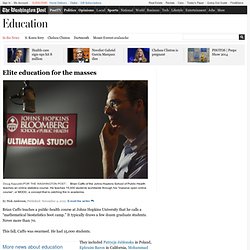
They logged on to a Web site called Coursera and signed up. They paid nothing for it. These students, a sliver of the more than 1.7 million who have registered with Coursera since April, reflect a surge of interest this year in free online learning that could reshape higher education. "The Danger of the Single Story" About Digital Immigrants and Natives. EDC MOOC Week 1 Reading "Digital Immigrants, Digital Natives": Prensky warns ‘immigrant’ teachers that they face irrelevance unless they figure out how to adapt their methods and approaches to new generations of learners.

When reading this paper, try to identify the strategies that Prensky uses to make his argument - how does the language he uses work to persuade the reader? Utopia, dystopia, technology, education and MOOCs. Despite the massive number of participants, I’ve actually found #edcmooc a relative oasis of calm and tranquility.

Mind you I haven’t explored far in the google and facebook groups/forums. Certainly the design of the course is much more traditional and individually focussed than #oldsmooc. The main content (so far videos and suggested texts which I’ve started to curate here is in the Coursera VLE. There are the usual additional online spaces of a wiki, twitter, Facebook and google groups.
Rethinking Learning: The 21st Century Learner. EDC 2013.mp4. The Twitter Revolution Must Die. Have you ever heard of the Leica Revolution?

No? That’s probably because folks who don’t know anything about “branding” insist on calling it the Mexican Revolution. An estimated two million people died in the long struggle (1910-1920) to overthrow a despotic government and bring about reform. Five Emotions Invented By The Internet. A vague and gnawing pang of anxiety centered around an IM window that has lulled.

During this time an individual feels unsure whether they have offended the IM recipient, committed a breach of IM etiquette, or have otherwise spoilt the presentation of themselves carefully crafted thus far thanks to the miracles of the textual medium. MOOC-HING about. I'm doing a MOOC on e-learning and digital cultures, as well as two other MOOCs (philosophy and astrobiology) and now find myself pontificating on the nature of MOOCs.