
Chaos theory. A double rod pendulum animation showing chaotic behavior.
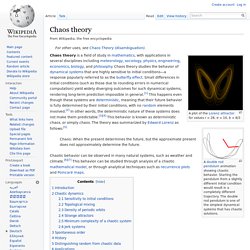
Starting the pendulum from a slightly different initial condition would result in a completely different trajectory. The double rod pendulum is one of the simplest dynamical systems that has chaotic solutions. Chaos: When the present determines the future, but the approximate present does not approximately determine the future. Chaotic behavior can be observed in many natural systems, such as weather and climate.[6][7] This behavior can be studied through analysis of a chaotic mathematical model, or through analytical techniques such as recurrence plots and Poincaré maps.
Introduction[edit] Chaos theory concerns deterministic systems whose behavior can in principle be predicted. Chaotic dynamics[edit] The map defined by x → 4 x (1 – x) and y → x + y mod 1 displays sensitivity to initial conditions. In common usage, "chaos" means "a state of disorder".[9] However, in chaos theory, the term is defined more precisely. Where , and , is: . Echoic memory. Echoic memory is one of the sensory memory registers; a component of sensory memory (SM) that is specific to retaining auditory information.

The sensory memory for sounds that people have just perceived is the form of echoic memory.[1] Unlike visual memory, in which our eyes can scan the stimuli over and over, the auditory stimuli cannot be scanned over and over. Overall, echoic memories are stored for slightly longer periods of time than iconic memories (visual memories).[2] Auditory stimuli are received by the ear one at a time before they can be processed and understood. For instance, hearing the radio is very different from reading a magazine. A person can only hear the radio once at a given time, while the magazine can be read over and over again. Hypnotic Language Patterns. Sometimes seen as a dark and sinister art, a magical power, or as something only heavyweight linguists can get to grips with, hypnotic language is actually very straightforward.

By definition, hypnotic language is designed to produce a hypnotic trance. Since trance is simply a highly focused state of attention, hypnotic language is language which focuses the attention and turns it inwards. Interest in hypnotic language patterns has grown alongside interest in the work of Milton H. Erickson, who pioneered the "indirect" approach to hypnosis. Before Erickson, subjects were basically told what to do - "you are feeling sleepy".
In addition, the internal, imaginative reality of the listener is unlikely to match what is being said to them if the suggestions are too specific. Indirect language patterns get round this in two ways. Nobody can argue with a statement like that! As before, at no point are you directly instructed to experience something specific inside your imagination. Milton H. Erickson. Milton Hyland Erickson (5 December 1901 – 25 March 1980) was an American psychiatrist and psychologist specializing in medical hypnosis and family therapy.
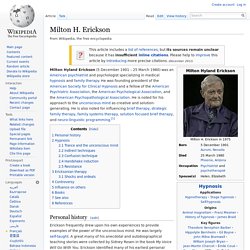
He was founding president of the American Society for Clinical Hypnosis and a fellow of the American Psychiatric Association, the American Psychological Association, and the American Psychopathological Association. He is noted for his approach to the unconscious mind as creative and solution-generating. He is also noted for influencing brief therapy, strategic family therapy, family systems therapy, solution focused brief therapy, and neuro-linguistic programming.[1] Personal history[edit] Erickson frequently drew upon his own experiences to provide examples of the power of the unconscious mind.
Erickson grew up in Lowell, Wisconsin, in a modest farming family and intended to become a farmer like his father. At age 17, he contracted polio and was so severely paralysed that the doctors believed he would die. Milton H. Hypnosis[edit] AirDroid. AirDroid. Psychology of the Bystander and tips for increasing chances of receiving help. SCHOPENHAUER'S 38 STRATAGEMS, OR 38 WAYS TO WIN AN ARGUMENT. Arthur Schopenhauer (1788-1860), was a brilliant German philosopher.

These 38 Stratagems are excerpts from "The Art of Controversy", first translated into English and published in 1896. Carry your opponent's proposition beyond its natural limits; exaggerate it. The more general your opponent's statement becomes, the more objections you can find against it. The more restricted and narrow his or her propositions remain, the easier they are to defend by him or her. Use different meanings of your opponent's words to refute his or her argument. (abstracted from the book:Numerical Lists You Never Knew or Once Knew and Probably Forget, by: John Boswell and Dan Starer)