
3Mirrors. Distributed Cognition as a Theoretical Framework for Information Visualization.
Classical Cognition vs Distributed cognition. 3D User Interfaces. Ecology. Wearable Computing. Steve Mann. Steven Mann (born 1962) is a researcher and inventor best known for his work on computational photography, particularly wearable computing and high dynamic range imaging.
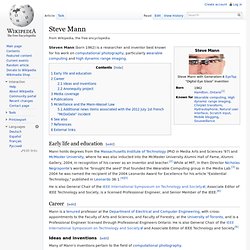
Early life and education[edit] He is also General Chair of the IEEE International Symposium on Technology and Society, Associate Editor of IEEE Technology and Society, is a licensed Professional Engineer, and Senior Member of the IEEE.[6] Career[edit] Mann is a tenured professor at the Department of Electrical and Computer Engineering, with cross-appointments to the Faculty of Arts and Sciences, and Faculty of Forestry, at the University of Toronto, and is a Professional Engineer licensed through Professional Engineers Ontario. University of Toronto: Mediated Reality & Wearable Computers. Edwin Hutchins. Hutchins aboard an airline flight deck Edwin Hutchins is a professor and former department head of cognitive science at the University of California, San Diego.

Hutchins is one of the main developers of distributed cognition. Hutchins was a student of the cognitive anthropologist Roy D'Andrade and has been a strong advocate of the use of anthropological methods in cognitive science. He is considered the father of modern cognitive ethnography. [citation needed] His early work involved studies of logic in legal discourse among people of the Trobriand Islands, Papua New Guinea.[1] For a time he worked in the Navy doing research on how crews of ship can function as a distributed machine, offloading the cognitive burden of ship navigation onto each member of the crew.
Other areas of his work include the study of airline cockpits, the development of cognitive ethnographic methods and tools, and human-computer interaction. References[edit] Jump up ^ Hutchins, Edwin (1980). External links[edit] Hutchins Home Page. I have spent my entire academic career trying to understand human cognition in social, cultural and material context.

I was originally trained as a cognitive anthropologist. I believe that cultural practices are a key component of human cognition. My early work concerned the relationships among language, culture, and thought. In 1975 and 1976, I conducted ethnographic research in the Trobriand Islands of Papua New Guinea. My focus was on reasoning in public litigation. As a postdoc, I constructed a model of traditional Micronesian navigation based mostly on published accounts of the navigators' practices. Later, while employed by the US Navy, I used insights derived from first-hand ethnographic studies to build computer-based training systems for steam propulsion systems and for radar navigation.
Since 1989 my primary research sites have been in the world of commercial aviation. Distributed Cognition in an Airline Cockpit. About Distributed Cognition. Distributed cognition is a psychological theory that knowledge lies not only within the individual, but also in the individual's social and physical environment.
This theory was developed in the mid-1980s by Edwin Hutchins. Using insights from sociology, cognitive science, and the psychology of Vygotsky (cf. cultural-historical psychology) it emphasizes the social aspects of cognition. It is a framework for studying cognition rather than a type of cognition. This framework involves the coordination between individuals, artifacts and the environment. It has several key components: Embodiment of information that is embedded in representations of interactionCoordination of enaction among embodied agentsEcological contributions to a cognitive ecosystem Distributed cognition is a branch of cognitive science that proposes that human knowledge and cognition are not confined to the individual. This abstraction can be categorized into three distinct types of processes: Early research[edit] Approach from Distributed Cognition. Distributed cognition takes into consideration a whole social system of cognition: the coordination between individuals, artifacts, and the environment.

Distributed cognition proposes that human knowledge is not confined to the individual. The theory focuses on how knowledge flows through the ecosystem of individuals, artifacts and the environment. By evaluating our work on the Group Web project from the distributed cognition perspective, we can see that our team is comprised of four individuals. We use artifacts such as computers, tablets, the internet to gather information and present our data collected on interaction design theories for the group web project. We also participate in a weekly class environment where we gain knowledge on how to apply interaction design theories and work together to question and interpret these theories.