
U.S. Leads Bid to Phase Out Whale Hunting. Slew of whale deaths mystifies scientists. Wednesday's stranding and sad death of a 60-ft fin whale in the Outer Hebrides comes all too swiftly after what seems to be an unusually high number of unexplained whale mortalities this year – enough to puzzle any whale CSI forensics team.

On 8 September a stranded fin whale died off Cleethorpes beach; on 23 September another fin whale died on the Humber, followed on 29 September by a rare sei whale in the same estuary (although my own research shows this was by no means unique. In 1888, a sei whale was harpooned and killed in the Solent, after following the Isle of Wight ferry from Portsmouth to Ryde). This year, two separate pods of pilot whales stranded in the Western Isles. Faced with yet another slumped and slowly expiring cetacean on the strand, scientists continue to be mystified by the cause for this run of whale casualties. But slowly, some new clues and possible culprits are emerging. Man-made problems may be to blame. Is this what is happening around Britain's shores? Earth's Whales Dying. High level of toxic PCBs in whale raises global alarm The orca found dead on the Olympic Peninsula earlier this year carried a level of industrial byproduct contaminants that is among the highest -- if not the highest -- ever measured in Orca whales, laboratory tests show.

The 22-foot-long female orca was so full of polychlorinated biphenyls that when scientists first attempted to test her fat, the result was too high for the machines to read it. "She basically knocked our instruments off," Gina Ylitalo, a researcher for the National Marine Fisheries Service, told fellow scientists at a recent seminar. "We had no idea we'd see these levels. " The PCB level found in the orca is dozens of times higher than concentrations known to affect the growth, reproduction and immune system of another marine mammal, the harbor seal. Although the toxic chemical's effect on orcas isn't as well-known, researchers believe orcas are affected in much the same way.
Beached Mother Whale Dies, Calf To Be Euthanized. Welcome to Save The Whales! Thar she blows! Dead whale explodes - US news - Environment. TAIPEI — Residents of Tainan learned a lesson in whale biology after the decomposing remains of a 60-ton sperm whale exploded on a busy street, showering nearby cars and shops with blood and organs and stopping traffic for hours.

The 56-foot-long whale had been on a truck headed for a necropsy by researchers, when gases from internal decay caused its entrails to explode in the southern city of Tainan. Residents and shop owners wore masks while trying to clean up the spilt blood and entrails. "What a stinking mess. This blood and other stuff that blew out on the road is disgusting, and the smell is really awful," a BBC News report quoted one Tainan resident as saying.
The whale had died on Jan. 17 after it beached itself on the southwestern coast of the island. Researchers at the National Cheng Kung University in Tainan said enough of the whale remained to allow for an examination by marine biologists. Reuters contributed to this report. Whales: Why Are Many Whales Endangered?: Habitat Degradation. Garbage Entangled fur seal.
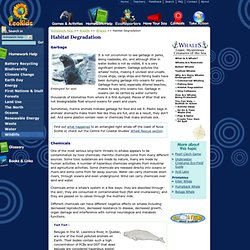
It is not uncommon to see garbage in parks, along roadsides, etc. and although litter in water bodies is not as visible, it is a very significant problem. Garbage pollutes the whales’ home, making it unclean and unsafe. Cruise ships, cargo ships and fishing boats have been dumping garbage into oceans for years. Garbage from land, especially littered beaches, makes its way into oceans too. Sometimes, marine animals mistake garbage for food and eat it. Chemicals One of the most serious long-term threats to whales appears to be contamination by toxic chemicals. Chemicals enter a whale’s system in a few ways: they are absorbed through the skin; they are consumed in contaminated food (fish and crustaceans); and they are passed on to calves through the mothers’ milk. Fast Fact : Belugas in the St. Noise Hearing is the most important sense to whales. To communicate, humpback whales can send sounds over hundreds of kilometres! Listen to more whale sounds. Why Are Whales Endangered.
Why Are Whales Endangered Whales are endangered from a variety of threats, most of which are the direct result of human activities.

Historically, a number of the large whale species were hunted almost to extinction by commercial whaling. Today some of these whale populations are stable or slowly increasing while others continue to decline. Of the 13 "Great Whale" species, 7 of them are currently classified as endangered or vulnerable. To learn why are whales endangered, contact us. Whales and Dolphins - Old dangers persist, new ones have appeared. Fact Sheet - Endangered Whales of the World.