The Chesapeake Bay Watershed - Chesapeake Bay Program. What is a watershed?

A watershed is an area of land that drains to a particular river, lake, bay or other body of water. Watersheds are sometimes called “basins” or “drainage basins.” We all live in a watershed. Some watersheds, like that of your local stream or creek, are small. Others, like the Chesapeake Bay watershed, are very large. What is the Chesapeake Bay watershed? The Chesapeake Bay watershed stretches across more than 64,000 square miles. The Chesapeake Bay’s land-to-water ratio (14:1) is the largest of any coastal water body in the world. What are the major rivers in the Chesapeake Bay watershed? The Susquehanna, Potomac, Rappahannock, York and James rivers are the five largest rivers in the Chesapeake Bay watershed. Altogether, more than 100,000 streams, creeks and rivers (called tributaries) thread through the Chesapeake Bay watershed.
Each of the streams, creeks and rivers in the Chesapeake Bay watershed has its own watershed. What watershed do I live in? Chesapeake Bay Watershed task. Water-related diseases. Water-related diseases task. Water In Crisis - Spotlight Sierra Leone. Alexandra Barton, Guest Writer Sierra Leone is a familiar and news-worthy country.

It is most often noted for its large and controversial industry of diamond mining. A brutal civil war that lasted a decade has left many images of amputees and refugees, impoverished and displaced. Added to these struggles, Sierra Leone is marked by the poorest standards of living. It has the seventh lowest life expectancy and one of the highest infant mortality rates in the world. Sierra Leoneans collect most of their drinking water from polluted sources. The average life expectancy for a Sierra Leonean is only 56 years. Sierra Leone's environment is disturbing production of agriculture and management of water. This country has insubstantial water storage to last through their dry season. Chemicals used during agriculture production are polluting surface waters where many rural citizens collect their drinking water. The government of Sierra Leone has a difficult task in managing water resources. Help for the hopeless.
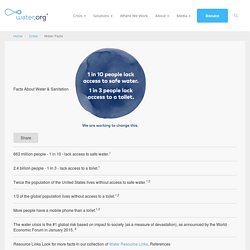
Facts: Water. Water 1 in 10 people lack access to safe water Sanitation 1 in 3 people lack access to a toilet Women & Children Women and children spend 125 million hours each day collecting water Disease Every 90 seconds a child dies from a water-related disease Economics Every $1 invested in water and sanitation provides a $4 economic return Facts About Water & Sanitation Share 663 million people - 1 in 10 - lack access to safe water.1 2.4 billion people - 1 in 3 - lack access to a toilet.1 Twice the population of the United States lives without access to safe water.1,2 1/3 of the global population lives without access to a toilet.1,2 More people have a mobile phone than a toilet.1,3 The water crisis is the #1 global risk based on impact to society (as a measure of devastation), as announced by the World Economic Forum in January 2015. 4 Resource Links Look for more facts in our collection of Water Resource Links.
References Donate now Get involved chevron_right Enewsletter sign-up. How are we doing?