
Fast, Accurate Detection of 100,000 Object Classes on a Single Machine. Computer Vision: Algorithms and Applications. © 2010 Richard Szeliski Welcome to the Web site ( for my computer vision textbook, which you can now purchase at a variety of locations, including Springer (SpringerLink, DOI), Amazon, and Barnes & Noble.
The book is also available in Chinese and Japanese (translated by Prof. Toru Tamaki). This book is largely based on the computer vision courses that I have co-taught at the University of Washington (2008, 2005, 2001) and Stanford (2003) with Steve Seitz and David Fleet. You are welcome to download the PDF from this Web site for personal use, but not to repost it on any other Web site. The PDFs should be enabled for commenting directly in your viewer. If you have any comments or feedback on the book, please send me e-mail. This Web site will also eventually contain supplementary materials for the textbook, such as figures and images from the book, slides sets, pointers to software, and a bibliography.
Electronic draft: September 3, 2010 Errata Slide sets. Putting the ‘art’ in artificial intelligence. Antonio TorralbaPhoto: M.

Scott Brauer Like many kids, Antonio Torralba began playing around with computers when he was 13 years old. Unlike many of his friends, though, he was not playing video games, but writing his own artificial intelligence (AI) programs. Growing up on the island of Majorca, off the coast of Spain, Torralba spent his teenage years designing simple algorithms to recognize handwritten numbers, or to spot the verb and noun in a sentence. But he was perhaps most proud of a program that could show people how the night sky would look from a particular direction. Today, Torralba is a tenured associate professor of electrical engineering and computer science at MIT, and an affiliate of the Computer Science and Artificial Intelligence Laboratory (CSAIL), where he develops AI systems that can interpret images to understand what scenes and objects they contain.
Photo: M. Image courtesy of Antonio Torralba. Data-driven Visual Similarity for Cross-domain Image Matching. Presented at SIGGRAPH Asia, 2011 People A data-driven technique to find visual similarity which does not depend on any particular image domain or feature representation.
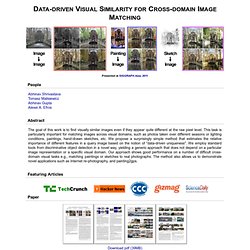
Visit the webpage to see some cool results and applications. Abstract The goal of this work is to find visually similar images even if they appear quite different at the raw pixel level. Featuring Articles. How to Build a Robot Tutorial - Society of Robots. Understanding Color In reality, color doesn't actually exist - color is simply a figment of your imagination.

No I'm not joking, serious. So what about blue and green and orange? VISION: IMAGES, SIGNALS AND NEURAL NETWORKS. Cortexica - creators of WINEfindr (Wine Finder) and BrandTrak. To see how we see – Cortexica Vision Systems releases its VisualSearch API. This really is the stuff of Sci-Fi movies: Build a computer program that can see as the human eye does.

Based on the principles of the human visual cortex, Cortexica Vision Systems claims to have done just that. The London startup, which was spun out of Imperial College London in February 2009 after six and a half years of research to understand how humans see and two years building algorithms to accurately mimic human visual recognition, today releases its VisualSearch API, which has been in private Beta for a while.
It’s aimed at brands who want to “directly engage with consumers” via their mobile device while bypassing the need to use QR codes or other barcodes or more traditional text search. iCub Robot Eye Tracking. Beauty in the Brain: Fractal Scene Statistics and Ease of Processing : Developing Intelligence. Neuroesthetics seeks to identify the neural basis of aesthetic experience – how does the brain give rise to the perception of beauty?

A new paper in Network indicates that artists consistently create works which contain the same statistical properties as natural scenes, even when the objects being depicted do not themselves contain such statistics when photographed. Redies, Hanisch, Blickhan and Denzler review previous work demonstrating that the “spatial frequencies” of natural scenes (essentially, their spatial complexity) follow a 1/f power spectrum, where increased spatial complexity is increasingly restricted to smaller portions of the scene. This property is sometimes referred to as “scale invariance” and is reflected in a variety of natural data, including human reaction time data, spontaneous fluctuations in brain activity, and perhaps in the connectivity of biological networks – neural and social alike.
Ai.stanford.edu/~ang/papers/icml09-ConvolutionalDeepBeliefNetworks.pdf. The Science of Word Recognition. About fonts > ClearType The Science of Word Recognition or how I learned to stop worrying and love the bouma Kevin LarsonAdvanced Reading Technology, Microsoft CorporationJuly 2004 Introduction Evidence from the last 20 years of work in cognitive psychology indicate that we use the letters within a word to recognize a word.

This paper is written from the perspective of a reading psychologist. The goal of this paper is to review the history of why psychologists moved from a word shape model of word recognition to a letter recognition model, and to help others to come to the same conclusion. I will start by describing three major categories of word recognition models: the word shape model, and serial and parallel models of letter recognition. Model #1: Word Shape The word recognition model that says words are recognized as complete units is the oldest model in the psychological literature, and is likely much older than the psychological literature.
Characters Model #2: Serial Letter Recognition. Welcome. Universality in the Evolution of Orientation Columns in the Visual Cortex. Retina model. Retinal Model. High-level vision: object ... NN model of optical flow.