Universe
Get flash to fully experience Pearltrees
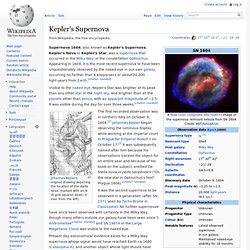
Supernova 1604 , also known as Kepler's Supernova , Kepler's Nova or Kepler's Star , was a supernova that occurred in the Milky Way , in the constellation Ophiuchus . It is the most recent supernova to have been unquestionably observed by the naked eye in our own galaxy , occurring no farther than 6 kiloparsecs or about 20,000 light-years from Earth . Visible to the naked eye , Kepler's Star was brighter at its peak than any other star in the night sky , and all the planets other than Venus , with apparent magnitude −2.5. It was visible during the day for over three weeks. The first recorded observation was in northern Italy on October 9, 1604. [ 2 ] Johannes Kepler began observing it in Prague on October 17. [ 3 ] It was subsequently named after him because his observations tracked the object for an entire year and because of his book on the subject, entitled De Stella nova in pede Serpentarii ("On the new star in Ophiuchus's foot", Prague 1606).
Kepler's Supernova
dharanish
Solar Prominence with images of Jupiter and Earth for size comparison. A prominence is a large, bright, gaseous feature extending outward from the Sun 's surface, often in a loop shape. Prominences are anchored to the Sun's surface in the photosphere , and extend outwards into the Sun's corona . While the corona consists of extremely hot ionized gases , known as plasma , which do not emit much visible light , prominences contain much cooler plasma, similar in composition to that of the chromosphere .
Solar prominence
South Asia | Condoms 'too big' for Indian men
11 Deep Space Photos You Won't Believe Aren't Photoshopped
Panspermia Panspermia ( Greek : πανσπερμία from πᾶς/πᾶν ( pas /pan) "all" and σπέρμα ( sperma ) "seed" ) is the hypothesis that life exists throughout the Universe , distributed by meteoroids , asteroids and planetoids . [ 1 ] In a National Institutes of Health study, the authors hypothesize that if biological complexity increased exponentially during evolution , life in the universe may have begun "10 billion years ago" [ 2 ] - more than 5 billion years before the Earth existed. Panspermia proposes that life forms that can survive the effects of space, such as extremophiles , become trapped in debris that is ejected into space after collisions between planets that harbor life and Small Solar System Bodies (SSSB).