
Creating two PowerPoint games. Most people think that PowerPoint is just for presentations that put you to sleep.

In fact, it’s a very versatile tool and fairly easy to get a lot out of, despite seeming a little scary at first glance. Here I’ll show you how to create two simple PowerPoint games. Hidden Pictures I made this example a while ago, and if I did it again I’d probably use #eltpics! Although it doesn’t look like much here, if you download it you can see that each time you click a box disappears, gradually revealing a picture and a word underneath. [To download, click ‘view on slideshare’. The Role of the Teacher in ICT... Learning Technology Research Keynote Speech delivered to the National Czech Teachers Conference University of Western Bohemia, Czech Republic May 20, 2000.
Jana says… Oregon Pre-Engineering & Applied Science Initiative. Překladač. 21 Things That Will Become Obsolete in Education by 2020. Last night I read and posted the clip on '21 Things That Became Obsolete in the Last Decade'.
Well, just for kicks, I put together my own list of '21 Things That Will Become Obsolete in Education by 2020'. 1. DesksThe 21st century does not fit neatly into rows. Neither should your students. Allow the network-based concepts of flow, collaboration, and dynamism help you rearrange your room for authentic 21st century learning. 1:1 technology. Top Ed-Tech Trends of 2011: The Business of Ed-Tech. Home. Study: Robots Inspire New Learning & Creativity Possibilities for Kids. + Share this In January 2012, Latitude Research completed a multi-phase innovation study (published in collaboration with LEGO® Learning Institute and Project Synthesis), Robots @ School, asking kids across the world to illustrate and write a story that answers this question: “What would happen if robots were a part of your everyday life—at school and beyond?”
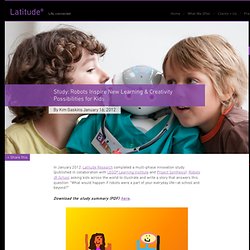
Download the study summary (PDF) here. “I have a few problems in spelling. The robot shall support me and improve me until I am at the same level as my classmates. The teacher tells the robot where my problems are. “RJ is a cool dude robot. Overall, the study found that robots are helping to reveal a potential shift in kids’ social and learning psychologies—moving from acts of knowledge transmission toward acts of exploration, collaboration, and creation. Research Overview Click here to view a larger version. Key Insights. iBooks Author and the Coming eTextbook Revolution in Higher Education. On January 19, 2012, Apple announced the availability of iBooks 2, an iOS app, and iBooks Author, a MacOS X application.
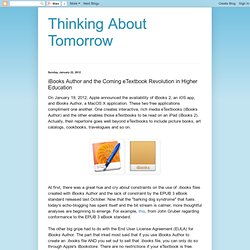
These two free applications compliment one another. One creates interactive, rich media eTextbooks (iBooks Author) and the other enables those eTextbooks to be read on an iPad (iBooks 2). Actually, their repertoire goes well beyond eTextbooks to include picture books, art catalogs, cookbooks, travelogues and so on. PresentationTube. Network: The Secret Life of Your Personal Data, Animated. Máme slona v obýváku? Text článku:
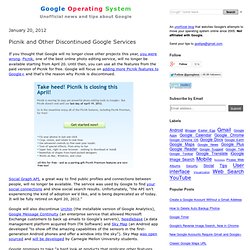
3 Great Ways to Use Google+ Hangout to Learn & Connect. The State of #EdTech in 2012. Picnik and Other Discontinued Google Services. If you thought that Google will no longer close other projects this year, you were wrong.
Guide to Using Free Apps to Support Higher Order Thinking Skills. Why Google is ditching search. There has been a huge maelstrom about Google integrating Google+ into its search links .
And it all misses the point. Twitter and others are complaining that Google is throwing its massive 65 percent plus market share weight around and quashing smaller competitors. The reason Twitter and others are so threatened is that the pattern of shared links within Google+ provides a decent enough indicator as to what links are interesting. 74 Interesting Ways to Use Google Forms in the Classroom. Online Icon Maker. Photo Pin : Free Photos for Your Blog or Website via Creative Commons. Search, plus Your World. Google Search has always been about finding the best results for you.
Sometimes that means results from the public web, but sometimes it means your personal content or things shared with you by people you care about. These wonderful people and this rich personal content is currently missing from your search experience. Learning Problems and Consultation Based Curricula. (This is a jumble of snippets in no particular order for a post that I’m not going to get round to writing…) Ewan McIntosh’s presentation at TEDxLondon: The Problem Finders [VIDEO] All our students, their parents and the people teaching them, have been indoctrinated that is teachers who sift through all the things we can learn, find the areas worth exploring, and make up theoretical problems for students to solve.
On top of this, most educators believe that it is their job to invent problems at just the right level of difficulty to appeal to every one of the 30 children in front of them. A couple of days after I saw this, John Naughton raised a similar issue at the Arcadia project review workshop – that experts and professionals are good at creating (or identifying) problems out of mess or muddle, the trick being that the problems are cast into a standard form to which known solutions/problem solving strategies can then be applied. Is this related? PS maybe related?