
Flooding. River Flooding What is the impact on people and places?

It may seem hard to believe that a small, slow-flowing stream or gentle river could cause serious damage to people and the places in which they live and work, but looks can be deceptive! People love to live near to rivers - in the past mainly for food, water, transport and protection. Even today people enjoy the peace and tranquility flowing water can offer. Flooding can turn even the most harmless looking watercourse into a raging torrent of large-scale destruction - buildings may prove no obstacle to its power; food crops may be ruined leading to food shortages and even starvation; peoples lives may be lost through drowning disease and homelessness. Rivers can be things of beauty and the historic lifeblood of a settlement. Why do Rivers Flood? Why do Rivers Flood?
Floods are natural events. In 1947 a severe winter blew into Europe from Russia. Man Using Flooding Rivers Web-Links to Investigate General information on Egypt Ancient Egypt. EarthCam - Webcam Network. Tyne Bridge Webcams. The Water Cycle. [in Spanish] © Contributed by Leanne Guenther Run and get a glass of water and put it on the table next to you.
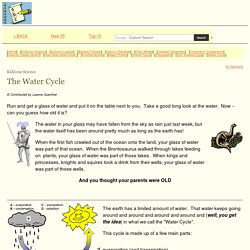
Take a good long look at the water. Now -- can you guess how old it is? The River Trent. The River Thames Guide - Thames Cruises, Thames Restaurants, Riverside Property, Hotels by the Thames, Conference Venues, Boats For Sale & Thames Info. The River Ribble - photographs of the Ribble from source to sea. Links to books and maps will take you straight to pages at where you can see further details of the publication.

All external links, will be displayed in a new window. I do check external links - but not very frequently! If you follow any which are out of date, please let me know. The photographs and captions are designed to be of use in the teaching of the Rivers theme in Key Stage 2 of the National Curriculum (England & Wales). A simplified version of the pages has been written by Wendy Pallant. If you spot any errors, or if you use the site in a school please let me know (I've had e-mails from Australia, the USA and the Middle East commenting on the site, and providing helpful corrections. Copyright notice All of the material (files, photographs, text and graphics - other than Amazon.co.uk, Schoolzone, 1and1.co.uk and Geography World logos) is copyright Graham Dean 1999 - 2010. Other sources of information Wikipedia article on the River Ribble. Last updated 6th March 2010. The Derwent is the major river of the Peak. The River Derwent is the largest river in the Peak District and a major tributary of the River Trent, which it joins just South of Derby.

The Derwent rises on the Eastern flank of Bleaklow and is approximately 80km (50 miles) long, draining a large proportion of the county of Derbyshire. View down the Upper Derwent The northern section of the river flows south from the flanks of Bleaklow down a steep-sided valley enclosed by gritstone moorland. Here it is crossed by the old 'Cut Gate' packhorse track, at a lonely spot known as 'Slippery Stones' - doubtless a spot where the packhorses were liable to come to grief.
The scenery in this area is magnificent, but in bad weather this is a remote and bleak place and at one time it was not uncommon for people to die when caught in winters storms here. Derwent Dam. The Amazon River. Investigating Rivers Homework. QCA document. Visit the Canterbury Environmental Education Centre ( details ) and undertake one of the relevant programmes, 'Water Cycle at Broad Oak Lakes' 'Weather Days' or the 'Great Stour River Study.' The Great Stour River Study programme involves walking along a section of the river refering to maps, noting relevant geographical, man made and biological features and undertaking simple experiments (for example measure differing speed of channel flow).
Visit the Virtual Tour pages to take this walk along the Great Stour, which can be used to prime or reinforce the field work. Rivers and Coasts - Main menu. BBC - BBC Newcastle River Tyne webcam. Geography Essentials - Investigating rivers. Other small streams and rivers, called tributaries, flow into the river and it increases in size as it travels along.

The river eventually slows down, curving around to make large bends called meanders. The river ends its journey when it flows into the sea, or a large lake. Some rivers are frozen for part of their journey. These are called glaciers. Cities, towns and villages have grown up on or near rivers because people use the water for many purposes. Some rivers are dammed to form reservoirs for drinking water, or to make electricity called hydro-electric power.