
Lawouach/WebSocket-for-Python - GitHub. Pcapy. Pcapy is a Python extension module that interfaces with the libpcap packet capture library.

Pcapy enables python scripts to capture packets on the network. Pcapy is highly effective when used in conjunction with a packet-handling package such as Impacket, which is a collection of Python classes for constructing and dissecting network packets. Source code You can download latest stable and development version at Latest stable release (0.10.8), updated August 26, 2010 - gzip'd tarball, zip file. 0.10.7, updated July 30, 2010 - gzip'd tarball, zip file. 0.10.6, updated December 4, 2008 - gzip'd tarball, zip file 0.10.5, updated on March 27, 2007 - gzip'd tarball, zip file 0.10.3, updated on Jan 5, 2004 - gzip'd tarball, zip file 0.10.2, updated on Oct 27, 2003 - gzip'd tarball, zip file Win32 binaries: Pick the appropriate Python or WinPcap version.
Advantages of Pcapy Works with Python threads. Quick start Click the following link to get the latest stable release. Supay 0.0.8. Package Index : setproctitle 1.1. A library to allow customization of the process title.
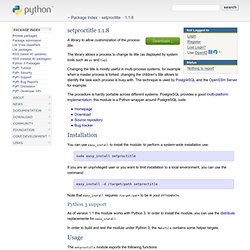
The library allows a process to change its title (as displayed by system tools such as ps and top). Changing the title is mostly useful in multi-process systems, for example when a master process is forked: changing the children's title allows to identify the task each process is busy with. The technique is used by PostgreSQL and the OpenSSH Server for example. The procedure is hardly portable across different systems. PostgreSQL provides a good multi-platform implementation: this module is a Python wrapper around PostgreSQL code. You can use easy_install to install the module: to perform a system-wide installation use: sudo easy_install setproctitle If you are an unprivileged user or you want to limit installation to a local environment, you can use the command: easy_install -d /target/path setproctitle Note that easy_install requires /target/path to be in your PYTHONPATH.
TrueCrypt - Free Open-Source On-The-Fly Disk Encryption Software for Windows 7/Vista/XP, Mac OS X and Linux. BackgroundCall. Pydkim - Python DKIM Library. NOTE: This page describes the last release of pydkim from 2008. The latest version is a fork found at dkimpy in Launchpad and is under active development. The pydkim module is a Python module that implements DKIM (DomainKeys Identified Mail) email signing and verification. Download The pydkim library is provided in source form. Matplotlib and pylons. CORE SECURITY TECHNOLOGIES. Impacket is a collection of Python classes focused on providing access to network packets.

Impacket allows Python developers to craft and decode network packets in simple and consistent manner. It includes support for low-level protocols such as IP, UDP and TCP, as well as higher-level protocols such as NMB,SMB and MSRPC (a.k.a. DCERPC). Impacket is highly effective when used in conjunction with a packet capture utility or package such as Pcapy. Packets can be constructed from scratch, as well as parsed from raw data. The following protocols are featured in Impacket Ethernet, Linux "Cooked" capture. The following tools are featured in Impacket secretsdump.py Performs various techniques to dump secrets from the remote machine without executing any agent there.
Psexec.py PSEXEC like functionality example using RemComSvc ( Jon's Python modules. Python_daemon. Package Index > python-daemon > 2.1.2 Not Logged In Status Nothing to report.

Esmre - Google Code. Esmre is a Python module that can be used to speed up the execution of a large collection of regular expressions.
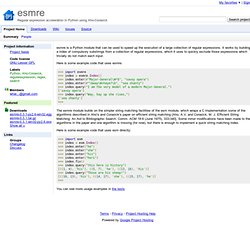
It works by building a index of compulsory substrings from a collection of regular expressions, which it uses to quickly exclude those expressions which trivially do not match each input. Here is some example code that uses esmre: >>> import esmre>>> index = esmre.Index()>>> index.enter(r"Major-General\W*$", "savoy opera")>>> index.enter(r"\bway\W+haye? \b", "sea shanty")>>> index.query("I am the very model of a modern Major-General. ")['savoy opera']>>> index.query("Way, hay up she rises,")['sea shanty']>>> The esmre module builds on the simpler string matching facilities of the esm module, which wraps a C implementation some of the algorithms described in Aho's and Corasick's paper on efficient string matching [Aho, A.V, and Corasick, M. Here is some example code that uses esm directly: You can see more usage examples in the tests.
Nagify: Python utility to display notifications about Nagios ale.