
Centre d'Etude et d'Enseignement des Techniques de Survie. Survival Wiki. Plantes comestibles. Website Survie : D. Manise. Survivalism. Movement of individuals or households preparing for emergencies and natural disasters Use of the term survivalist dates from the early 1960s.[2] History[edit] 1930s to 1950s[edit] The origins of the modern survivalist movement in the United Kingdom and the United States include government policies, threats of nuclear warfare, religious beliefs, and writers who warned of social or economic collapse in both non-fiction and apocalyptic and post-apocalyptic fiction.
[citation needed] The Great Depression that followed the Wall Street Crash of 1929 is cited by survivalists as an example of the need to be prepared.[4][5] Primitive skills. Primitive skills refers to prehistoric handicrafts and pre-industrial technology.

Primitive skills are those skills that relate to living off the land, often using handcrafted tools made from naturally gathered materials. Examples of primitive skills include: gathering and foraging native plants and animals for food, skinning and preparing game, basketry and pot making, constructing shelters, fire making, and useful plant identification. Interest in primitive skills has coincided with a resurgence in interest in natural and self-sufficient living techniques.
In North America, primitive skills enthusiasts often emulate Native-American traditional crafts. In Europe, primitive skills enthusiasts often practice traditional Bronze and Iron Age art forms.[1] See also[edit] References[edit] Jump up ^ "Society of Primitive Technology: About". 2009. Self-sufficiency.
Self-sufficiency (also called self-containment) is the state of not requiring any aid, support, or interaction, for survival; it is therefore a type of personal or collective autonomy.
On a national scale, a totally self-sufficient economy that does not trade with the outside world is called an autarky. The term self-sufficiency is usually applied to varieties of sustainable living in which nothing is consumed outside of what is produced by the self-sufficient individuals. Retreat (survivalism) A retreat is a place of refuge for those in the survivalist subculture or movement.
A retreat is also sometimes called a bug-out location (BOL). Survivalist retreats are intended to be self-sufficient and easily defended, and are generally located in sparsely populated rural areas. With the increasing inflation of the 1960s, the impending US monetary devaluation, the continuing concern with possible nuclear exchanges between the US and the Soviet Union, and the increasing vulnerability of urban centers to supply shortages and other systems failures, a number of primarily conservative and libertarian thinkers began suggesting that individual preparations would be wise.
Harry Browne began offering seminars in 1967 on how to survive a monetary collapse. Woodcraft. The term woodcraft (or woodlore) denotes skills and experience in matters relating to living and thriving in the woods—such as hunting, fishing, and camping—whether on a short- or long-term basis.

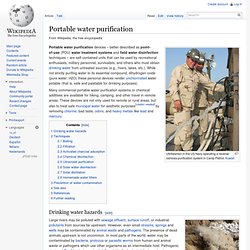
Traditionally, woodcraft pertains to subsistence lifestyles, with implications of hunting-gathering. In more recent times, and in developed countries, it relates more to either outdoor recreationalism or survivalism. Whether traditional or modern, woodcraft may be roughly equated to the phrase "living off the land". Portable water purification. Utilitiesman in the US Navy operating a reverse osmosis purification system in Camp Patriot, Kuwait Portable water purification devices – better described as point-of-use (POU) water treatment systems and field water disinfection techniques – are self-contained units that can be used by recreational enthusiasts, military personnel, survivalists, and others who must obtain drinking water from untreated sources (e.g., rivers, lakes, etc.).
While not strictly purifing water to its essential compound, dihydrogen oxide (pure water, H2O) these personal devices render unchlorinated water potable (that is, safe and palatable for drinking purposes). Drinking water hazards[edit] Turbid creek water caused by heavy rains. Giardia lamblia and Cryptosporidium spp., both of which cause diarrhea (see giardiasis and cryptosporidiosis) are common pathogens. Techniques[edit] 31st Marine Expeditionary Unit (MEU) Service Support Group 31. Bug-out bag. Off-the-shelf Red Cross preparedness kit .
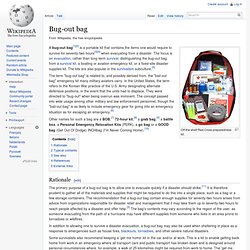
A bug-out bag[1][2] is a portable kit that contains the items one would require to survive for seventy-two hours[3][4] when evacuating from a disaster. The focus is on evacuation, rather than long-term survival, distinguishing the bug-out bag from a survival kit, a boating or aviation emergency kit, or a fixed-site disaster supplies kit. The kits are also popular in the survivalism subculture.[5] The term "bug-out bag" is related to, and possibly derived from, the "bail-out bag" emergency kit many military aviators carry.
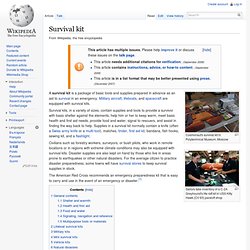
In the United States, the term refers to the Korean War practice of the U.S. Survival kit. Cosmonaut's survival kit in Polytechnical Museum, Moscow Sailors take inventory of a C-2A Greyhound's life raft kit in USS Kitty Hawk (CV 63) paraloft shop.
First aid kit. Large and small first aid kits used by the British Red Cross for event first aid, in the internationally recognised ISO green with a white cross.

These kits also feature the red cross which is a protected symbol under the Geneva Conventions and may only be used by the Red Cross or military A small first aid kit, but in a non-recognised colour and bearing an equal white cross on a red background, illegal under the Geneva conventions A first aid kit is a collection of supplies and equipment for use in giving first aid,[1] and can be put together for the purpose by an individual or organization or purchased complete.
There is a wide variation in the contents of first aid kits based on the knowledge and experience of those putting it together, the differing first aid requirements of the area where it may be used and variations in legislation or regulation in a given area. Format[edit] Michael Pritchard. Michael Pritchard's water filter turns filthy water drinkable. The Lifesaver Bottle. Outillage: l'eau...