
Lexicon. Logogram Publishing is publishing version 4 of the Sumerian Lexicon in both softcover and hardcover.
The finished book, with an official publication date of December 10, 2006, has 6,400 entries in 336 pages. Where version 3 drew upon 36 sources, version 4 draws upon 96 sources. The printed books have arrived from the printer. Here is an early review from Gebhard J. Selz: "It is just a week ago that I received your lexicon; my students have used your web-site for years.
"Finally, we have a highly useful tool; it is a tremendous step forward in teaching and learning Sumerian and it will prove indispensable for any beginner for learning the "dark Sumerian". Carol von der Lin writes concerning the hardcover edition, "Just received my copy of your Sumerian Lexicon, and I'm so impressed with the quality. Place Secure Order for the Sumerian Lexicon book. Version 3.0 by John A. The following lexicon contains 1,255 Sumerian logogram words and 2,511 Sumerian compound words. John A.
Mesopotamian Year Names. Neo-Sumerian and Old Babylonian Date Formulae prepared by Marcel Sigrist and Peter Damerow The list of more than 2,000 year names which is made accessible here has been compiled as a tool for the dating of cuneiform tablets as well as for supporting historical studies on early bookkeeping techniques.
This tool essentially consists of a collection of date formulae in administrative documents as they were used by the scribes in ancient Mesopotamia, and of computer generated indices for a quick identification of incomplete date formulae on damaged cuneiform tablets and of issues and events mentioned in these formulae. ETANA. Abzu is a guide to networked open access data relevant to the study and public presentation of the Ancient Near East and the Ancient Mediterranean world.
The editor of Abzu is Charles E. Jones, Head Librarian Institute for the Study of the Ancient World, New York University.Contact the editor directly at cejo@uchicago.edu. Abzu has been available on the Internet since 5 October, 1994.The current Abzu resource has been made possible with a grant from the Andrew W. Mellon Foundation. Star Catalogue. This catalogue is derived from BPO2.
The Sumerian transliteration is in all-caps, and then the Akkadian is in italics. The English translation of the name is in quotes, followed by the modern star or constellation to which it refers. I have not included alternate spellings for any of the constellation names, as this would lead to a maze of circular definitions. Also, this catalogue is alphabetized by the Sumerian. Archaeological Site Photographs: Mesopotamia: Kish - Мозилин фајерфокс (Mozilla Firefox) Page 1 - Мозилин фајерфокс (Mozilla Firefox) Tell Abu Shahrain (Eridu) Visited 11.00-13.07, 5 June, 2008 The seven mounds of Eridu lie about 24 km south-west of Ur.
Excavations were conducted by a number of early explorers (J. E. Taylor 1855; R. Campbell Thompson 1918; H. R. J. The Eridu Temple ... a reconstruction - Мозилин фајерфокс (Mozilla Firefox) Archaeological Site Photographs: Mesopotamia: Eridu - Мозилин фајерфокс (Mozilla Firefox) The Sumerian king list: translation - Мозилин фајерфокс (Mozilla Firefox) The Electronic Text Corpus of Sumerian LiteratureCatalogues: by date | by number | in full | Website info: navigation help | site description | display conventions | recent changesProject info: consolidated bibliography | about the project | credits and copyright | linksThis composition: composite text | bibliography (In the following translation, mss. are referred to by the sigla used by Vincente 1995; from those listed there, mss.
Fi, Go, P6, and WB 62 were not used; if not specified by a note, numerical data come from ms. WB.) 1-39After the kingship descended from heaven, the kingship was in Eridug. In Eridug, Alulim became king; he ruled for 28800 years. 40-94After the flood had swept over, and the kingship had descended from heaven, the kingship was in Kic. 95-133In E-ana, Mec-ki-aj-gacer, the son of Utu, became lord and king; he ruled for 324 (ms. 134-147In Urim, Mec-Ane-pada became king; he ruled for 80 years.
(In mss. 211-223In Mari, Anbu (?) (mss. GHF - Мозилин фајерфокс (Mozilla Firefox) Ur - Wikipedia, the free encyclopedia - Мозилин фајерфокс (Mozilla Firefox) The site is marked by the partially restored ruins of the Ziggurat of Ur, which contained the shrine of Nanna, excavated in the 1930s.
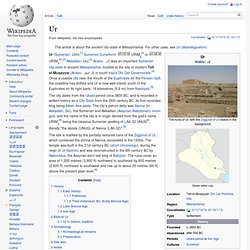
The temple was built in the 21st century BC (short chronology), during the reign of Ur-Nammu and was reconstructed in the 6th century BC by Nabonidus, the Assyrian born last king of Babylon. The ruins cover an area of 1,200 metres (3,900 ft) northwest to southeast by 800 metres (2,600 ft) northeast to southwest and rise up to about 20 metres (66 ft) above the present plain level.[6] History[edit] Early history[edit] Prehistory[edit] Archaeologists have discovered evidence of an early occupation at Ur during the Ubaid period. Third millennium BC (Early Bronze Age)[edit] PSD: home page - Мозилин фајерфокс (Mozilla Firefox) Sumer - Wikipedia, the free encyclopedia - Мозилин фајерфокс (Mozilla Firefox) The irrigated farming together with annual replenishment of soil fertility and the surplus of storable food in temple granaries created by this economy allowed the population of this region to rise to levels never before seen, unlike those found in earlier cultures of shifting cultivators.
This much greater population density in turn created and required an extensive labour force and division of labour with many specialised arts and crafts. At the same time, historic overuse of the irrigated soils led to progressive salinisation, and a Malthusian crisis which led to depopulation of the Sumerian region over time, leading to its progressive eclipse by the Akkadians of middle Mesopotamia. Sumer was also the site of early development of writing, progressing from a stage of proto-writing in the mid 4th millennium BC to writing proper in the 3rd millennium BC (see Jemdet Nasr period). Origin of name[edit] Néo-sumérien « Chroniques assyriologiques. Néo-sumérien Histoire, institution - R.
D. BIGGS, "Šulgi in Simurrum", in: Fs Astour, p. 169-178: 3 fragments néo-assyriens édités par Wiseman et Black (1996), et qui pourraient appartenir à la "Prophétie de Šulgi", relatent les campagnes de ce roi contre Simurrum et s’ajoutent au petit corpus de sources sur ce thème (quelques noms d’année de Šulgi et quelques fragments de littérature ominale paléo-babylonienne).