
Sleep as a Competitive Advantage. Dennis Rivera for The New York TimesThe most powerful short-term solution for insufficient sleep isn’t caffeine.

It’s a brief nap. At 6 p.m. last Friday, I boarded a plane for Bangalore, India. At 1 p.m. Tuesday, I arrived back in New York after two days of meetings and traveling 34 hours across nine time zones. As you can imagine, I didn’t see much of Bangalore. Sleep as a Competitive Advantage. LE JEU DE LA MORT (2009) - documentaire complet. Raising a Moral Child. Photo What does it take to be a good parent?

We know some of the tricks for teaching kids to become high achievers. For example, research suggests that when parents praise effort rather than ability, children develop a stronger work ethic and become more motivated. Yet although some parents live vicariously through their children’s accomplishments, success is not the No. 1 priority for most parents. We’re much more concerned about our children becoming kind, compassionate and helpful. Despite the significance that it holds in our lives, teaching children to care about others is no simple task. Are some children simply good-natured — or not? Genetic twin studies suggest that anywhere from a quarter to more than half of our propensity to be giving and caring is inherited.
Procrastination Is Not Laziness. I was going to tackle my procrastination problem last weekend but I never got around to it.
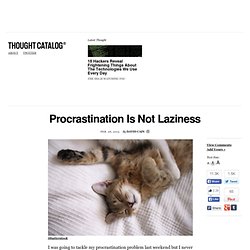
By Sunday at 5:48 p.m. I realized I had blown it again. Throughout the week I feel like I barely have enough time to cook, eat, tidy up, write an article and do the odd errand. I lean towards the weekend, when I have two whole days to finally get some work done. To improve my blog, to catch up on my correspondence, to get some monkeys off my back like fixing things that need fixing, organizing things that need organizing, tackling things that need tackling. Crossing The Street. I judge people.

All the time. You probably do it too, based on what you can tell about a person. By how they talk, what they wear, and how they carry themselves. By what you know of their family, where they went to school, or where they work. Maybe subconsciously by their skin color and accent too, though you’ll never admit it out loud. Generalizing From One Example. Related to: The Psychological Unity of Humankind, Instrumental vs.
Epistemic: A Bardic Perspective "Everyone generalizes from one example. At least, I do. " -- Vlad Taltos (Issola, Steven Brust) My old professor, David Berman, liked to talk about what he called the "typical mind fallacy", which he illustrated through the following example: There was a debate, in the late 1800s, about whether "imagination" was simply a turn of phrase or a real phenomenon.
Thinking in a Foreign Language Makes Decisions More Rational. To judge a risk more clearly, it may help to consider it in a foreign language.

A series of experiments on more than 300 people from the U.S. and Korea found that thinking in a second language reduced deep-seated, misleading biases that unduly influence how risks and benefits are perceived. “Would you make the same decisions in a foreign language as you would in your native tongue?” Asked psychologists led by Boaz Keysar of the University of Chicago in an April 18 Psychological Science study.
Scott Fraser: Why eyewitnesses get it wrong. Neuroscience of free will. Neuroscience of free will refers to recent neuroscientific investigation of questions concerning free will.

It is a topic of philosophy and science. One question is whether, and in what sense, rational agents exercise control over their actions or decisions. As it has become possible to study the living brain, researchers have begun to watch decision making processes at work. Findings could carry implications for moral responsibility in general.[1] Moreover, some research shows that if findings seem to challenge people's belief in the idea of free will itself then this can affect their sense of agency (e.g. sense of control in their life).[2][3] In many senses the field remains highly controversial and there is no consensus among researchers about the significance of findings, their meaning, or what conclusions may be drawn.