
Solar Panels, Roof Tiles, Photovoltaic Systems. Portfolio Vivien MULLER. Researchers Create Highly Transparent Solar Cells for Windows that Generate Electricity — UCLA Engineering. By Jennifer Marcus | July 20, 2012 Transparent Solar Cells UCLA researchers have developed a new transparent solar cell that is an advance toward giving windows in homes and other buildings the ability to generate electricity while still allowing people to see outside. Their study appears in the journal ACS Nano. The UCLA team describes a new kind of polymer solar cell (PSC) that produces energy by absorbing mainly infrared light, not visible light, making the cells nearly 70% transparent to the human eye. They made the device from a photoactive plastic that converts infrared light into an electrical current. Yang added that there has been intense world-wide interest in so-called polymer solar cells.
Polymer solar cells have attracted great attention due to their advantages over competing solar cell technologies. Previously, many attempts have been made toward demonstrating visibly transparent or semitransparent PSCs. StarChild: The Solar System. The Solar System Listen to an audio version of this page.
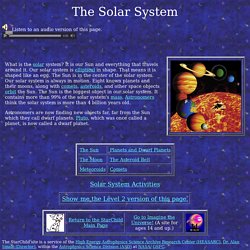
Solar System Activities The StarChild site is a service of the High Energy Astrophysics Science Archive Research Center (HEASARC), Dr. Alan Smale (Director), within the Astrophysics Science Division (ASD) at NASA/GSFC. StarChild Authors: The StarChild Team StarChild Graphics & Music: Acknowledgments StarChild Project Leader: Dr. Solar System Live. Solar Systems. Cost of Solar Panels, Systems, Cost of Solar Power - Solar Online Australia. Cost of Solar Power – Solar Pricing This section lists our typical pricing for solar power systems supplied and installed in NSW.

Note that the final cost may vary for some sites. Please Contact Us if you require a fixed price quotation. Our Solar Rebate Info page includes details of the latest Government funding that is currently available to help households and businesses in the installation of small-scale solar, wind and hydro electricity systems. Systems installed on or after 9 June 2009, where no rebate application has been made up to that date under the ‘Solar Homes and Communities Plan’, will now receive ‘Solar Credits’ under the RET scheme rather than the rebate.
Solar System, Solar System Information. Our Cosmic Neighborhood From our small world we have gazed upon the cosmic ocean for thousands of years.
Ancient astronomers observed points of light that appeared to move among the stars. They called these objects "planets," meaning wanderers, and named them after Roman deities—Jupiter, king of the gods; Mars, the god of war; Mercury, messenger of the gods; Venus, the goddes of love and beauty, and Saturn, father of Jupiter and god of agriculture. The stargazers also observed comets with sparkling tails, and meteors or shooting stars apparently falling from the sky. Since the invention of the telescope, three more planets have been discovered in our solar system: Uranus (1781), Neptune (1846), and, now downgraded to a dwarf planet, Pluto (1930). The four planets closest to the sun—Mercury, Venus, Earth, and Mars—are called the terrestrial planets because they have solid rocky surfaces. Nearly every planet—and some of the moons—has an atmosphere. The Solar System. Our solar neighborhood is an exciting place.
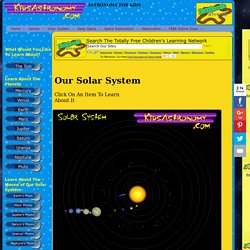
The Solar System is full of planets, moons, asteroids, comets, minor planets, and many other exciting objects. Solar System. Discovery and exploration Andreas Cellarius's illustration of the Copernican system, from the Harmonia Macrocosmica (1660) For many thousands of years, humanity, with a few notable exceptions, did not recognize the existence of the Solar System.
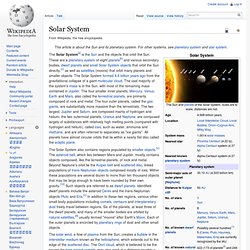
People believed Earth to be stationary at the centre of the universe and categorically different from the divine or ethereal objects that moved through the sky. Although the Greek philosopher Aristarchus of Samos had speculated on a heliocentric reordering of the cosmos,[11] Nicolaus Copernicus was the first to develop a mathematically predictive heliocentric system.[12] His 17th-century successors, Galileo Galilei, Johannes Kepler and Isaac Newton, developed an understanding of physics that led to the gradual acceptance of the idea that Earth moves around the Sun and that the planets are governed by the same physical laws that governed Earth.